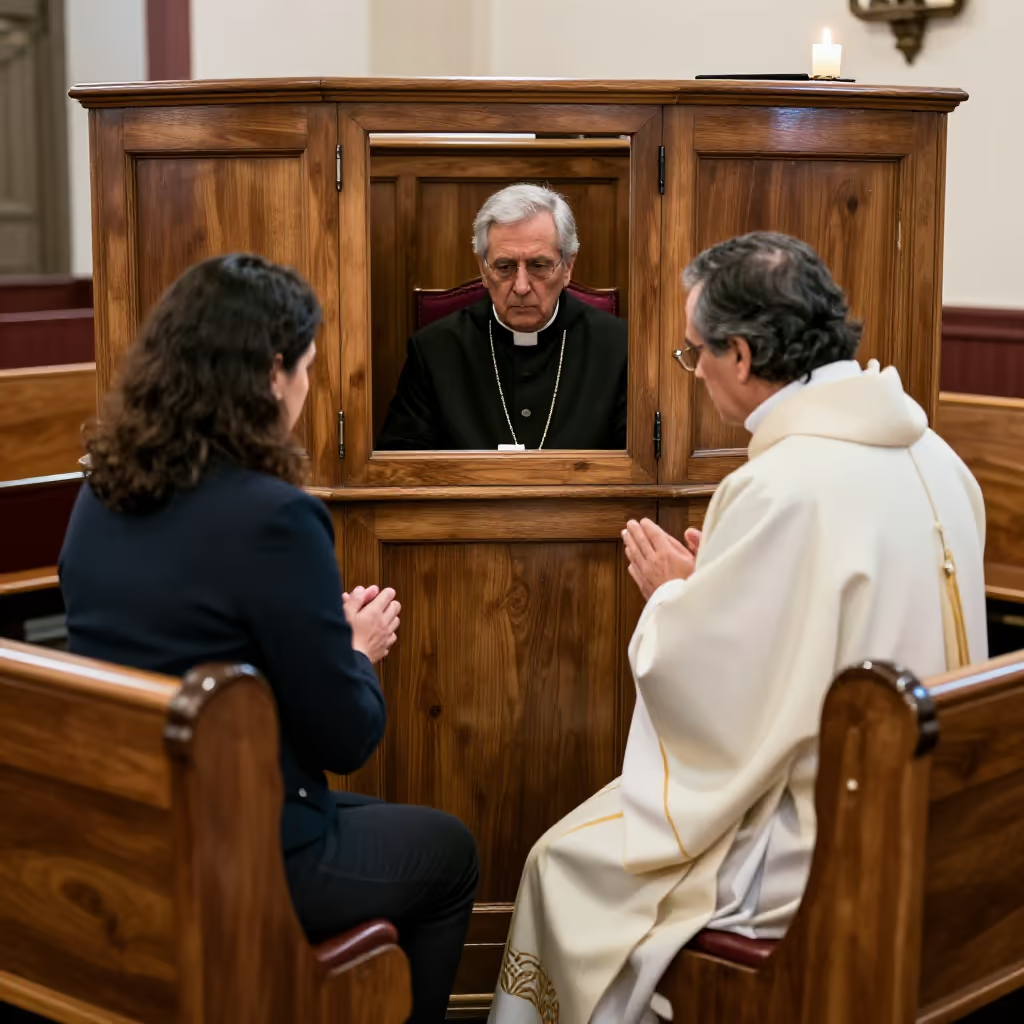
In the Catholic and Orthodox Church, the sacrament in which a believer confesses their sins to a priest in order to obtain forgiveness.
example
Der Priester nahm den Gläubigen die Beichte ab.
The priest heard the believers' confessions.

Usage tips
Word family
'Die Beichte' (confession) is the noun corresponding to the verb 'beichten' (to confess). When someone confesses, they 'legt eine Beichte ab' (make a confession).
EXAMPLE
Er wollte seine Fehler beichten.
He wanted to confess his mistakes.
Context clue
You can recognize the religious meaning from words such as 'Kirche' (church), 'Priester' (priest), or 'Sünden' (sins). The figurative meaning refers to everyday or public admissions of mistakes.
EXAMPLE
Er ging in die Kirche, um die Beichte abzulegen.
He went to church to make his confession.
Typical verbs
In the religious context, there are fixed verb combinations: a person 'legt die Beichte ab' (makes a confession) or 'geht zur Beichte' (goes to confession). The priest 'nimmt die Beichte ab' (hears the confession).
EXAMPLE
Viele Gläubige gehen vor Ostern zur Beichte.
Many believers go to confession before Easter.
Typical combination
In the figurative meaning too, the fixed expression 'eine Beichte ablegen' (to make a confession) is usually used. This emphasizes the serious or official character of an admission.
EXAMPLE
Der Angeklagte legte vor Gericht eine umfassende Beichte ab.
The defendant made a comprehensive confession in court.
Compare with
near_synonym · confusable
Beichte vs Bekenntnis
declaration / confession
'Bekenntnis' and 'Beichte' can both mean that someone openly admits something. 'Beichte' fits especially with religion: a person tells a priest their sins. In everyday language, 'Beichte' can also be used jokingly or figuratively for an open confession. 'Bekenntnis' is broader: it can express guilt, but also a faith or a conviction. Learners may confuse the words because both have to do with admitting something. When it is about church and sins, 'Beichte' is more precise. When it is about a public declaration or a general admission, 'Bekenntnis' fits better.
Beichte
Vor Ostern ging Maria zur Beichte in die Kirche.
Before Easter, Maria went to confession at the church.
Bekenntnis
Nach langem Schweigen machte der Täter ein Bekenntnis.
After a long silence, the perpetrator made a confession.