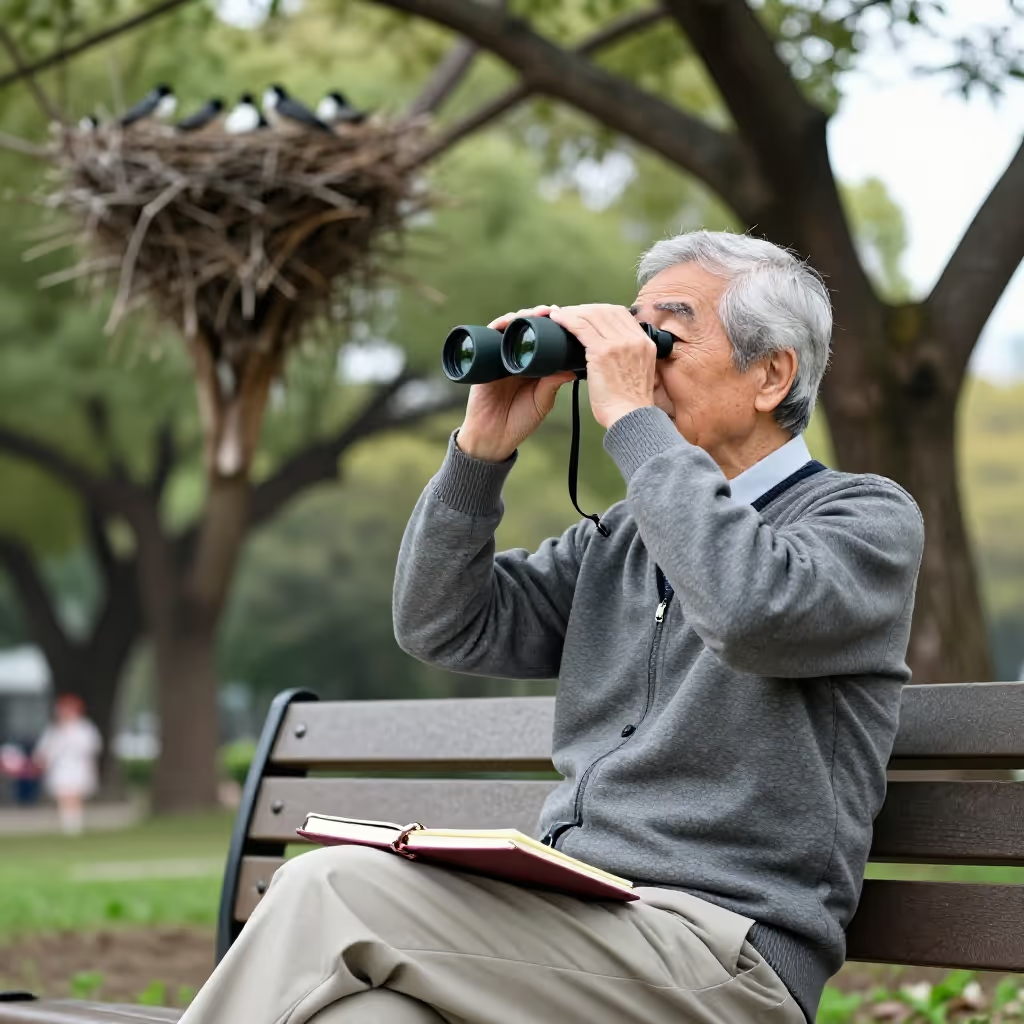
To watch someone or something attentively with your eyes over a certain period of time in order to see what happens.
example
Vom Fenster aus beobachtete sie die spielenden Kinder im Park.
From the window, she observed the children playing in the park.

Usage tips
Word structure
'Beobachten' (to observe) is an inseparable verb made up of the prefix 'be-' and the verb 'achten' (to pay attention, to respect). The prefix 'be-' makes the action directed toward an object.
EXAMPLE
Achte gut auf deine Sachen!
Take good care of your things!
Sentence structure
The verb 'beobachten' (to observe) always needs an accusative object (whom or what you observe). It is often followed by a subordinate clause with 'wie' (how) or 'dass' (that), which describes what the object does or what happens to it.
EXAMPLE
Wir beobachteten, wie die Sonne langsam unterging.
We observed how the sun slowly set.
Context clues
The context makes the exact meaning clear. If it is about people or animals, it usually means 'zusehen' (to watch) (m01). With abstract things like prices or the weather, it is about identifying a development (m02). In a scientific context, it means 'systematisch untersuchen' (to examine systematically) (m03).
EXAMPLE
Ich beobachte die Vögel im Garten.
I observe the birds in the garden.
Typical collocations
When it is about developments, 'beobachten' (to observe) is often used with abstract nouns. Common phrases are: eine Tendenz beobachten (to observe a trend), eine Entwicklung beobachten (to observe a development), or eine Veränderung beobachten (to observe a change).
EXAMPLE
Wir beobachten mit Sorge die politische Entwicklung im Land.
We are observing the political development in the country with concern.
Compare with
near_synonym · confusable
beobachten vs schauen
to look / watch
'schauen' and 'beobachten' can both mean that you follow something with your eyes. The difference lies in the attention and duration. 'schauen' is more general: you look briefly or watch something, such as a film. 'beobachten' is used when you watch for longer and more closely because you want to know what happens or how something changes. Learners can confuse the words because both have to do with seeing. A simple rule is: for a normal look, you are more likely to say 'schauen'; for close observation over a period of time, 'beobachten' is more likely.
beobachten
Im Park beobachtet Anna die Vögel, bis sie wegfliegen.
In the park, Anna watches the birds until they fly away.
schauen
Ich schaue kurz auf mein Handy, bevor das Gespräch beginnt.
I quickly look at my phone before the conversation begins.