

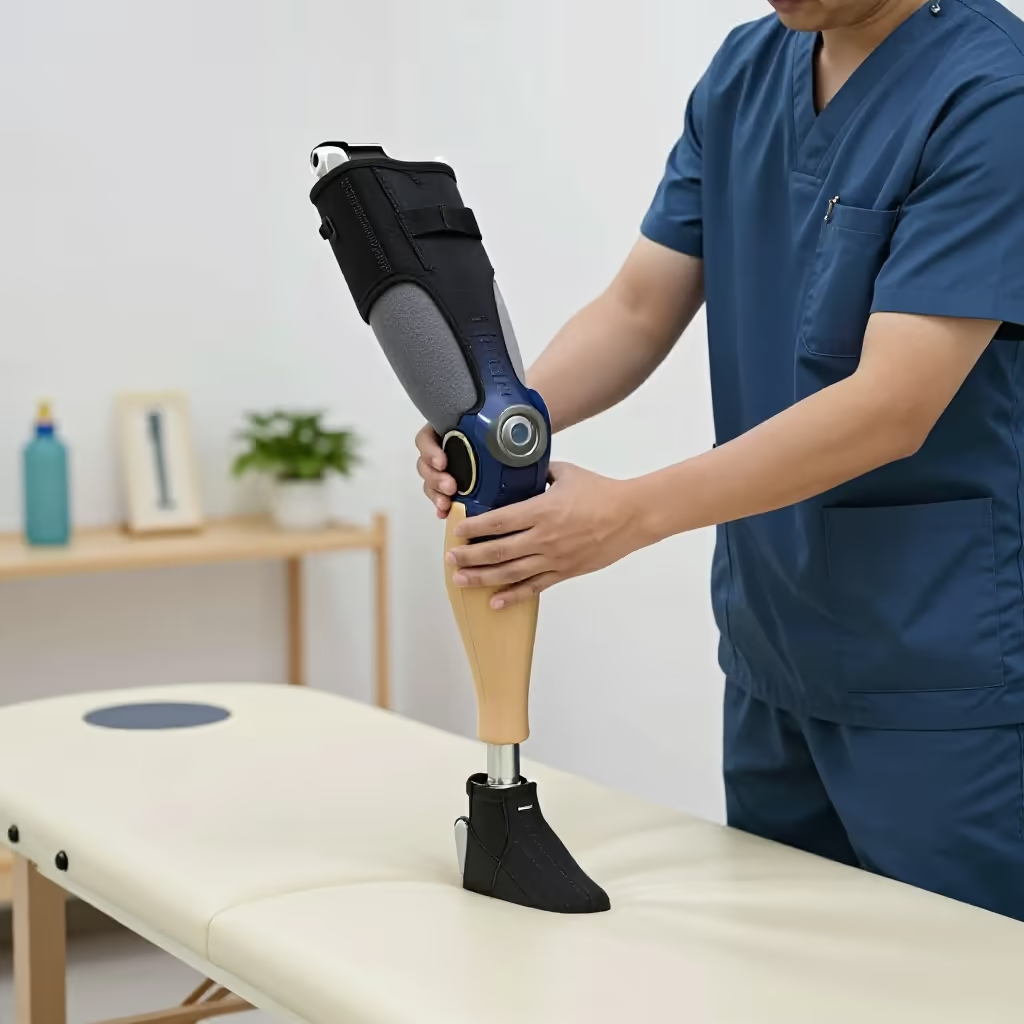
beweglich
flexible / movable
Having the ability to move or be moved; not rigid or fixed.
EXAMPLE
Nach der Operation war sein Knie nur noch eingeschränkt beweglich.
After the operation, his knee had only limited mobility.
flexible / movable
Loading your saved state.
flexible / movable
Having the ability to move or be moved; not rigid or fixed.
Nach der Operation war sein Knie nur noch eingeschränkt beweglich.
After the operation, his knee had only limited mobility.

mentally flexible
Mentally flexible and adaptable; able to think quickly and react to new situations.
Trotz ihres hohen Alters ist sie geistig sehr beweglich geblieben.
Despite her advanced age, she has remained very mentally flexible.

movable
Not tied to a fixed location; transportable. Often refers to goods or property.
Möbel, Autos und Schmuck zählen zum beweglichen Vermögen.
Furniture, cars, and jewelry count as movable assets.

moveable
Not fixed in time; variable. Often used for holidays whose date changes every year.
Ostern ist ein beweglicher Feiertag.
Easter is a moveable holiday.
The adjective is formed from the verb 'bewegen' (to move) and the suffix '-lich' (-able/-ly). It literally means 'able to move or be moved,' and this basic idea appears in all its meanings.
Die neuen Roboterarme sind extrem beweglich.
The new robotic arms are extremely flexible.
The noun that 'beweglich' (flexible / movable) describes reveals the exact meaning. A 'bewegliches Gelenk' (flexible joint) is physically flexible, a 'beweglicher Geist' (flexible mind) is mentally flexible, and a 'beweglicher Feiertag' (moveable holiday) is flexible in terms of time.
Er ist 90 Jahre alt, aber sein Geist ist immer noch sehr beweglich.
He is 90 years old, but his mind is still very flexible.
The combination 'geistig beweglich' (mentally flexible) is a very common fixed expression. It describes a person who can think quickly and adapt to new ideas.
Regelmäßiges Lesen und Lernen hilft dabei, geistig beweglich zu bleiben.
Regular reading and learning help you stay mentally flexible.
In legal and business contexts, 'beweglich' (movable) describes property that is not permanently attached to a place. Typical terms are 'bewegliches Vermögen' (movable assets) or 'bewegliche Güter' (movable goods).
Zum beweglichen Vermögen zählen zum Beispiel Autos, Schmuck und Bargeld.
Movable assets include cars, jewelry, and cash, for example.
The phrase 'beweglicher Feiertag' (moveable holiday) refers to a holiday whose date changes every year, such as Easter or Pentecost.
Der Karfreitag ist ein beweglicher Feiertag, der immer vor Ostern liegt.
Good Friday is a moveable holiday that always falls before Easter.
mobile
Mobil and beweglich can both express that someone is able to move. „Mobil“ often emphasizes that a person can get around independently or is fit for use, while „beweglich“ describes the general ability to move. For a patient, „mobil“ is usually more appropriate; for body parts or general mobility, „beweglich“ is more suitable.

Nach der Operation ist ihr Bein wieder beweglich.
After the operation, her leg is movable again.
Nach der Operation ist die Patientin wieder mobil und geht allein zur Toilette.
After the operation, the patient is mobile again and can walk to the bathroom on her own.