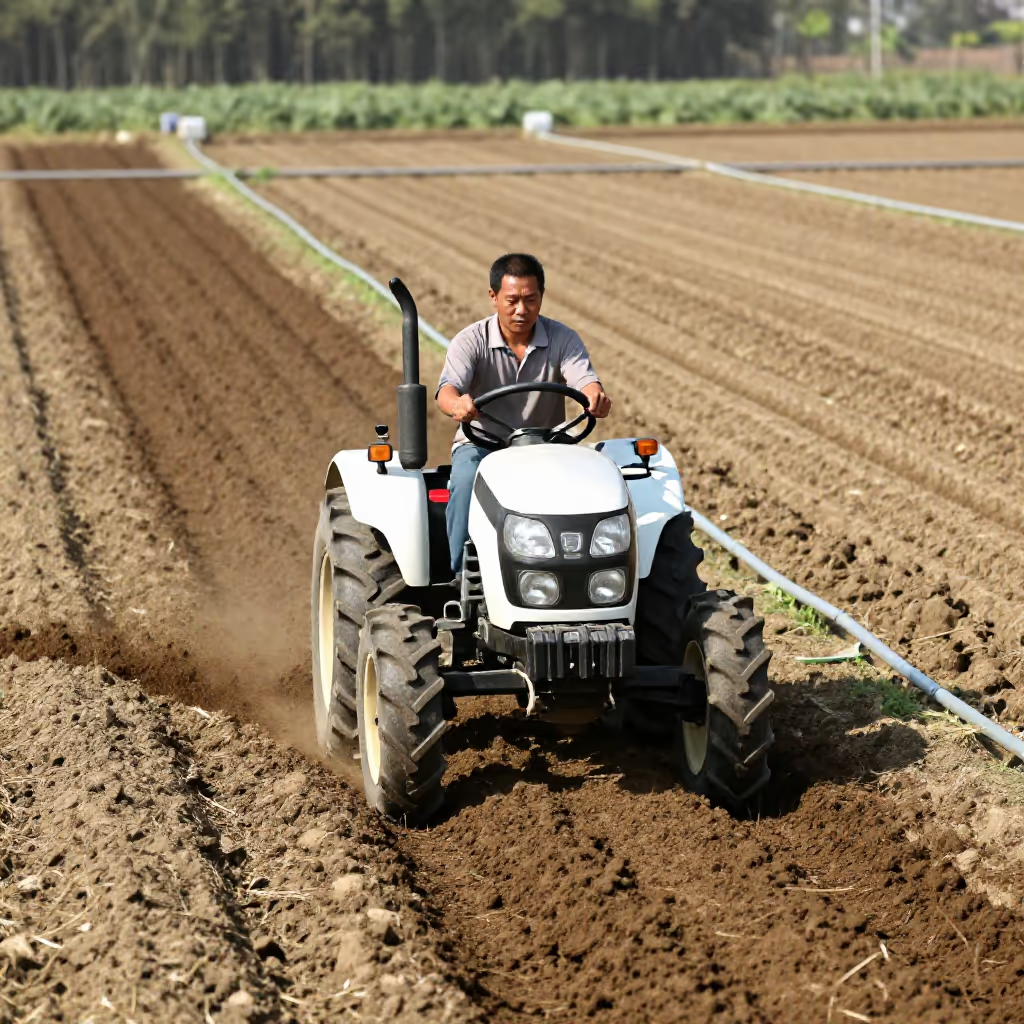
To use and work agricultural or forestry land in a planned way in order to produce a yield.
example
Die Familie bewirtschaftet den Bauernhof schon in der fünften Generation.
The family has been cultivating the farm for five generations.

Usage tips
Inseparable verb
'Bewirtschaften' (to cultivate / manage) is an inseparable verb. The prefix 'be-' remains firmly attached to the verb stem 'wirtschaften' in all tenses and sentence constructions.
EXAMPLE
Er hat den Hof seiner Eltern übernommen und bewirtschaftet ihn jetzt.
He took over his parents' farm and now cultivates it.
Sentence structure and usage
The verb 'bewirtschaften' (to cultivate / manage) is transitive, which means it always requires an accusative object. You always 'bewirtschaftet' (cultivate / manage) SOMETHING.
EXAMPLE
Welche Firma bewirtschaftet dieses Bürogebäude?
Which company manages this office building?
Context clues
You can recognize the exact meaning of 'bewirtschaften' (to cultivate / manage) from the object. If it refers to land, for example 'einen Hof' (a farm), it is about agriculture. If it refers to a building, 'ein Haus' (a house), it is about management. If it refers to a hospitality business, 'eine Hütte' (a hut), it is about operating or running it.
EXAMPLE
Ein Bauer bewirtschaftet seine Felder.
A farmer cultivates his fields.
Typical collocations
In an agricultural context, 'bewirtschaften' (to cultivate) is often combined with these nouns: 'einen Bauernhof' (a farm), 'Land' (land), 'Felder' (fields), 'einen Acker' (a field), or 'einen Wald' (a forest).
EXAMPLE
Viele Bauern bewirtschaften ihr Land nach ökologischen Prinzipien.
Many farmers cultivate their land according to ecological principles.
Compare with
near_synonym · confusable
bewirtschaften vs führen
to lead
'führen' and 'bewirtschaften' can both mean that you are responsible for a business or an area. 'führen' is more general: you can run a company, a team, or a department and make decisions. 'bewirtschaften' is more specific and fits land, forests, buildings, restaurants, or huts. It is not only about management, but also about use, care, operation, and often yield or supply. Learners may confuse the words because both have to do with responsibility. As a guide: you are more likely to use 'führen' for people or organizations, and 'bewirtschaften' for areas of land, buildings, or a restaurant.
bewirtschaften
Die Familie bewirtschaftet einen Bauernhof am Rand des Dorfes.
The family cultivates a farm on the edge of the village.
führen
Frau Becker führt seit drei Jahren eine kleine Firma.
Ms. Becker has been running a small company for three years.