


bitte
please
A particle used to formulate a polite request or instruction.
EXAMPLE
Gib mir bitte das Salz.
Please pass me the salt.
please
Loading your saved state.
please
A particle used to formulate a polite request or instruction.
Gib mir bitte das Salz.
Please pass me the salt.

you're welcome
A polite response to thanks, in the sense of 'you're welcome' or 'no problem'.
Vielen Dank für deine Hilfe! – Bitte!
Thank you very much for your help! — You're welcome!

here you go
Used to offer or hand something to someone.
Bitte, nehmen Sie doch noch ein Stück Kuchen.
Here you go, please have another piece of cake.

Pardon?
A question used to ask for the repetition of something you did not understand.
Ich habe dich akustisch nicht verstanden, wie bitte?
I didn't hear you clearly—pardon?
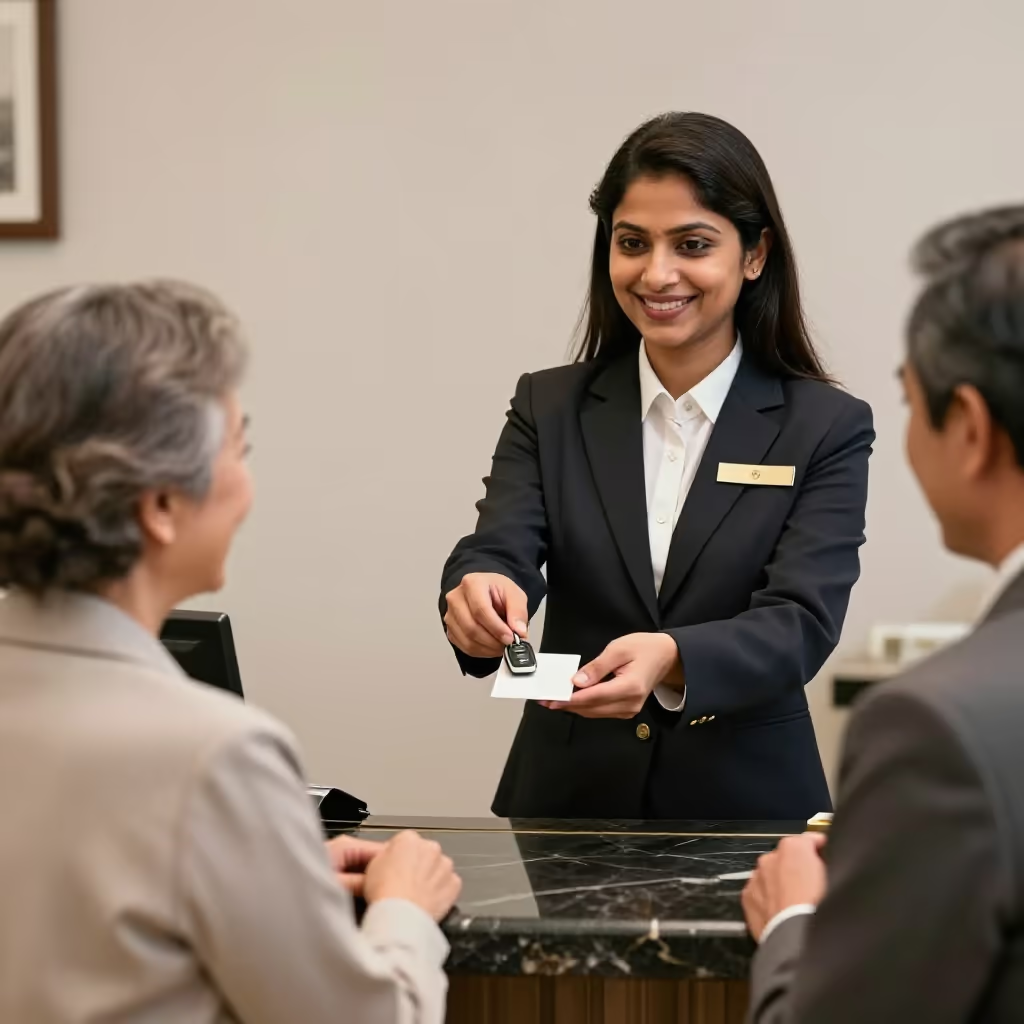
here you are / you're welcome
A stronger, often more formal or friendlier form used to offer something, hand something over, or respond to thanks.
Hier ist Ihr Kaffee. – Danke! – Bitte sehr.
Here is your coffee. — Thank you! — You're very welcome.
The word 'bitte' comes from the verb 'bitten' (to ask/request). So when you say 'bitte' (please), you are literally formulating a small 'Bitte' (request).
Ich möchte Sie um einen Gefallen bitten.
I would like to ask you for a favor.
The meaning of 'bitte' depends heavily on the situation. Whether it is a request, a response to 'Danke' (thank you), or an offer can be recognized from the context and from the reaction of the person you are speaking to.
Hier, bitte, das ist für Sie. – Oh, danke! – Bitte!
Here you go, this is for you. — Oh, thank you! — You're welcome!
In a polite request or instruction, 'bitte' can flexibly stand at the beginning, in the middle, or at the end of the sentence without changing the meaning.
Bitte schließen Sie die Tür.
Please close the door.
In response to 'Danke' (thank you), 'bitte' (you're welcome) is the most common and natural answer. It is short, polite, and used in almost all situations.
Hier ist dein Kaffee. – Oh, danke schön! – Bitte.
Here is your coffee. — Oh, thank you very much! — You're welcome.
If you did not understand something, 'Wie bitte?' (Pardon?) is a polite and neutral way to ask for repetition. It is much more polite than 'Was?' (What?).
Entschuldigung, die Verbindung war schlecht. Wie bitte?
Sorry, the connection was bad. Pardon?
The forms 'bitte schön' and 'bitte sehr' are somewhat more formal or emphatic than the simple 'bitte'. They are often used in service situations when handing something to someone.
Einmal Pommes mit Ketchup, bitte sehr!
One order of fries with ketchup—here you are!
once / times
Mal and bitte can make a request sound less harsh. Mal mainly makes it sound casual and offhand, while bitte explicitly expresses politeness. In a familiar conversation, mal is suitable; for a clearly polite request, use bitte.

Komm bitte kurz ins Büro.
Please come by the office for a moment.
Komm mal kurz ins Büro.
Come by the office for a moment.