


sehen
to see
To perceive with the eyes; to use the ability to see.
EXAMPLE
Ohne meine Brille kann ich fast nichts sehen.
Without my glasses, I can hardly see anything.
to see
Loading your saved state.
to see
To perceive with the eyes; to use the ability to see.
Ohne meine Brille kann ich fast nichts sehen.
Without my glasses, I can hardly see anything.

to see
To understand, recognize, or realize something.
Jetzt sehe ich, was du meinst.
Now I see what you mean.
to watch / see
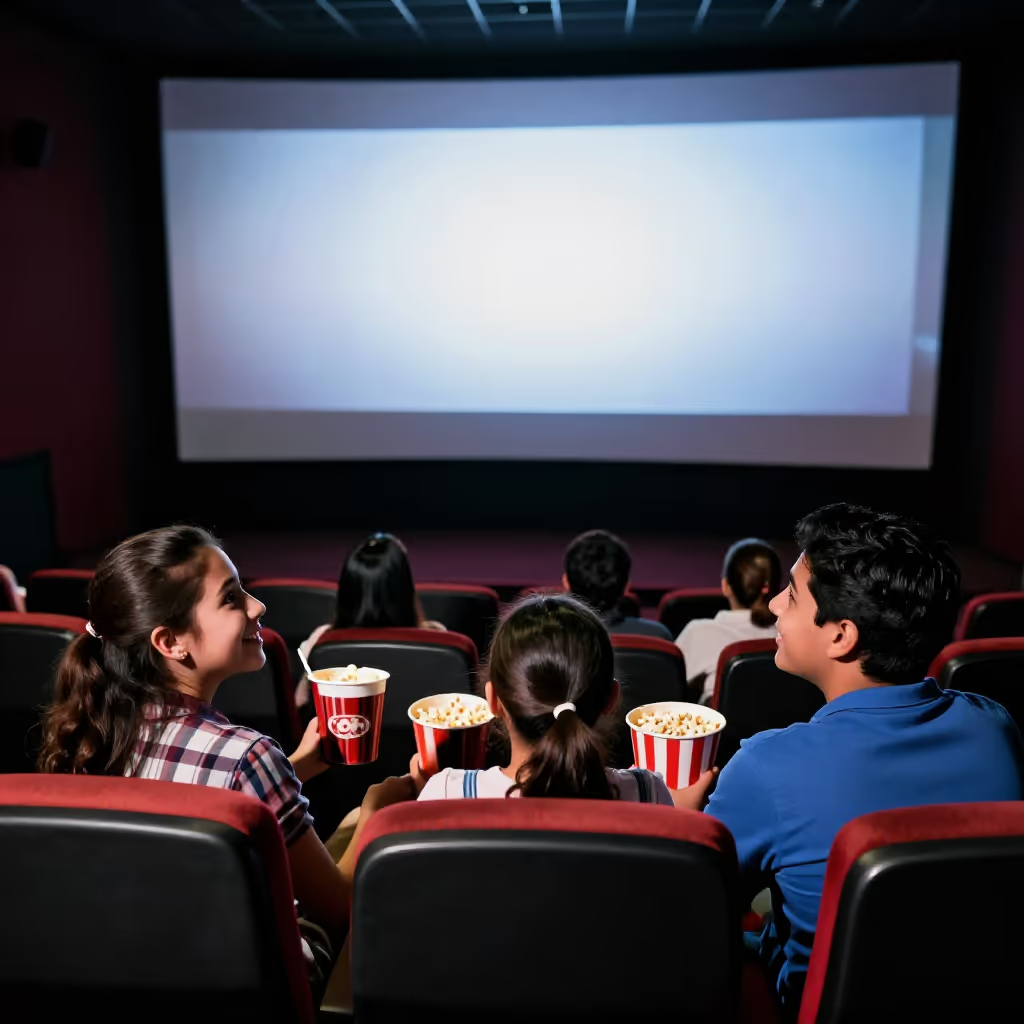
To watch something, for example a film, a play, or a sports event.
Wollen wir am Wochenende einen Film sehen?
Do we want to watch a film this weekend?

to see each other
To meet or encounter each other.
Wir sehen uns morgen im Büro.
We'll see each other tomorrow at the office.

to see as
To judge or view something in a certain way.
Ich sehe das als eine große Chance für uns alle.
I see that as a great opportunity for all of us.

to check on
To look in on someone or something in order to check whether everything is all right.
Kannst du bitte kurz nach dem Baby sehen?
Could you please quickly check on the baby?

to be impressive
To be impressive or presentable.
Das Ergebnis deiner Arbeit kann sich wirklich sehen lassen.
The result of your work is really impressive.
'Sehen' (to see) is a strong verb and changes its vowel in the 2nd and 3rd person singular. 'e' becomes 'ie'. So it is 'du siehst' (you see) and 'er/sie/es sieht' (he/she/it sees).
Siehst du den Vogel dort auf dem Baum?
Do you see the bird there in the tree?
When you observe another person doing an action, you can use 'sehen' (to see) with a second verb in the infinitive without 'zu'. The second verb then comes at the end of the sentence.
Ich sehe die Kinder im Garten spielen.
I see the children playing in the garden.
In conversations, 'sehen' (to see) is often used metaphorically in the sense of 'verstehen' (to understand) or 'erkennen' (to recognize/realize). It is a common response to signal agreement or understanding.
Ah, jetzt sehe ich das Problem!
Ah, now I see the problem!
In the meaning of 'sich etwas anschauen' (to watch something), 'sehen' (to see/watch) is often combined with media or events. Typical phrases are 'einen Film sehen' (to watch a film), 'ein Theaterstück sehen' (to see a play), or 'ein Fußballspiel sehen' (to watch a soccer match).
Wir haben gestern Abend eine interessante Dokumentation gesehen.
We watched an interesting documentary yesterday evening.
When 'sehen' (to see) is used reflexively with 'sich', it means 'sich treffen' (to meet) or 'sich begegnen' (to encounter each other). It is often used for appointments or chance meetings.
Wann sehen wir uns wieder?
When will we see each other again?
To express a personal assessment or perspective, the fixed structure 'etwas als etwas (Akkusativ) sehen' (to see something as something) is used.
Er sieht diese Aufgabe als eine persönliche Herausforderung.
He sees this task as a personal challenge.
In the meaning of 'kontrollieren' (to check), 'sehen' (to see/check) is always used with the preposition 'nach' and the dative. It expresses a quick check.
Ich gehe mal kurz nach den Kindern sehen.
I'm going to quickly check on the children.
The expression 'kann sich sehen lassen' (is impressive / can be shown off) is a fixed unit. It is used to express that a result or achievement is very good and impressive.
Dein neues Auto kann sich wirklich sehen lassen!
Your new car is really impressive!
to meet / to hit
Sich sehen and sich treffen can both express meeting someone. „Sich treffen“ puts more emphasis on coming together, whether by arrangement or by chance, whereas „sich sehen“ focuses more on the encounter or seeing each other again. Use „treffen“ for an arrangement and „sehen“ for the contact itself.

Nach der Arbeit sehen wir uns im Café.
After work, we'll see each other at the café.
Nach der Arbeit treffen wir uns im Café.
After work, we'll meet at the café.