


hier
here
Refers to the place where the speaker is located.
EXAMPLE
Lass uns hier eine Pause machen, die Aussicht ist wunderschön.
Let's take a break here; the view is beautiful.
here
Loading your saved state.
here
Refers to the place where the speaker is located.
Lass uns hier eine Pause machen, die Aussicht ist wunderschön.
Let's take a break here; the view is beautiful.

present / here
Used to signal one's presence, for example during attendance checking.
Als die Lehrerin seinen Namen aufrief, schrie er laut „Hier!“.
When the teacher called his name, he shouted loudly, 'Here!'

here
Used when handing something to someone.
Hier, nimm meinen Schirm, es fängt an zu regnen.
Here, take my umbrella; it's starting to rain.
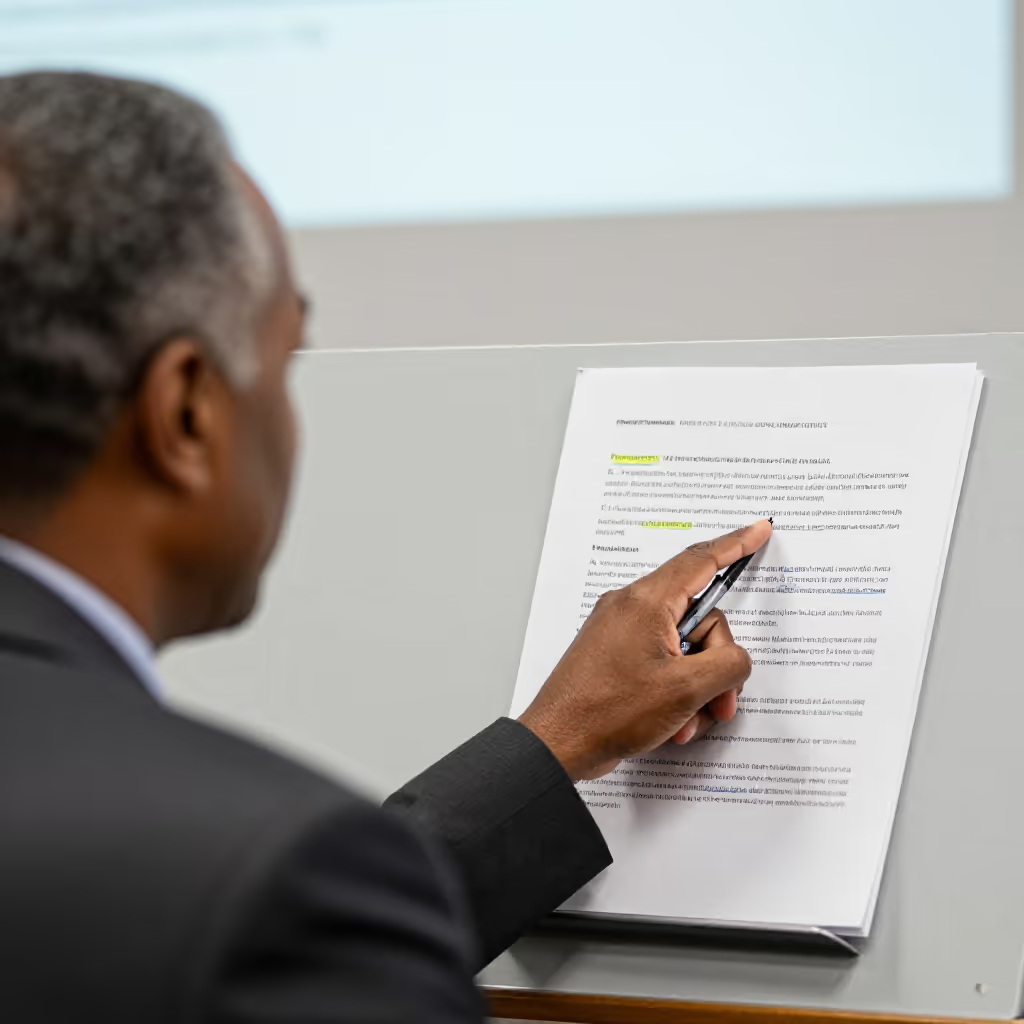
here
Refers to a specific point in a text, argument, or process.
Genau hier in diesem Absatz liegt der entscheidende Fehler seiner Argumentation.
Right here in this paragraph is the crucial mistake in his argument.

here and there
Means 'sometimes', 'occasionally', or 'in various places'.
Ich treffe ihn nur noch hier und da in der Stadt.
I still run into him here and there in town.
The word 'hier' (here) can be combined with many prepositions to form pronominal adverbs (e.g., hier + mit = hiermit). These refer to something mentioned earlier or to the current situation.
Hierüber müssen wir später noch einmal sprechen.
We'll have to talk about this again later.
When 'hier' (here) is at the beginning of the sentence in position 1, the verb follows directly after it (inversion). However, it can also come after the verb and the subject to be less emphasized.
Hier ist das Rauchen verboten.
Smoking is prohibited here.
As a short answer to a question about attendance, for example from a list of names at school or university, you call out 'Hier!' (Here!/Present!). It is a fixed convention.
Der Lehrer rief meinen Namen und ich antwortete laut: 'Hier!'
The teacher called my name and I answered loudly: 'Here!'
When giving someone something, you can say 'Hier!' (Here!) or 'Hier, bitte!' (Here you go!). This is a typical utterance in spoken language, often accompanied by a gesture.
Hier, ich habe dir einen Kaffee mitgebracht.
Here, I brought you a coffee.
The expression 'hier und da' (here and there) means 'sometimes' or 'in various places'. The meaning is not literal, but expresses irregular frequency or distribution.
Ich habe hier und da ein paar Kratzer am Auto.
I have a few scratches here and there on the car.
there / since / then
Da and hier can both confirm that a person is present. Hier explicitly signals the speaker’s location and is also used when attendance is being checked. Da more often confirms that someone is present or available without emphasizing the speaker’s location.

Bei der Anwesenheitskontrolle sagte ich laut: „Hier!“
During the attendance check, I called out, “Here!”
Keine Sorge, ich bin da und kann dir helfen.
Don’t worry, I’m here and can help you.