

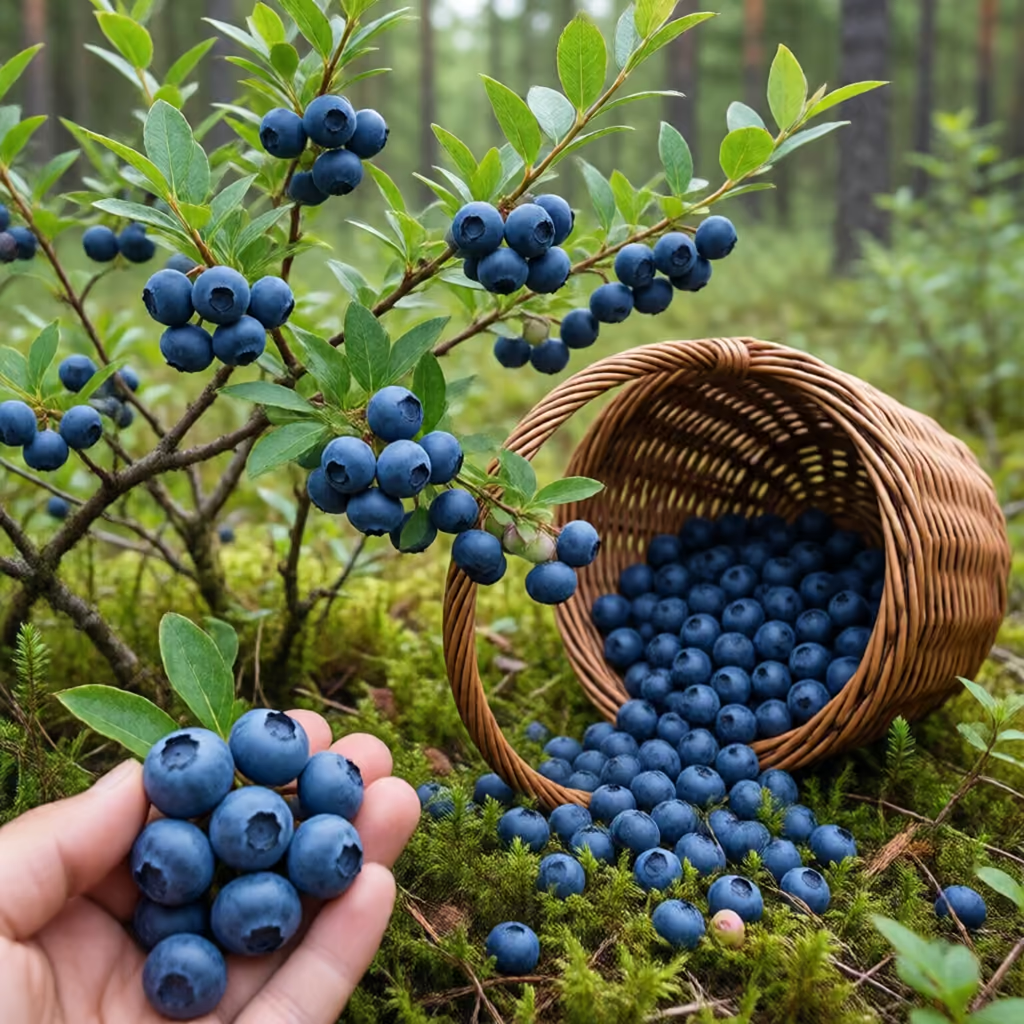
die Blaubeere
blueberry
The small, usually dark blue berry of the blueberry bush, which can be eaten fresh or used, for example, in cakes and jam.
Im Wald haben wir viele reife Blaubeeren gesammelt.
We collected many ripe blueberries in the forest.
blueberry
die Blaubeere, die Blaubeeren
Loading your saved state.

blueberry
The small, usually dark blue berry of the blueberry bush, which can be eaten fresh or used, for example, in cakes and jam.
Im Wald haben wir viele reife Blaubeeren gesammelt.
We collected many ripe blueberries in the forest.
| gender | feminine die |
|---|---|
| plural | die Blaubeeren |
| genitive | der Blaubeere |
| singular | plural | |
|---|---|---|
| nominative | die Blaubeere | die Blaubeeren |
| accusative | die Blaubeere | die Blaubeeren |
| dative | der Blaubeere | den Blaubeeren |
| genitive | der Blaubeere | der Blaubeeren |
The article changes with the case; it is shown in colour.
'Blaubeere' (blueberry) is made up of 'blau' (blue) and 'Beere' (berry). The first component describes the fruit's typical color.
Die Blaubeere färbt den Teig leicht blau.
The blueberry turns the batter slightly blue.
Common compounds with 'Blaubeere' (blueberry) refer to food and drinks, such as 'Blaubeerkuchen' (blueberry cake), 'Blaubeermarmelade' (blueberry jam), and 'Blaubeersaft' (blueberry juice).
Zum Frühstück gab es Joghurt mit frischen Blaubeeren.
For breakfast, we had yogurt with fresh blueberries.
'Blaubeere' (blueberry) often appears with verbs that describe eating or processing fruit, such as 'essen' (to eat), 'sammeln' (to collect), 'waschen' (to wash), and 'backen' (to bake).
Vor dem Backen wäscht sie die Blaubeeren vorsichtig.
Before baking, she carefully washes the blueberries.