

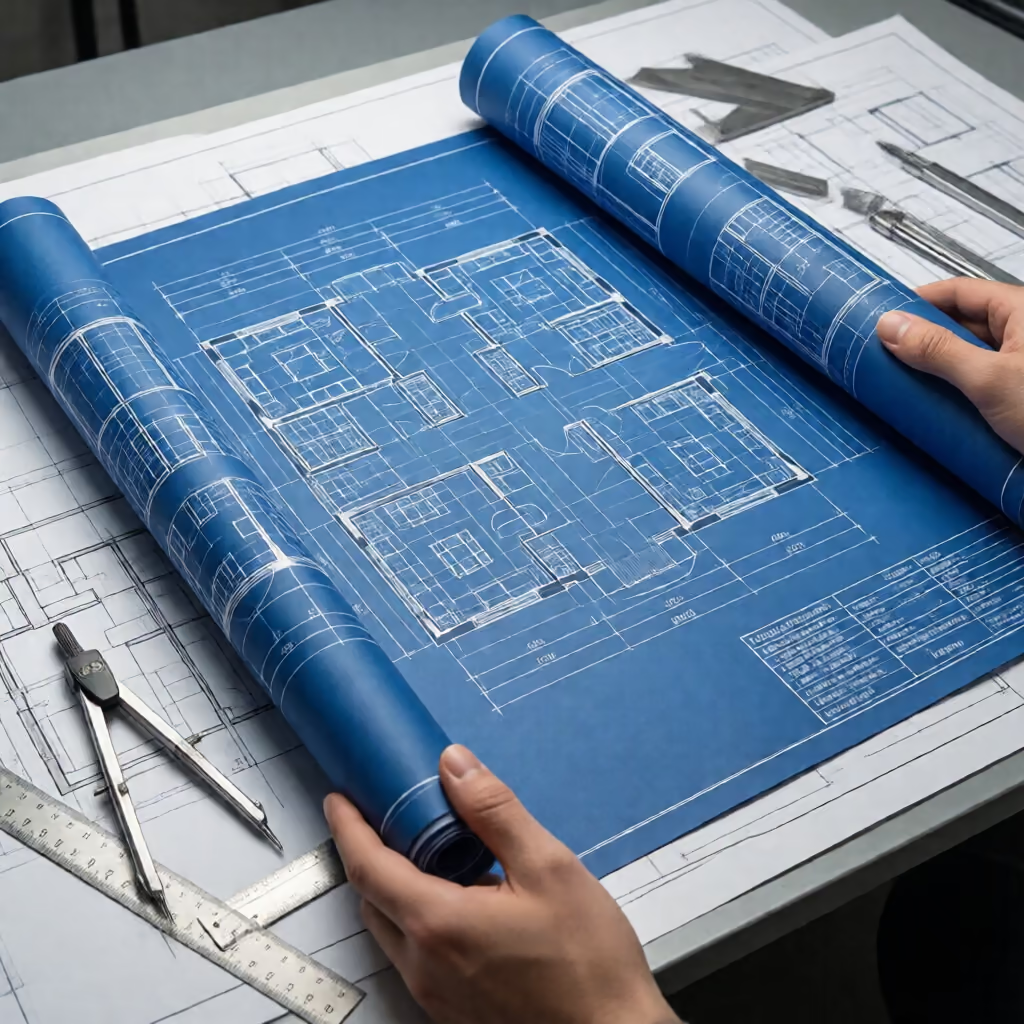
die Blaupause
blueprint
A technical copy or reproduction of a plan or drawing, usually on blue-colored paper.
Der Architekt legte die Blaupause des neuen Gebäudes auf den Tisch.
The architect placed the blueprint of the new building on the table.

blueprint
die Blaupause, die Blaupausen
Loading your saved state.

blueprint
A technical copy or reproduction of a plan or drawing, usually on blue-colored paper.
Der Architekt legte die Blaupause des neuen Gebäudes auf den Tisch.
The architect placed the blueprint of the new building on the table.

blueprint
A precise plan or model that serves as a template for developing or implementing something.
Der Bericht soll als Blaupause für künftige Reformen dienen.
The report is intended to serve as a blueprint for future reforms.
| gender | feminine die |
|---|---|
| plural | die Blaupausen |
| genitive | der Blaupause |
| singular | plural | |
|---|---|---|
| nominative | die Blaupause | die Blaupausen |
| accusative | die Blaupause | die Blaupausen |
| dative | der Blaupause | den Blaupausen |
| genitive | der Blaupause | der Blaupausen |
The article changes with the case; it is shown in colour.
'Blaupause' visibly consists of 'blau' (blue) and 'Pause' (copy / tracing). Here, 'Pause' refers to the technical process of making a copy or tracing; this gave rise to the term for a usually blue-colored technical copy.
Die alte Blaupause zeigte noch die ursprüngliche Raumaufteilung.
The old blueprint still showed the original layout of the rooms.
When the context involves paper, drawings, or construction plans, 'Blaupause' usually means a technical copy. When it appears in contexts such as reforms, concepts, or strategies, it often refers to a model or precise plan in a figurative sense.
Der Ingenieur verglich die Blaupause mit der fertigen Zeichnung.
The engineer compared the blueprint with the finished drawing.
Das erfolgreiche Projekt wurde zur Blaupause für weitere Veränderungen.
The successful project became a blueprint for further changes.
In its figurative meaning, 'Blaupause' is often used with 'für' (for) and refers to a model for something to come. Typical collocations include 'als Blaupause dienen' (to serve as a blueprint), 'eine Blaupause für Reformen' (a blueprint for reforms), and 'eine Blaupause entwickeln' (to develop a blueprint).
Die Forscher haben eine Blaupause für den Umbau der Energieversorgung entwickelt.
The researchers developed a blueprint for restructuring the energy supply.