

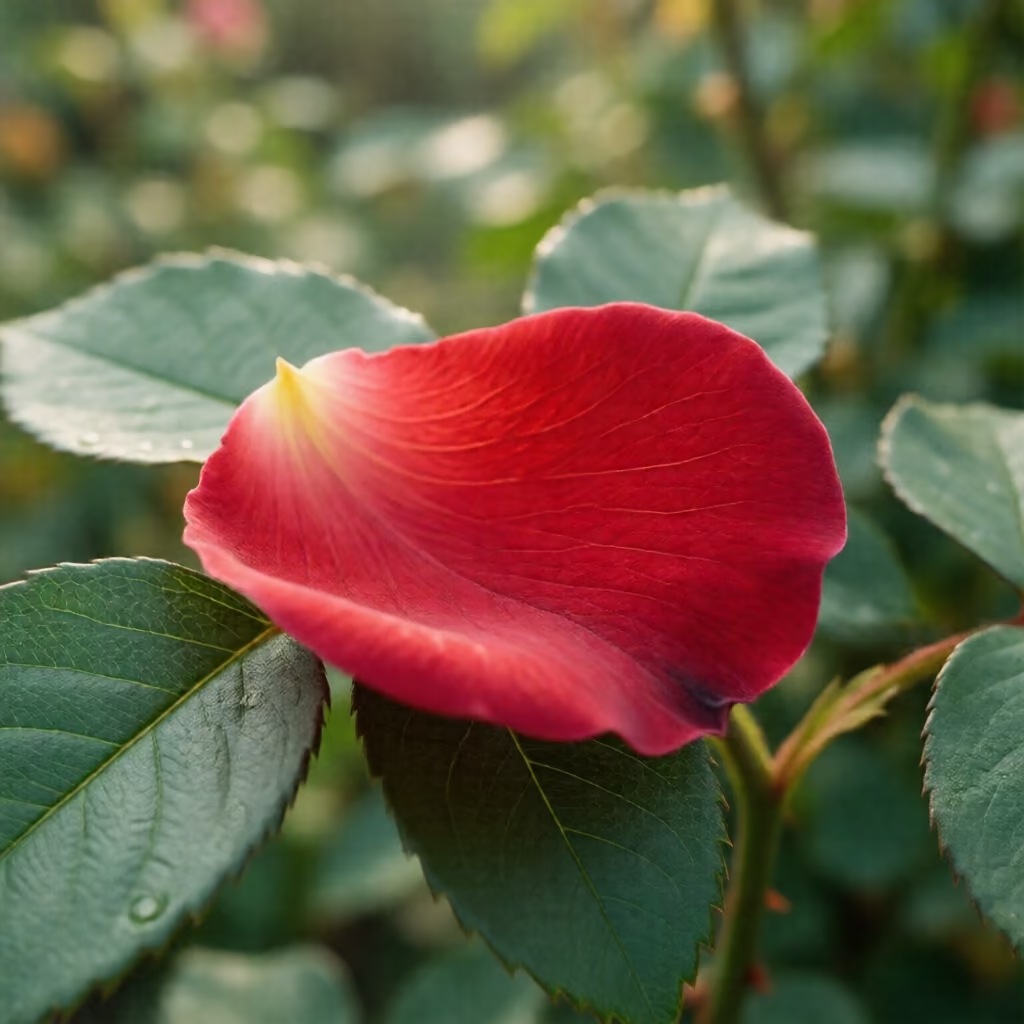
das Blütenblatt
petal
An individual, usually colorful leaf of a flower that surrounds the inner parts of the flower.
EXAMPLE
Die Rose hat zarte, rote Blütenblätter.
The rose has delicate red petals.
petal
das Blütenblatt, die Blütenblätter
Loading your saved state.
petal
An individual, usually colorful leaf of a flower that surrounds the inner parts of the flower.
Die Rose hat zarte, rote Blütenblätter.
The rose has delicate red petals.
| gender | neuter das |
|---|---|
| plural | die Blütenblätter |
| genitive | des Blütenblattes |
| singular | plural | |
|---|---|---|
| nominative | das Blütenblatt | die Blütenblätter |
| accusative | das Blütenblatt | die Blütenblätter |
| dative | dem Blütenblatt | den Blütenblättern |
| genitive | des Blütenblattes des Blütenblatts | der Blütenblätter |
The article changes with the case; it is shown in colour.
'Blütenblatt' is made up of 'Blüte' (flower/blossom) and 'Blatt' (leaf), connected by an 'n'. The first part indicates which part of the plant the leaf belongs to.
Auf dem Foto erkennt man jedes einzelne Blütenblatt der Tulpe.
In the photo, you can see each individual petal of the tulip.
Common phrases include 'Blütenblätter fallen ab' (petals fall off), 'Blütenblätter verlieren' (to lose petals), and 'Blütenblätter abzupfen' (to pluck petals). With 'verlieren' (to lose), the flower is the subject; with 'abzupfen' (to pluck), a person usually is.
Die Rose auf dem Küchentisch verliert langsam ihre Blütenblätter.
The rose on the kitchen table is slowly losing its petals.
Das Kind zupfte vorsichtig ein Blütenblatt nach dem anderen ab.
The child carefully plucked off one petal after another.
Typical descriptions include 'zarte Blütenblätter' (delicate petals), 'samtige Blütenblätter' (velvety petals), and 'verwelkte Blütenblätter' (wilted petals). 'Samtig' (velvety) describes the soft surface, while 'verwelkt' (wilted) describes the condition.
Die samtigen Blütenblätter fühlen sich angenehm weich an.
The velvety petals feel pleasantly soft.