

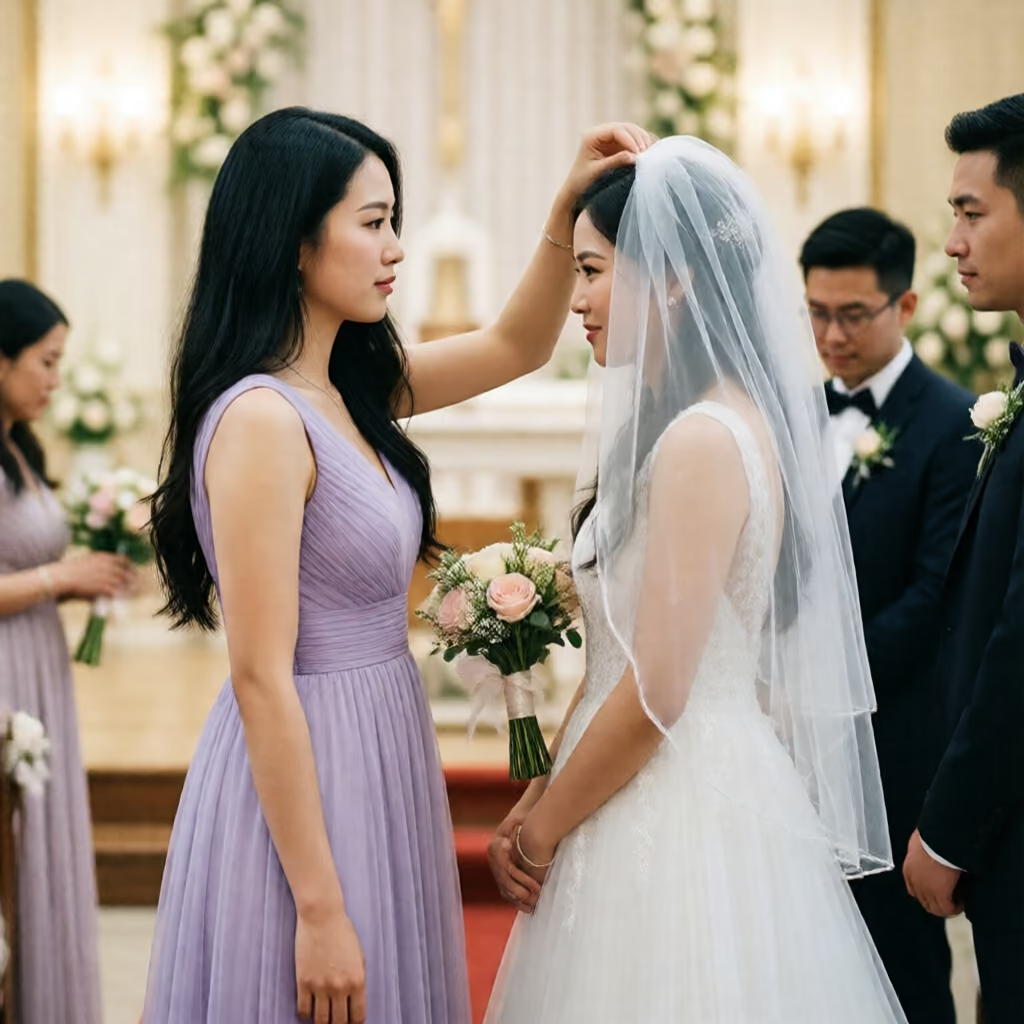
die Brautjungfer
bridesmaid
A young woman who accompanies and supports the bride at the wedding.
EXAMPLE
Meine Schwester ist bei der Hochzeit meine Brautjungfer.
My sister is my bridesmaid at the wedding.
bridesmaid
die Brautjungfer, die Brautjungfern
Loading your saved state.
bridesmaid
A young woman who accompanies and supports the bride at the wedding.
Meine Schwester ist bei der Hochzeit meine Brautjungfer.
My sister is my bridesmaid at the wedding.
| gender | feminine die |
|---|---|
| plural | die Brautjungfern |
| genitive | der Brautjungfer |
| singular | plural | |
|---|---|---|
| nominative | die Brautjungfer | die Brautjungfern |
| accusative | die Brautjungfer | die Brautjungfern |
| dative | der Brautjungfer | den Brautjungfern |
| genitive | der Brautjungfer | der Brautjungfern |
The article changes with the case; it is shown in colour.
'Brautjungfer' (bridesmaid) consists of 'Braut' (bride) and 'Jungfer' (maiden). The element 'Jungfer' originally referred to an unmarried young woman; today, the term 'Brautjungfer' does not reliably indicate a person's marital status.
Ihre Brautjungfer ist seit zwei Jahren verheiratet.
Her bridesmaid has been married for two years.
To indicate someone's role at a wedding, German often uses 'als Brautjungfer' (as a bridesmaid), usually without an article. This pattern is used, for example, in 'als Brautjungfer dabei sein' (to be there as a bridesmaid) or 'als Brautjungfer zur Hochzeit gehen' (to go to the wedding as a bridesmaid).
Ich bin bei der Hochzeit meiner Cousine als Brautjungfer dabei.
I am going to be there as a bridesmaid at my cousin's wedding.
A typical expression is 'jemanden bitten, Brautjungfer zu sein' (to ask someone to be a bridesmaid). The person being asked appears in the accusative after 'bitten' (to ask); the desired role follows in the infinitive with 'zu'.
Lea hat mich gebeten, ihre Brautjungfer zu sein.
Lea asked me to be her bridesmaid.