

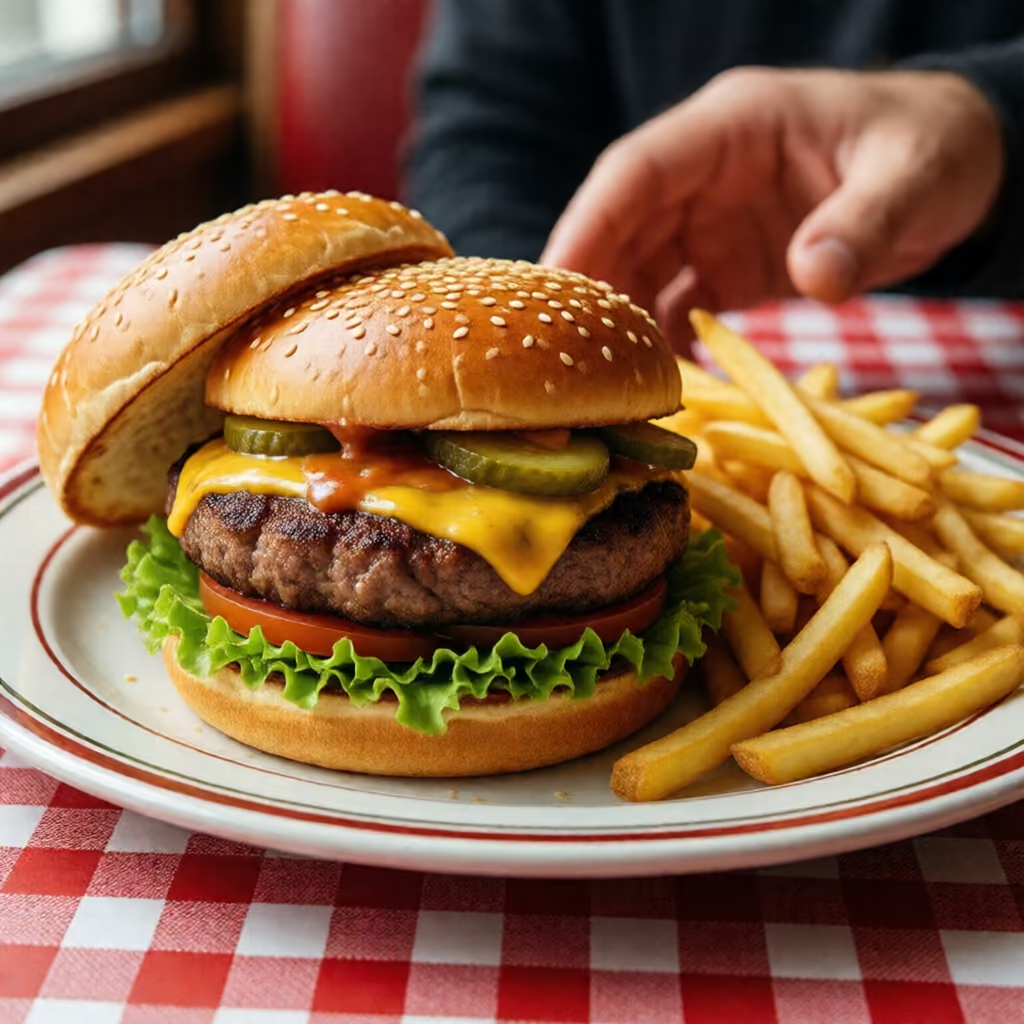
der Cheeseburger
cheeseburger
A soft bread roll cut open and filled with a fried slice of ground meat and cheese, often also with lettuce, vegetables, and sauce.
Ich bestelle einen Cheeseburger mit Pommes.
I’m ordering a cheeseburger with fries.
cheeseburger
der Cheeseburger, die Cheeseburger
Loading your saved state.

cheeseburger
A soft bread roll cut open and filled with a fried slice of ground meat and cheese, often also with lettuce, vegetables, and sauce.
Ich bestelle einen Cheeseburger mit Pommes.
I’m ordering a cheeseburger with fries.
| gender | masculine der |
|---|---|
| plural | die Cheeseburger |
| genitive | des Cheeseburgers |
| singular | plural | |
|---|---|---|
| nominative | der Cheeseburger | die Cheeseburger |
| accusative | den Cheeseburger | die Cheeseburger |
| dative | dem Cheeseburger | den Cheeseburgern |
| genitive | des Cheeseburgers | der Cheeseburger |
The article changes with the case; it is shown in colour.
The verbs 'bestellen' (to order), 'nehmen' (to have / choose), and 'essen' (to eat) are especially common with 'Cheeseburger'. The phrase 'Cheeseburger-Menü' (cheeseburger meal) is also often found on menus and used when ordering.
Am Bahnhof hat er ein Cheeseburger-Menü bestellt.
He ordered a cheeseburger meal at the train station.
When 'Cheeseburger' refers to the product being ordered, it is usually in the accusative. Additions after 'mit' (with) are in the dative.
Ich nehme einen Cheeseburger mit einer Portion Pommes.
I’ll have a cheeseburger with a portion of fries.
The word is especially common on menus, when placing orders, and in conversations about fast food restaurants. In these contexts, it refers to an individual dish and can also be part of a meal name.
Auf der Speisekarte gibt es den Cheeseburger auch als vegetarische Variante.
The menu also offers the cheeseburger as a vegetarian option.