


dabei
there
Expresses that someone is present at an event or in a place.
EXAMPLE
Gestern war ein großes Fest in der Stadt, und ich war auch dabei.
Yesterday there was a big festival in the city, and I was there too.
there / with you
Loading your saved state.
there
Expresses that someone is present at an event or in a place.
Gestern war ein großes Fest in der Stadt, und ich war auch dabei.
Yesterday there was a big festival in the city, and I was there too.

while doing so
Describes an action that takes place at the same time as another action.
Er hörte Musik und las dabei ein Buch.
He listened to music and read a book while doing so.

with you
Means that you are carrying something with you or have brought it along.
Hast du deinen Regenschirm dabei? Es soll später regnen.
Do you have your umbrella with you? It's supposed to rain later.

to be in the process
A fixed expression that means you are currently in the process of doing something.
Stör mich nicht, ich bin gerade dabei, die E-Mails zu beantworten.
Don't disturb me; I'm in the middle of answering the emails.

yet
Introduces a contrast or unexpected information, similar to 'trotzdem' (nevertheless) or 'obwohl' (although).
Sie isst sehr viel und ist dabei ganz schlank.
She eats a lot and yet is very slim.
'Dabei' is a pronominal adverb made up of 'da' and 'bei'. 'Da' refers to a thing or situation already known from the context. So it literally means 'bei dieser Sache' (with this thing) or 'an diesem Ort' (at this place).
Morgen ist ein wichtiges Meeting. Bist du auch dabei?
Tomorrow is an important meeting. Will you be there too?
The combination 'etwas dabeihaben' (to have something with you) means that you are carrying something with you. The object stands between the conjugated verb 'haben' (to have) and 'dabei'.
Ich habe meinen Ausweis nicht dabei.
I don't have my ID with me.
The expression 'dabei sein, etwas zu tun' (to be in the process of doing something) describes that you are right in the middle of an action. It is always formed with an infinitive construction with 'zu'.
Ich bin gerade dabei, das Abendessen vorzubereiten.
I'm in the middle of preparing dinner.
When 'dabei' connects two actions, it means that they take place at the same time. It refers to the action in the first part of the sentence.
Er telefoniert und macht sich dabei Notizen.
He is talking on the phone and taking notes while doing so.
In this meaning, 'dabei' introduces surprising or contrasting information. It can stand at the beginning of a sentence and then requires the verb to follow directly after it (inversion).
Er sagt, er hat keine Zeit. Dabei sitzt er nur vor dem Fernseher.
He says he has no time. Yet he's just sitting in front of the TV.
so that / with it
Damit refers to an object mentioned earlier that is used as a means. Dabei refers to an activity taking place at the same time, in which someone is involved. So when talking about helping, damit goes with the tool, while dabei refers to the activity itself.
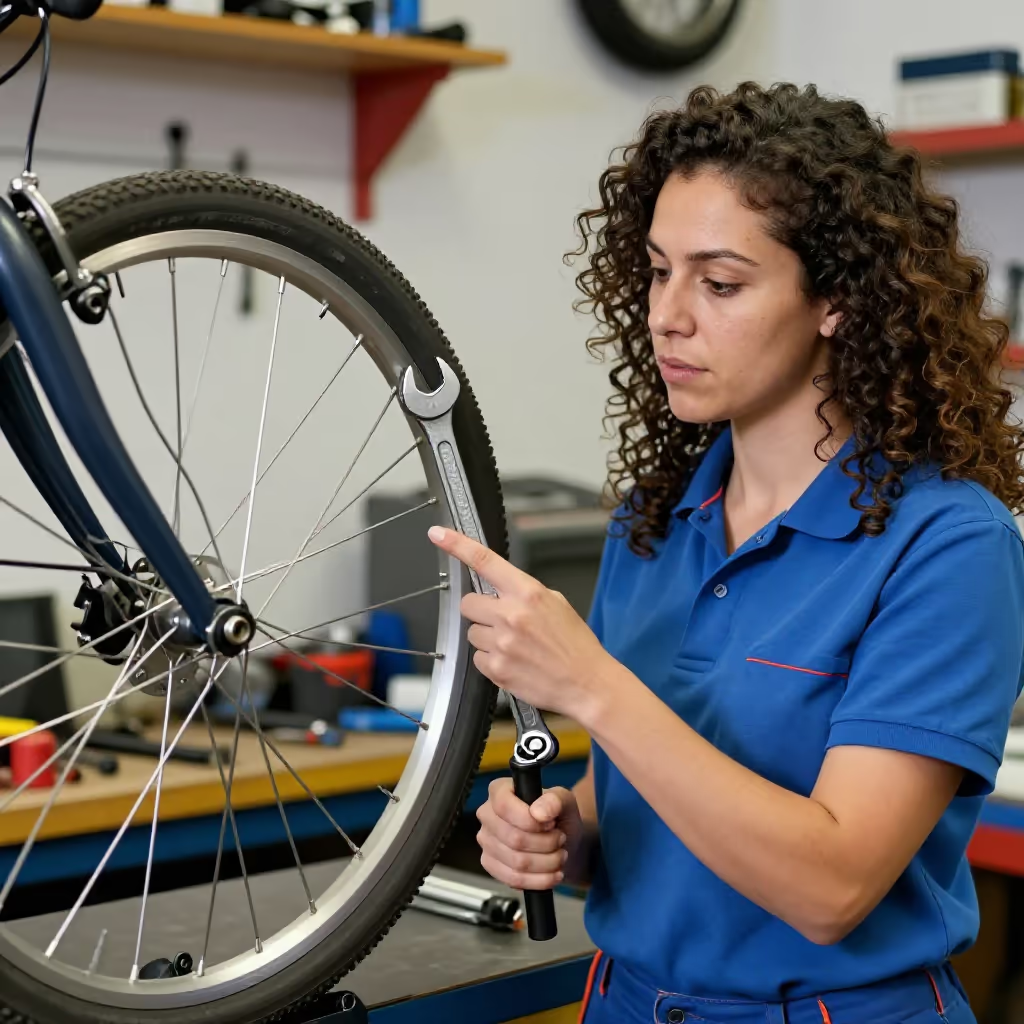
Ich streiche heute das Zimmer, und du kannst mir dabei helfen.
I’m painting the room today, and you can help me while I do it.
Nimm den breiten Pinsel, damit kannst du mir beim Streichen helfen.
Take the wide paintbrush; you can use it to help me paint.