

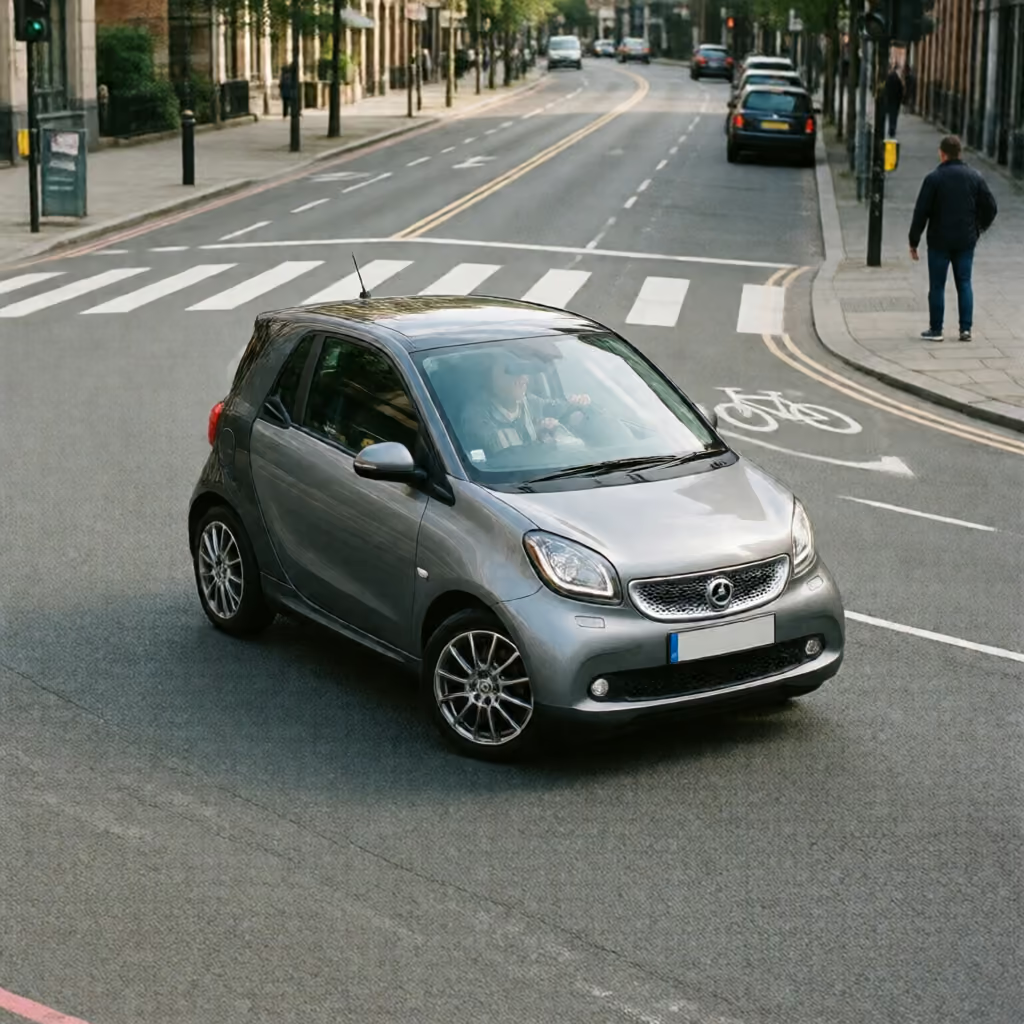
das Abbiegen
turning
Changing direction, especially in road traffic, by driving onto another street or in another direction.
EXAMPLE
Beim Abbiegen muss sie auf die Fußgänger achten.
When turning, she has to watch out for pedestrians.
turning
das Abbiegen
Loading your saved state.
turning
Changing direction, especially in road traffic, by driving onto another street or in another direction.
Beim Abbiegen muss sie auf die Fußgänger achten.
When turning, she has to watch out for pedestrians.
| gender | neuter das |
|---|---|
| genitive | des Abbiegens |
| singular | plural | |
|---|---|---|
| nominative | das Abbiegen | – |
| accusative | das Abbiegen | – |
| dative | dem Abbiegen | – |
| genitive | des Abbiegens | – |
The article changes with the case; it is shown in colour.
'Abbiegen' (to turn) is the infinitive used as a noun. This allows the action itself to become the subject of a sentence, for example with 'Das Abbiegen erfordert …' (Turning requires …).
Das Abbiegen erfordert an dieser Kreuzung besondere Vorsicht.
Turning requires particular caution at this intersection.
'Beim Abbiegen' (when turning) describes what happens or what needs to be taken into account during the process. 'Vor dem Abbiegen' (before turning) refers to the time before it, while 'nach dem Abbiegen' (after turning) refers to the time afterward.
Beim Abbiegen darfst du den Radweg nicht blockieren.
When turning, you must not block the cycle path.
Vor dem Abbiegen musst du rechtzeitig blinken.
Before turning, you have to signal in good time.
Nach dem Abbiegen liegt die Apotheke auf der rechten Seite.
After turning, the pharmacy is on the right.
The direction often comes directly after the noun: 'das Abbiegen nach links' (turning left) or 'das Abbiegen nach rechts' (turning right). In traffic regulations, the expressions 'Abbiegen ist erlaubt' (turning is allowed) and 'Abbiegen ist verboten' (turning is prohibited) are typical.
Das Abbiegen nach links ist an dieser Kreuzung verboten.
Turning left is prohibited at this intersection.