

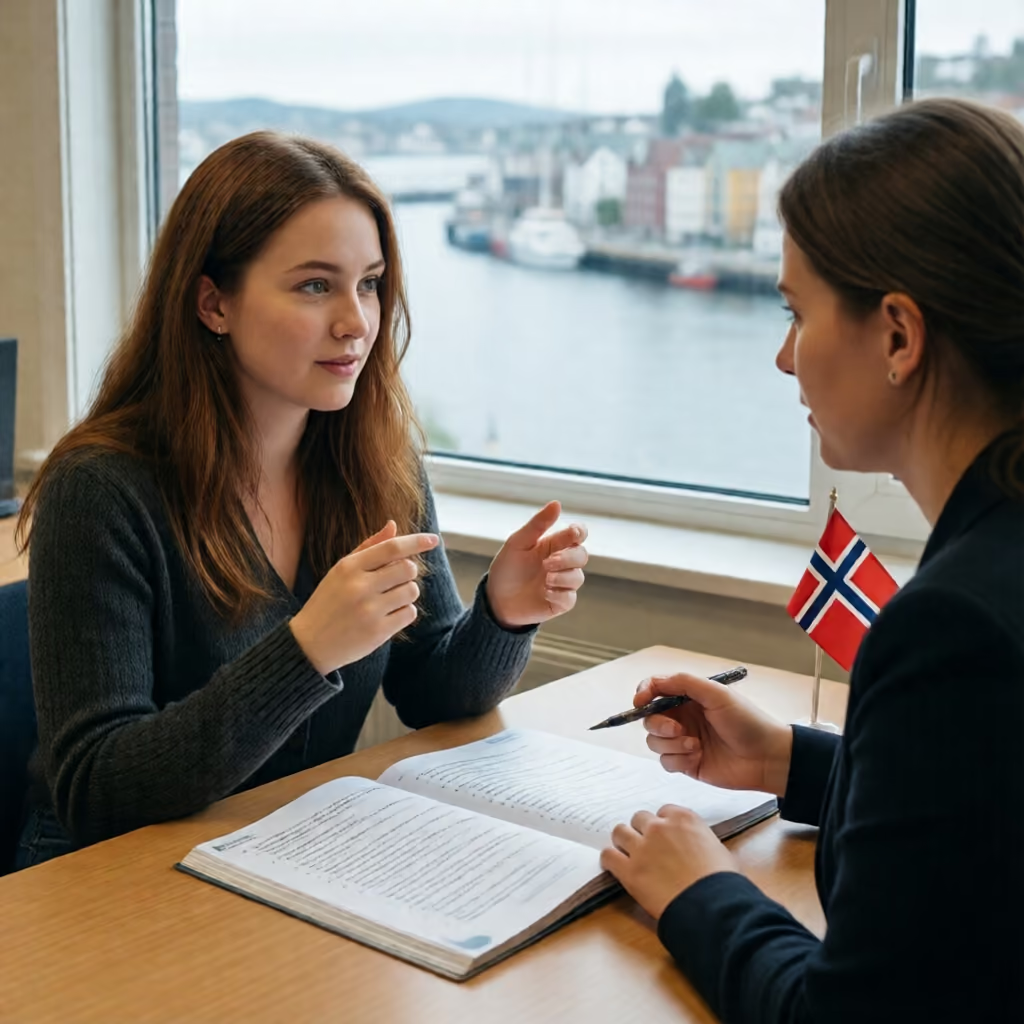
das Norwegisch
Norwegian
The Germanic language spoken in Norway and used in its main forms, Bokmål and Nynorsk.
Ich lerne Norwegisch, weil ich später in Oslo arbeiten möchte.
I am learning Norwegian because I would like to work in Oslo later.
Norwegian
(das) Norwegisch
Loading your saved state.

Norwegian
The Germanic language spoken in Norway and used in its main forms, Bokmål and Nynorsk.
Ich lerne Norwegisch, weil ich später in Oslo arbeiten möchte.
I am learning Norwegian because I would like to work in Oslo later.
| gender | neuter das |
|---|---|
| genitive | (des) Norwegisch |
| singular | plural | |
|---|---|---|
| nominative | (das) Norwegisch das Norwegische | – |
| accusative | (das) Norwegisch das Norwegische | – |
| dative | (dem) Norwegisch | – |
| genitive | (des) Norwegisch (des) Norwegischs, des Norwegischen | – |
The article changes with the case; it is shown in colour.
After verbs such as „lernen“ (to learn), „sprechen“ (to speak), and „verstehen“ (to understand), „Norwegisch“ (Norwegian) usually appears without an article when no further description is added.
Meine Nachbarin spricht Norwegisch und versteht auch deutsche Texte.
My neighbor speaks Norwegian and also understands German texts.
Use „auf Norwegisch“ (in Norwegian) to indicate the language in which something is written, said, or explained. This expression goes with verbs such as „schreiben“ (to write), „antworten“ (to reply), and „erklären“ (to explain).
Kannst du mir auf Norwegisch antworten?
Can you reply to me in Norwegian?
With a possessive word such as „mein“ (my) or „ihr“ (her), „Norwegisch“ (Norwegian) refers to a person's language skills. Typical expressions include „sein Norwegisch verbessern“ (to improve one's Norwegian) and „sein Norwegisch auffrischen“ (to brush up on one's Norwegian).
Vor ihrem Aufenthalt in Bergen möchte sie ihr Norwegisch auffrischen.
Before her stay in Bergen, she would like to brush up on her Norwegian.