

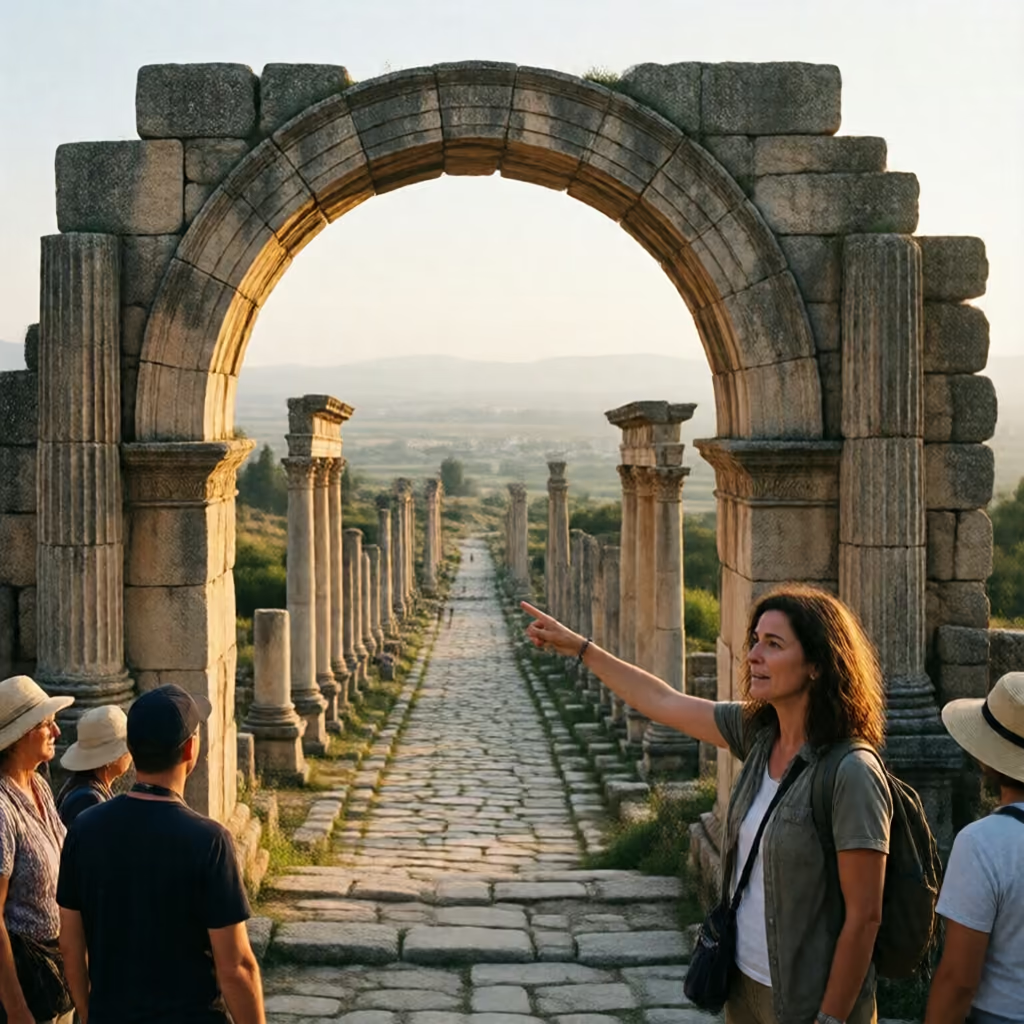
das Reich
empire
A large territory or state ruled by a ruler; often an empire or kingdom.
EXAMPLE
Das Römische Reich bestand viele Jahrhunderte lang.
The Roman Empire existed for many centuries.
realm
das Reich, die Reiche
Loading your saved state.
empire
A large territory or state ruled by a ruler; often an empire or kingdom.
Das Römische Reich bestand viele Jahrhunderte lang.
The Roman Empire existed for many centuries.

realm
An area or world characterized by a particular quality, group, or idea.
Im Reich der Fantasie ist vieles möglich.
In the realm of fantasy, anything is possible.

kingdom
In biology, a major group into which living organisms are classified according to shared characteristics.
Der Mensch gehört zum Reich der Tiere.
Humans belong to the animal kingdom.

to belong to the realm of fable
To be untrue, made up, or completely unbelievable.
Dass Spinat besonders viel Eisen enthält, gehört ins Reich der Fabel.
The claim that spinach contains especially large amounts of iron belongs to the realm of fable.
| gender | neuter das |
|---|---|
| plural | die Reiche |
| genitive | des Reichs |
| singular | plural | |
|---|---|---|
| nominative | das Reich | die Reiche |
| accusative | das Reich | die Reiche |
| dative | dem Reich | den Reichen |
| genitive | des Reichs des Reiches | der Reiche |
The article changes with the case; it is shown in colour.
In this meaning, 'Reich' (empire) frequently appears in historical or political texts. Typical collocations describe the formation, expansion, or rule of an empire.
Das Reich wurde im Laufe der Zeit immer größer.
The empire grew larger and larger over time.
Viele Völker kämpften um die Herrschaft über das Reich.
Many peoples fought for control of the empire.
'Reich' (empire) often appears with verbs such as 'gründen' (to found), 'erobern' (to conquer), 'regieren' (to rule), and 'zerfallen' (to collapse). These collocations help you formulate historical descriptions naturally.
Der Herrscher regierte das Reich fast vierzig Jahre lang.
The ruler governed the empire for almost forty years.
For a particular conceptual or thematic area, 'Reich' (realm) is often used with 'im' and a complement beginning with 'der': 'im Reich der …' (in the realm of …). The complement identifies what characterizes this area.
Im Reich der Musik gelten oft andere Regeln als im Alltag.
In the realm of music, different rules often apply than in everyday life.
In biological texts, 'Reich' (kingdom) is often combined with a group of living organisms. Common collocations include 'Reich der Tiere' (animal kingdom), 'Reich der Pflanzen' (plant kingdom), and 'Reich der Pilze' (fungal kingdom).
Bakterien werden in der biologischen Systematik einem eigenen Reich zugeordnet.
In biological taxonomy, bacteria are assigned to their own kingdom.
The expression 'ins Reich der Fabel gehören' (to belong to the realm of fable) is used when rejecting a claim or story as made up or unbelievable. It often follows an exaggerated account or a rumor.
Die Geschichte von dem Schatz im Garten gehört wohl ins Reich der Fabel.
The story about the treasure in the garden probably belongs to the realm of fable.