

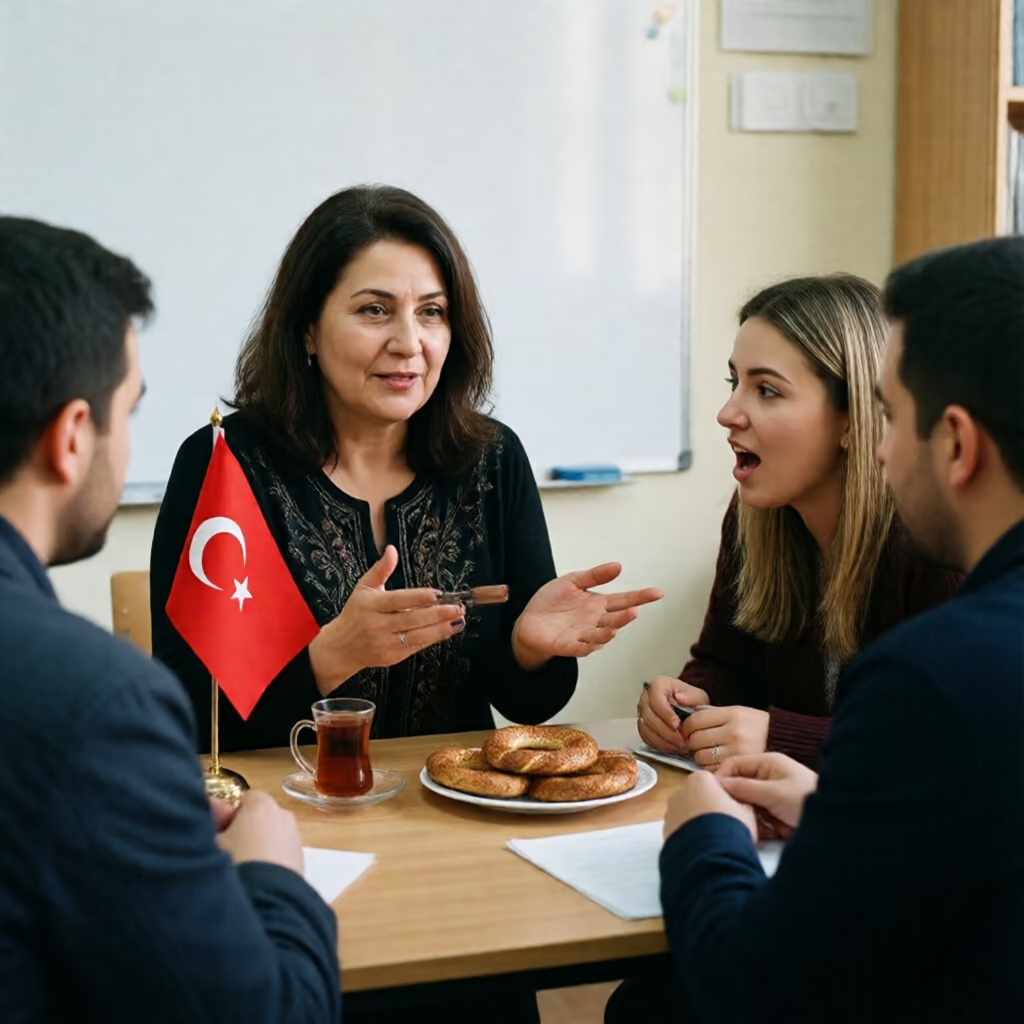
das Türkisch
Turkish
The Turkish language, spoken mainly in Turkey and by Turkish-speaking people.
EXAMPLE
Das Türkisch, das sie im Kurs spricht, klingt schon sehr sicher.
The Turkish she speaks in class already sounds very confident.
Turkish
(das) Türkisch
Loading your saved state.
Turkish
The Turkish language, spoken mainly in Turkey and by Turkish-speaking people.
Das Türkisch, das sie im Kurs spricht, klingt schon sehr sicher.
The Turkish she speaks in class already sounds very confident.
| genitive | (des) Türkisch |
|---|
| singular | plural | |
|---|---|---|
| nominative | (das) Türkisch das Türkische | – |
| accusative | (das) Türkisch das Türkische | – |
| dative | (dem) Türkisch | – |
| genitive | (des) Türkisch (des) Türkischs, des Türkischen | – |
The article changes with the case; it is shown in colour.
'Türkisch' (Turkish) is derived from 'Türke' (Turk) and formed with the suffix '-isch' (-ish). As the name of a language, the adjective is nominalized and is therefore capitalized.
Das Türkisch der neuen Mitschülerin klingt sehr klar.
The new classmate's Turkish sounds very clear.
As the name of a language, 'Türkisch' (Turkish) is often used without an article. 'Das Türkisch' (the Turkish) is often used to refer to a specific form of the language, such as the language spoken by a person, used in a course, or heard in a film.
Das Türkisch in dieser Serie klingt sehr natürlich.
The Turkish in this series sounds very natural.
Common collocations include 'Türkisch lernen' (to learn Turkish), 'Türkisch sprechen' (to speak Turkish), 'Türkisch verstehen' (to understand Turkish), and 'auf Türkisch antworten' (to reply in Turkish). The quality of someone's language skills is also often described with expressions such as 'fließendes Türkisch' (fluent Turkish) or 'gutes Türkisch' (good Turkish).
Ihr Türkisch hat sich durch den Sprachkurs deutlich verbessert.
Her Turkish has improved significantly as a result of the language course.