

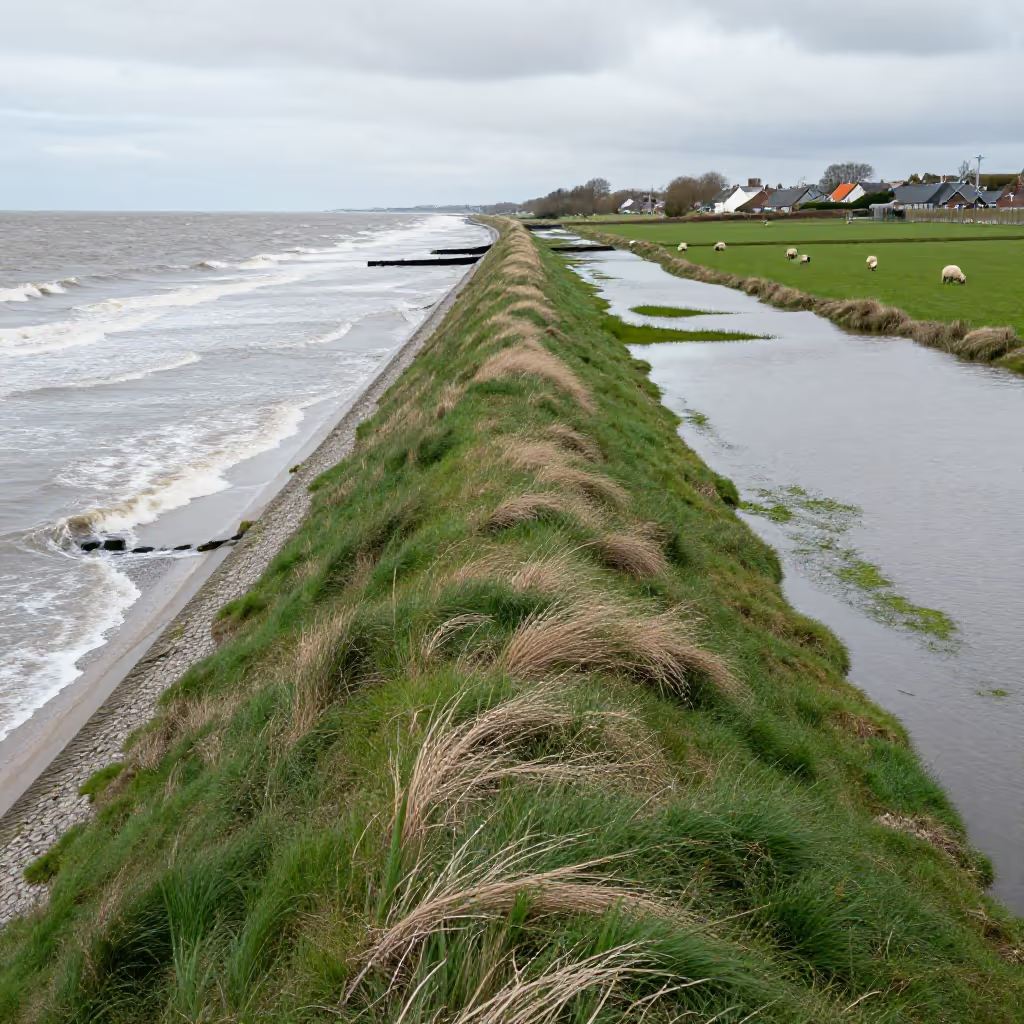
A human-made embankment, usually made of earth, that protects land from flooding by the sea or a river.
example
An der Nordseeküste schützen hohe Deiche das flache Land vor Sturmfluten.
On the North Sea coast, high dikes protect the flat land from storm surges.
Usage tips
Correct preposition
The prepositions used with 'Deich' (dike) describe the position precisely. You go for a walk 'auf dem Deich' (on the dike, on top of it), you drive 'am Deich' (along the dike, next to it), and you live safely 'hinter dem Deich' (behind the dike, protected).
EXAMPLE
Im Urlaub sind wir jeden Tag auf dem Deich spazieren gegangen.
On vacation, we went for a walk on the dike every day.
Typical verbs
Typical verbs describe the construction and function of the dike. You can 'bauen' (build), 'erhöhen' (raise), or 'verstärken' (reinforce) a dike. If it does not withstand the water, the dike 'bricht' (breaks).
EXAMPLE
Nach dem Hochwasser mussten die Deiche am Fluss verstärkt werden.
After the flood, the dikes along the river had to be reinforced.
Regional use
The word 'Deich' (dike) is especially common in northern Germany and in coastal regions, where protection from flooding and storm surges plays a major role.
EXAMPLE
Ohne die Deiche würde ein großer Teil der Niederlande überflutet werden.
Without the dikes, a large part of the Netherlands would be flooded.
Compare with
near_synonym · confusable
Deich vs Wall
rampart / embankment
'der Wall' and 'der Deich' can both mean a protective structure made of earth that protects against water. 'Der Deich' is the precise and very natural word for this, especially along rivers or by the sea. 'Der Wall' is more general and can also refer to other protective structures, for example against attacks. In water-related contexts, 'Wall' can fit, but 'Deich' is usually more precise. Learners may confuse the words because a dike looks like a rampart or embankment. When talking about floods or storm surges, 'Deich' is usually the best choice.
Deich
Der Deich schützt die Häuser hinter dem Fluss vor Hochwasser.
The dike protects the houses behind the river from flooding.
Wall
Am Rand des Feldes steht ein niedriger Wall, der das Wasser vom Weg fernhält.
At the edge of the field there is a low embankment that keeps the water away from the path.