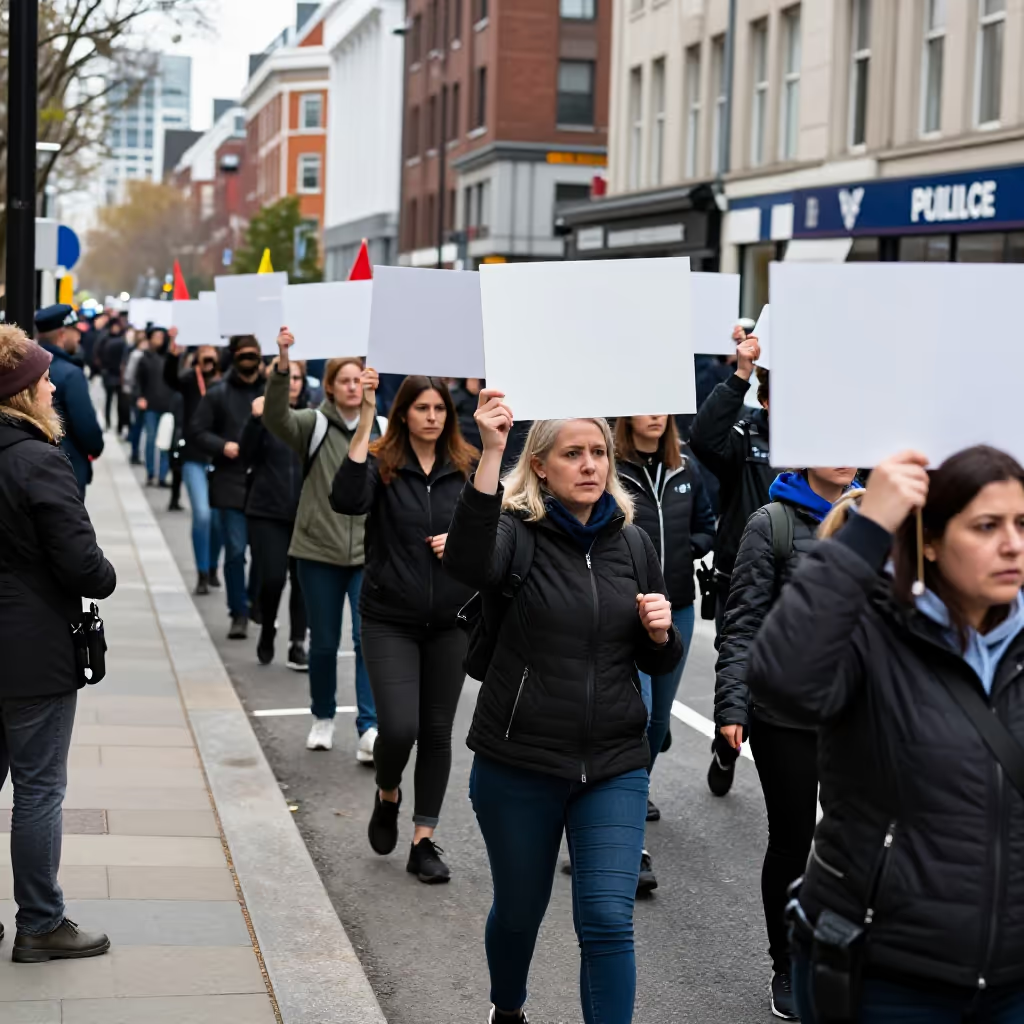
A public gathering of people who take to the streets together to express their opinion on a political or social issue. In doing so, they protest against something or show their support for a cause.
example
Tausende Menschen nahmen an der Demonstration für den Klimaschutz teil.
Thousands of people took part in the demonstration for climate protection.

Usage tips
Word family
The noun 'die Demonstration' (demonstration) is derived directly from the verb 'demonstrieren' (to demonstrate). If you understand that 'demonstrieren' can mean both 'to protest' and 'to demonstrate/show something', you also understand the different meanings of the noun.
EXAMPLE
Er demonstrierte, wie die Maschine funktioniert.
He demonstrated how the machine works.
Context clues
The context reveals the meaning: If it’s about politics, protest, and streets, it means a public gathering. If it’s about a product or a function, it means a demonstration or presentation. If it’s about feelings or qualities, it is an expression of them.
EXAMPLE
Die Demonstration gegen die neue Steuer war sehr laut.
The demonstration against the new tax was very loud.
Typical verbs
In the context of protests, 'Demonstration' (demonstration) is often used with certain verbs: you can 'an einer Demonstration teilnehmen' (take part in a demonstration), 'zu einer Demonstration gehen' (go to a demonstration), or 'eine Demonstration organisieren' (organize a demonstration).
EXAMPLE
Die Gewerkschaft hat zu einer Demonstration aufgerufen.
The union called for a demonstration.
Prepositions 'für' and 'gegen'
To express the purpose of a protest, you use the prepositions 'für' (for) or 'gegen' (against), followed by the accusative. You demonstrate 'für' a cause that you support and 'gegen' a cause that you reject.
EXAMPLE
Es war eine Demonstration für mehr Umweltschutz.
It was a demonstration for more environmental protection.
Typical collocations
When referring to a demonstration or presentation, typical phrases are 'eine Demonstration geben' (to give a demonstration) or 'eine Demonstration bekommen' (to get a demonstration). Often, it is also specified what the demonstration is of, e.g. 'eine Demonstration der Software' (a demonstration of the software).
EXAMPLE
Der Erfinder gab eine eindrucksvolle Demonstration seiner neuen Maschine.
The inventor gave an impressive demonstration of his new machine.
Expression with 'von'
In the meaning of 'expression' or 'proof', 'Demonstration' (demonstration) is almost always used in the fixed structure 'eine Demonstration von' (a demonstration of) followed by a noun in the dative (e.g. 'von Stärke' (of strength), 'von Solidarität' (of solidarity)).
EXAMPLE
Die schnelle Hilfe war eine Demonstration von echter Solidarität.
The quick help was a demonstration of true solidarity.
Compare with
near_synonym · confusable
Demonstration vs Aktion
action / sale
'Aktion' and 'Demonstration' can both be public forms through which people draw attention to an issue. But 'Aktion' is broader: it can be an information stand, a fundraising campaign, or another planned measure. 'Demonstration' usually means that many people gather publicly and show their opinion, often in the street. Learners may confuse the words because a demonstration can also be a kind of 'Aktion'. In addition, 'Demonstration' can also mean showing how something works, for example a device; then it has nothing to do with protest.
Demonstration
Nach der Arbeit geht meine Mutter zu einer Demonstration für bessere Pflege.
After work, my mother is going to a demonstration for better nursing care.
Aktion
Wir machen eine Aktion vor der Schule, um auf das Problem aufmerksam zu machen.
We are holding an action in front of the school to draw attention to the problem.