

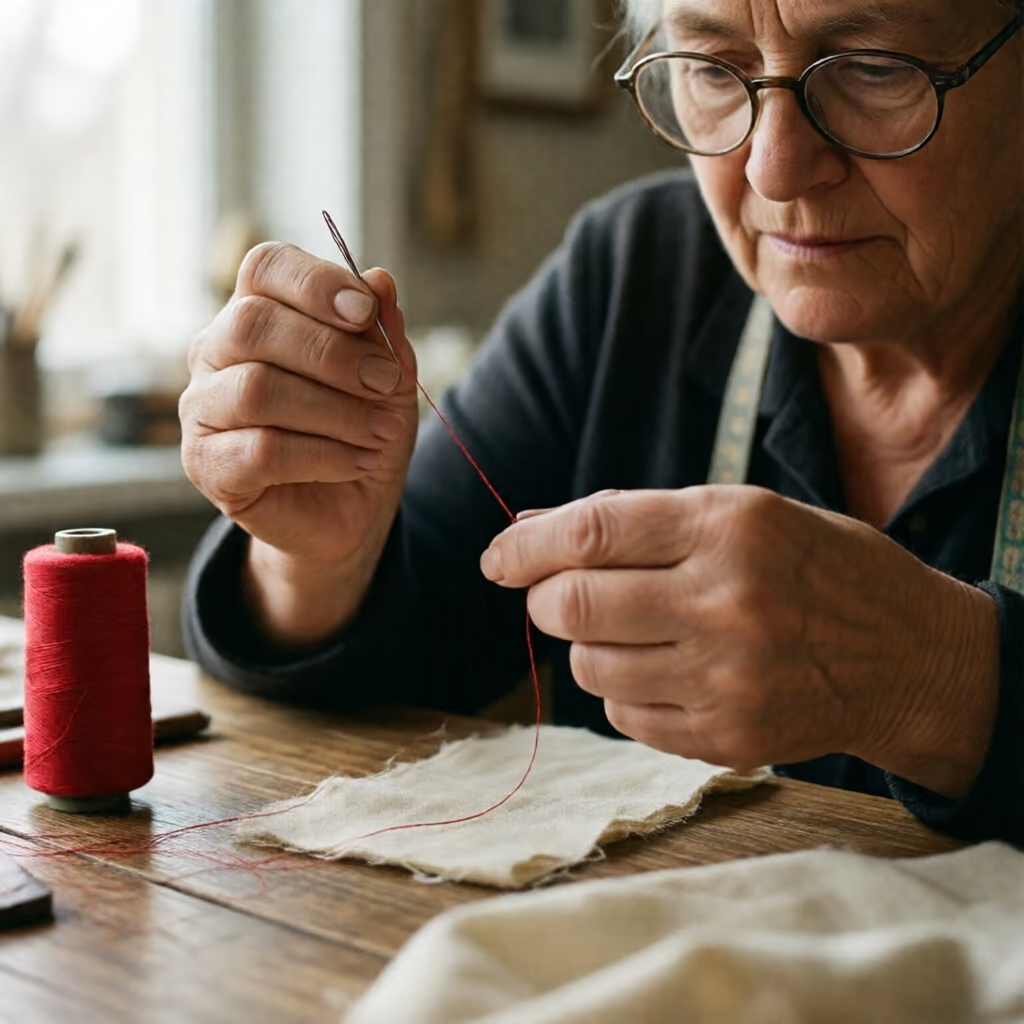
der Faden
thread
A thin, long, flexible material made of interconnected fibers, used for sewing, weaving, or tying.
EXAMPLE
Der Faden ist zu dünn für diesen Stoff.
The thread is too thin for this fabric.
thread / fathom
der Faden, die Fäden
Loading your saved state.
thread
A thin, long, flexible material made of interconnected fibers, used for sewing, weaving, or tying.
Der Faden ist zu dünn für diesen Stoff.
The thread is too thin for this fabric.

thread / strand
A thin, thread-like line or structure, for example in a technical or biological context.
Unter dem Mikroskop waren die feinen Fäden des Pilzmyzels deutlich zu erkennen.
The fine threads of the fungal mycelium were clearly visible under the microscope.

thread
The underlying connection or coherence of a conversation, story, or argument.
Die vielen Unterbrechungen machten es schwer, dem Faden des Gesprächs zu folgen.
The many interruptions made it difficult to follow the thread of the conversation.

the common thread
A continuous theme or recognizable connection running through a speech, text, or project.
In ihrem Vortrag fehlte leider der rote Faden.
Unfortunately, her presentation lacked a clear common thread.

to lose the thread
To lose the connection between one's thoughts and therefore no longer know how to continue telling or explaining something.
Entschuldigung, ich habe gerade den Faden verloren.
Sorry, I just lost the thread.

to pick up the thread
To continue a conversation, story, or argument from an earlier point.
Nach der kurzen Pause nahm die Rednerin den Faden wieder auf.
After the short break, the speaker picked up the thread again.

to hang by a thread
To be in an uncertain or dangerous situation in which a small change can have major consequences.
Nach dem Unfall hing sein Leben am seidenen Faden.
After the accident, his life was hanging by a thread.

fathom
An old unit of length from seafaring, used mainly to indicate water depth; one fathom is approximately 1.8 meters.
Die Wassertiefe wurde früher in Faden angegeben.
Water depth used to be given in fathoms.
| gender | masculine der |
|---|---|
| plural | die Fäden |
| genitive | des Fadens |
| singular | plural | |
|---|---|---|
| nominative | der Faden | die Fäden die Faden |
| accusative | den Faden | die Fäden die Faden |
| dative | dem Faden | den Fäden den Faden |
| genitive | des Fadens | der Fäden der Faden |
The article changes with the case; it is shown in colour.
In its literal sense, 'Faden' (thread) frequently occurs with actions such as 'einfädeln' (to thread), 'vernähen' (to sew up), and 'abschneiden' (to cut off). The fixed expression 'der Faden reißt' (the thread breaks) is also very common.
Sie fädelte den Faden vorsichtig durch das Nadelöhr.
She carefully threaded the thread through the eye of the needle.
Beim Nähen riss der Faden plötzlich.
While sewing, the thread suddenly broke.
In this meaning, 'Faden' (thread) refers to something that looks like a thread, such as fine structures in plants and fungi or a thin strand of a viscous substance. The expression 'Fäden ziehen' (to form strings) is typical, for example with melted cheese or honey.
Der geschmolzene Käse auf der Pizza zog lange Fäden.
The melted cheese on the pizza formed long strings.
In its figurative meaning, 'Faden' (thread) frequently occurs with words such as 'Gespräch' (conversation), 'Erzählung' (narrative), 'Argumentation' (argument), or 'Gedanke' (thought). This usually makes it clear that 'Faden' refers to the coherence of an extended spoken or written passage.
In der Mitte des Romans reißt der Faden der Erzählung plötzlich ab.
In the middle of the novel, the thread of the narrative suddenly breaks off.
The fixed expression 'der rote Faden' (the common thread) is used especially for presentations, texts, conversations, and projects. Common verbs used with it are 'haben' (to have), 'erkennen' (to recognize), and 'verlieren' (to lose).
Der Bericht hat einen klaren roten Faden und ist leicht zu lesen.
The report has a clear common thread and is easy to read.
In 'den Faden verlieren' (to lose the thread), 'Faden' is in the accusative because the expression contains an accusative object. The expression is often used in conversations or while explaining something, also with 'gerade' (just) or 'kurz' (briefly).
Wegen der Zwischenfragen verlor die Dozentin kurz den Faden.
Because of the questions from the audience, the lecturer briefly lost the thread.
'Den Faden aufnehmen' (to pick up the thread) is often combined with 'wieder' (again) or 'dort' (there) and refers to continuing after a pause or interruption. Here too, 'Faden' is in the accusative.
Nach dem Telefonat nahm er den Faden seiner Erklärung wieder auf.
After the phone call, he picked up the thread of his explanation again.
In the fixed expression 'am seidenen Faden hängen' (to hang by a thread), 'am' stands for 'an dem' and requires the dative. The expression usually describes a situation whose outcome is still completely uncertain.
Nach dem knappen Wahlergebnis hing die Entscheidung am seidenen Faden.
After the narrow election result, the decision was hanging by a thread.
As a unit of length, 'Faden' (fathom) is now found mainly in historical, nautical, or technical texts. In this usage, the word frequently occurs with information about water depth or distance.
Der alte Bericht nennt eine Wassertiefe von zwölf Faden.
The old report gives a water depth of twelve fathoms.