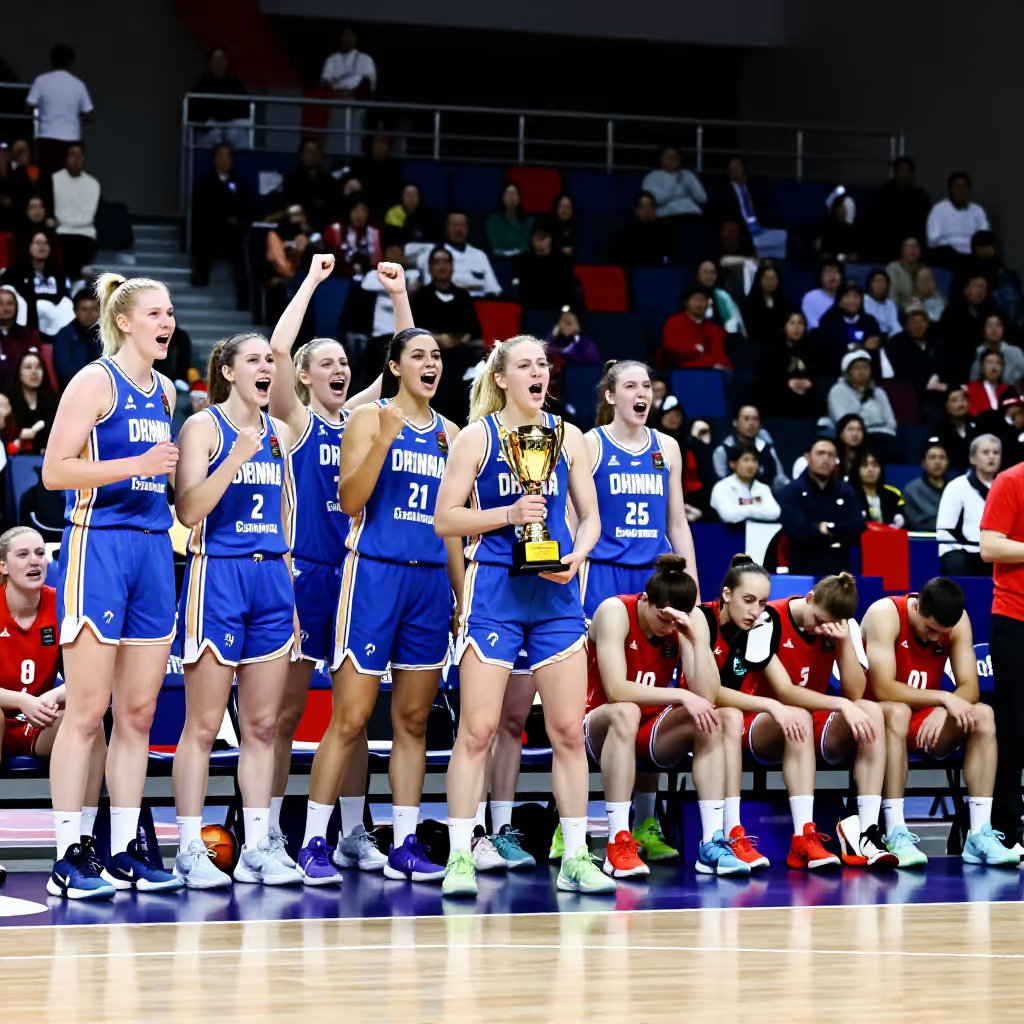
The superiority or dominant position of a person, group, company, or state in a particular area such as business, politics, or sports.
example
Die Dominanz des FC Bayern in der Bundesliga ist seit Jahren ungebrochen.
FC Bayern's dominance in the Bundesliga has been unbroken for years.

Usage tips
Word family
'Dominanz' (dominance) belongs to a word family with the adjective 'dominant' (dominant) and the verb 'dominieren' (to dominate). All three words describe a form of superiority or control.
EXAMPLE
Das Team dominierte das Spiel von der ersten Minute an.
The team dominated the game from the very first minute.
Context clue
You can easily recognize the different meanings by the topic. If it is about 'Wirtschaft' (business/economy) or 'Sport' (sports), superiority (m01) is meant. In the context of 'Verhalten' (behavior) or 'Gruppen' (groups), it is about psychology (m02). With 'Genen' (genes) or 'Vererbung' (inheritance), the biological meaning (m03) is meant.
EXAMPLE
Die wirtschaftliche Dominanz des Unternehmens ist beeindruckend.
The company's economic dominance is impressive.
Sentence structure and usage pattern
The dominant position is often expressed with the preposition 'von' (+ dative) for the actor and 'in' (+ dative) for the area. The pattern is: 'die Dominanz von jemandem/etwas in einem Bereich' (the dominance of someone/something in an area).
EXAMPLE
Die Dominanz von diesem Team in der Liga ist unbestreitbar.
The dominance of this team in the league is undeniable.
Typical collocations
In the context of business or politics, 'Dominanz' (dominance) is often combined with adjectives such as 'wirtschaftlich' (economic), 'politisch' (political), or 'kulturell' (cultural). Typical verbs are 'seine Dominanz zeigen' (to show one's dominance), 'ausbauen' (to expand), or 'brechen' (to break).
EXAMPLE
Das Land versucht, seine technologische Dominanz weiter auszubauen.
The country is trying to further expand its technological dominance.
Compare with
near_synonym
Dominanz vs Herrschaft
rule / control
'die Herrschaft' and 'die Dominanz' both have to do with power and superiority. 'Herrschaft' more often means that someone is actually exercising control, for example over a country, a people, or a situation. 'Dominanz' more often describes a strong or leading position in relation to others. This does not always have to be official rule. In sports, business, or a group, 'Dominanz' often sounds more natural. When it is about political control or actual governing, 'Herrschaft' fits better.
Dominanz
Im Spiel zeigte die Mannschaft von Anfang an klare Dominanz.
In the game, the team showed clear dominance from the very beginning.