

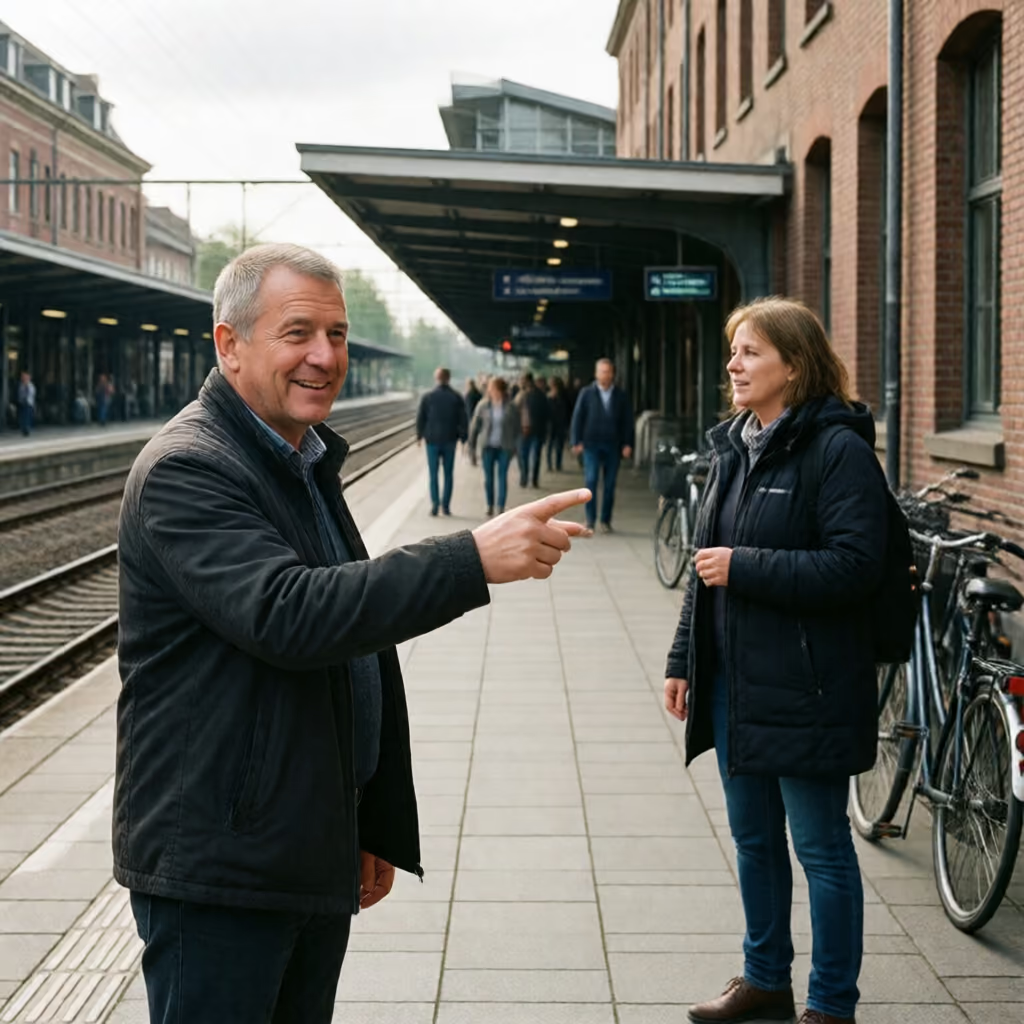
der Duisburger
person from Duisburg
A man who comes from Duisburg or lives there.
EXAMPLE
Der Duisburger zeigte uns den Weg zum Hauptbahnhof.
The man from Duisburg showed us the way to the main train station.
person from Duisburg
der Duisburger, die Duisburger
Loading your saved state.
person from Duisburg
A man who comes from Duisburg or lives there.
Der Duisburger zeigte uns den Weg zum Hauptbahnhof.
The man from Duisburg showed us the way to the main train station.
| gender | masculine der |
|---|---|
| plural | die Duisburger |
| genitive | des Duisburgers |
| singular | plural | |
|---|---|---|
| nominative | der Duisburger | die Duisburger |
| accusative | den Duisburger | die Duisburger |
| dative | dem Duisburger | den Duisburgern |
| genitive | des Duisburgers | der Duisburger |
The article changes with the case; it is shown in colour.
'Duisburger' is formed from the place name 'Duisburg' and the ending '-er'. This ending creates a term for a person who is connected to that place.
Der Duisburger arbeitet seit vielen Jahren im Stadtzentrum.
The man from Duisburg has been working in the city center for many years.
On its own, 'Duisburger' does not specify whether the person was born in Duisburg or lives there. The expression 'gebürtiger Duisburger' (a native of Duisburg) makes it clear that Duisburg is the person's birthplace.
Als gebürtiger Duisburger kennt er die Geschichte des Hafens sehr gut.
As a native of Duisburg, he knows the history of the harbor very well.
Common combinations are 'gebürtiger Duisburger' (native of Duisburg), 'ehemaliger Duisburger' (former resident of Duisburg), and 'langjähriger Duisburger' (long-time resident of Duisburg). These additions clarify the person's relationship to the city.
Der ehemalige Duisburger besucht seine Heimatstadt regelmäßig.
The former resident of Duisburg regularly visits his hometown.