

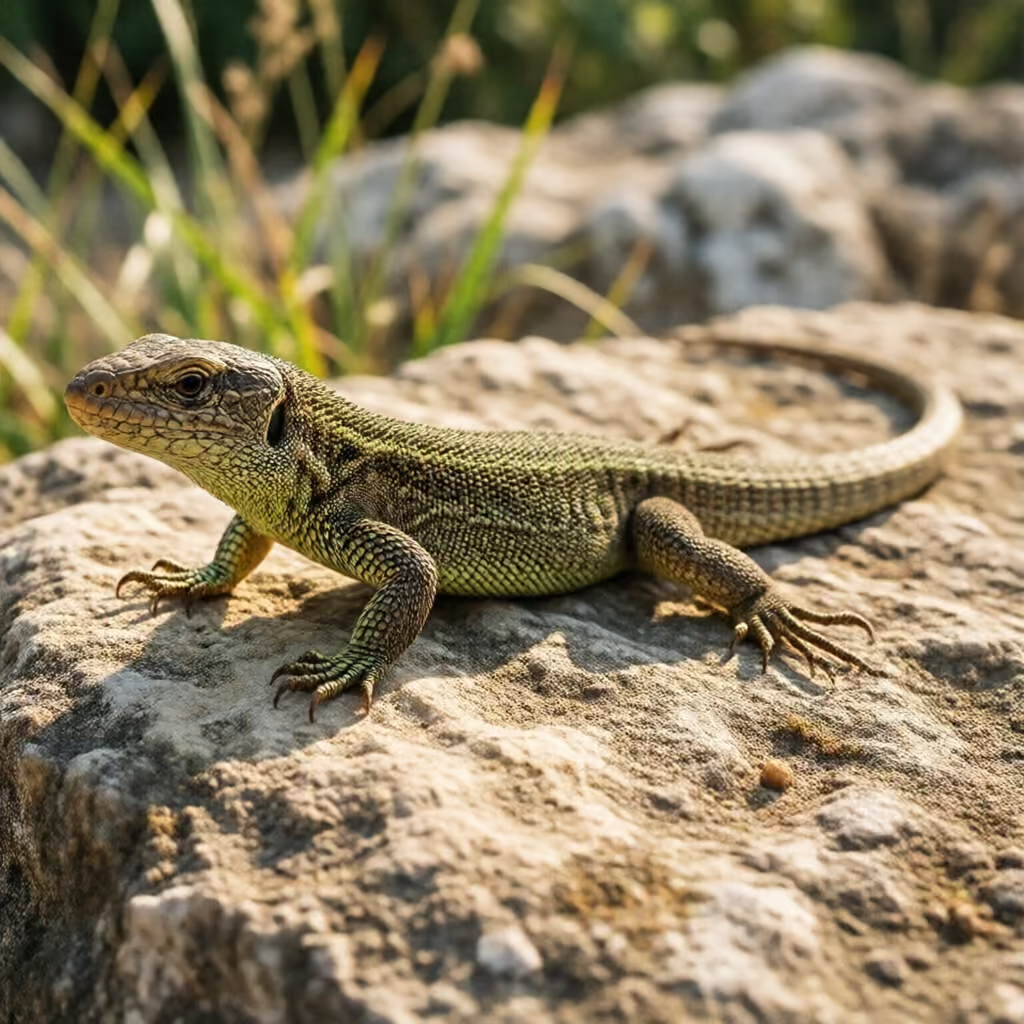
die Echse
lizard
A crawling animal with four legs, a long tail, and usually dry, scaly skin. Lizards are reptiles.
EXAMPLE
Die Echse sonnte sich auf einem warmen Stein.
The lizard basked in the sun on a warm stone.
lizard
die Echse, die Echsen
Loading your saved state.
lizard
A crawling animal with four legs, a long tail, and usually dry, scaly skin. Lizards are reptiles.
Die Echse sonnte sich auf einem warmen Stein.
The lizard basked in the sun on a warm stone.
| gender | feminine die |
|---|---|
| plural | die Echsen |
| genitive | der Echse |
| singular | plural | |
|---|---|---|
| nominative | die Echse | die Echsen |
| accusative | die Echse | die Echsen |
| dative | der Echse | den Echsen |
| genitive | der Echse | der Echsen |
The article changes with the case; it is shown in colour.
The word 'Echse' (lizard) is often used with verbs that express slow movement or observation, such as 'kriechen' (to crawl), 'sich sonnen' (to bask in the sun), 'sich verstecken' (to hide), and 'beobachten' (to observe).
Die Echse versteckte sich unter einem flachen Stein.
The lizard hid under a flat stone.
Common collocations include 'eine Echse im Terrarium halten' (to keep a lizard in a terrarium), 'eine Echse beobachten' (to observe a lizard), and 'eine Echse fotografieren' (to photograph a lizard). These expressions are especially common in texts about keeping animals and observing nature.
Die Kinder beobachteten eine Echse im Terrarium.
The children observed a lizard in the terrarium.
In the context of 'Echse' (lizard), words for warm, dry places and sources of heat often appear, such as 'Sonnenplatz' (sunbathing spot), 'Felsen' (rocks), 'Terrarium' (terrarium), or 'Wüstenlandschaft' (desert landscape). These words help you quickly identify the animal in a sentence.
Im Terrarium braucht die Echse einen warmen Sonnenplatz unter einer Lampe.
In the terrarium, the lizard needs a warm sunbathing spot under a lamp.