

der Efeu
ivy
An evergreen climbing plant that grows up trees, walls, and other surfaces.
EXAMPLE
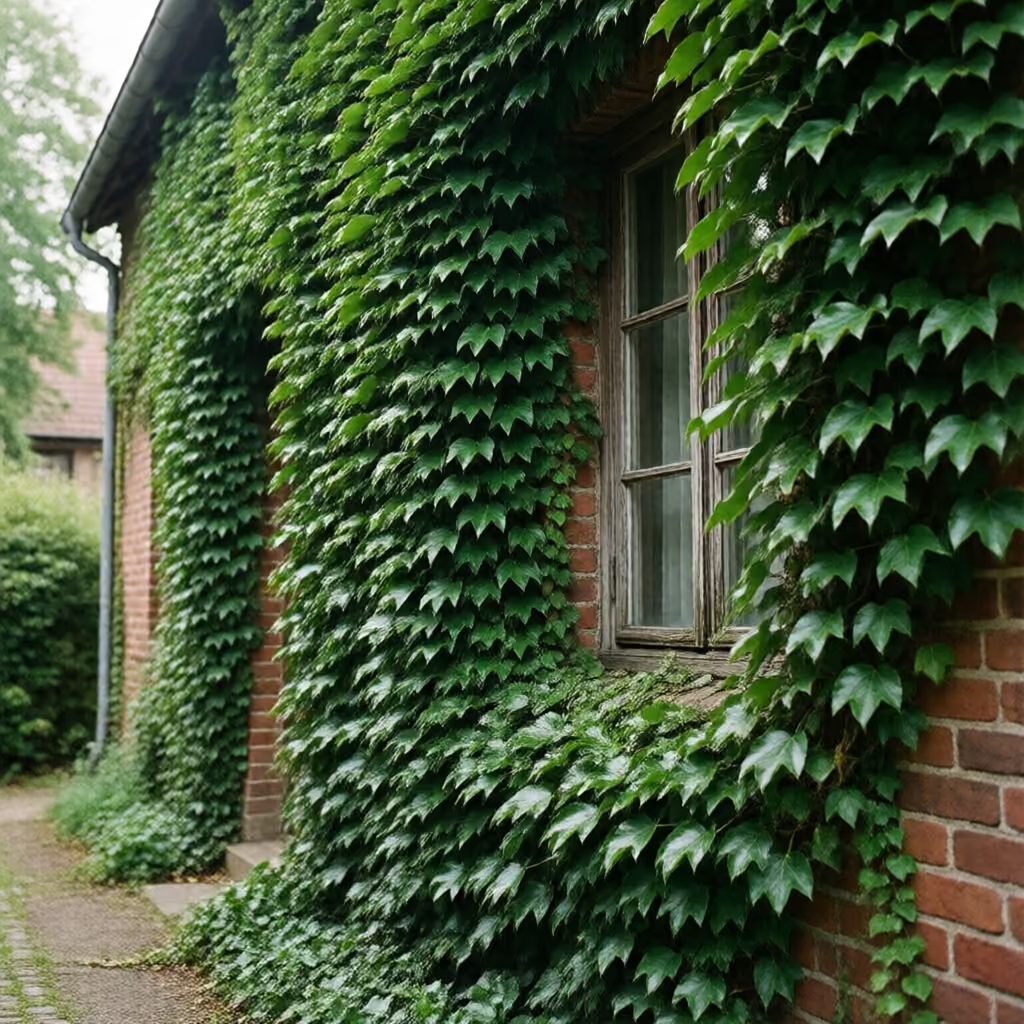
Der Efeu bedeckt inzwischen die gesamte Hauswand.
The ivy now covers the entire wall of the house.
ivy
der Efeu
Loading your saved state.
ivy
An evergreen climbing plant that grows up trees, walls, and other surfaces.
Der Efeu bedeckt inzwischen die gesamte Hauswand.
The ivy now covers the entire wall of the house.
| gender | masculine der |
|---|---|
| genitive | des Efeus |
| singular | plural | |
|---|---|---|
| nominative | der Efeu | – |
| accusative | den Efeu | – |
| dative | dem Efeu | – |
| genitive | des Efeus | – |
The article changes with the case; it is shown in colour.
To describe the growth of ivy, the verb 'ranken' (to climb or trail) is often used. The expression 'an einer Mauer emporranken' (to climb up a wall) describes upward movement; 'an' is followed by the dative here.
Der Efeu rankt an einer alten Steinmauer empor.
The ivy climbs up an old stone wall.
For surfaces on which ivy grows, 'mit Efeu bewachsen sein' (to be covered with ivy) is a typical expression. The surface is the subject of the sentence.
Die Rückseite der Garage ist dicht mit Efeu bewachsen.
The back of the garage is densely covered with ivy.
When talking about gardening, people often say 'Efeu pflanzen' (to plant ivy) or 'Efeu zurückschneiden' (to prune ivy). 'Zurückschneiden' describes shortening the shoots, for example when the plant is taking up too much space.
Wir müssen den Efeu zurückschneiden, damit er nicht vor das Fenster wächst.
We have to prune the ivy so that it doesn't grow in front of the window.