

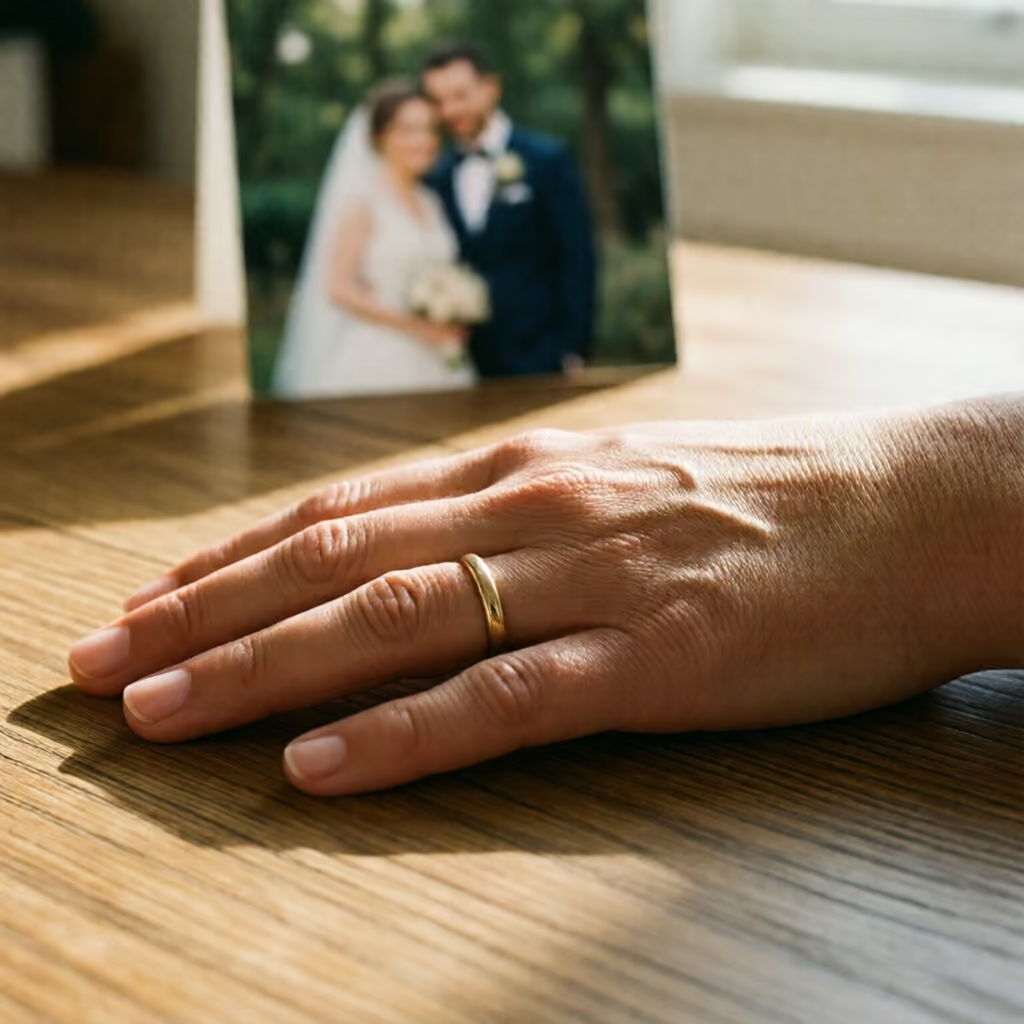
der Ehering
wedding ring
A ring worn by married people as a symbol of their marriage.
EXAMPLE
Sie trägt ihren Ehering seit ihrer Hochzeit jeden Tag.
She has worn her wedding ring every day since her wedding.
wedding ring
der Ehering, die Eheringe
Loading your saved state.
wedding ring
A ring worn by married people as a symbol of their marriage.
Sie trägt ihren Ehering seit ihrer Hochzeit jeden Tag.
She has worn her wedding ring every day since her wedding.
| gender | masculine der |
|---|---|
| plural | die Eheringe |
| genitive | des Eherings |
| singular | plural | |
|---|---|---|
| nominative | der Ehering | die Eheringe |
| accusative | den Ehering | die Eheringe |
| dative | dem Ehering | den Eheringen |
| genitive | des Eherings des Eheringes | der Eheringe |
The article changes with the case; it is shown in colour.
'Ehering' (wedding ring) is made up of 'Ehe' (marriage) and 'Ring' (ring). The base word 'Ring' refers to the object; 'Ehe' specifies that it is a ring associated with marriage.
Der Ehering meiner Großmutter ist aus Gold.
My grandmother's wedding ring is made of gold.
'Ehering' (wedding ring) is particularly often used with the verbs 'tragen' (to wear), 'anstecken' (to put on), 'abnehmen' (to take off), and 'verlieren' (to lose). During a wedding ceremony, the ring is put on; in everyday life, people wear it on their finger.
Bei der Trauung steckten sie sich gegenseitig den Ehering an.
During the wedding ceremony, they put the wedding rings on each other.
In Germany, married people usually wear their wedding ring on the ring finger of their right hand. In many other countries, such as the United Kingdom or the United States, people wear it on their left hand instead.
Wie in Deutschland üblich, trägt mein Vater den Ehering an der rechten Hand.
As is customary in Germany, my father wears his wedding ring on his right hand.