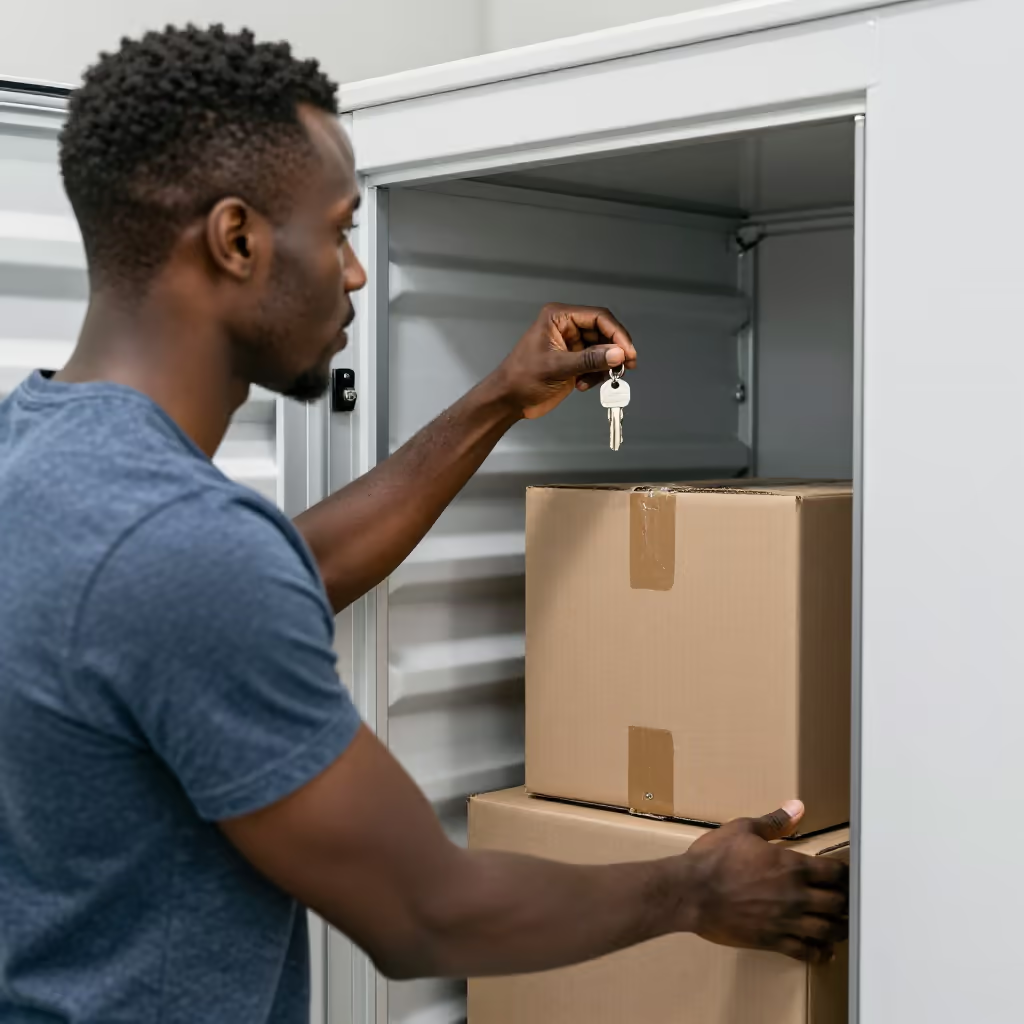
The legal relationship between a person and a thing that gives them full power of disposal over it. It describes the right to own something, use it, and make decisions about it.
example
Nach der letzten Ratenzahlung geht das Auto in mein Eigentum über.
After the final installment payment, the car passes into my ownership.

Usage tips
Word formation
'Eigentum' (property/ownership) is derived from the adjective 'eigen' (own). The ending '-tum' is often used in German to form abstract nouns from adjectives, as in 'Reichtum' (wealth, from 'reich' (rich)).
EXAMPLE
Das Adjektiv 'eigen' ist die Basis für das Nomen 'Eigentum'.
The adjective 'eigen' (own) is the basis for the noun 'Eigentum' (property/ownership).
Abstract vs. concrete
The word has an abstract and a concrete meaning. The abstract, legal meaning (m01) is uncountable. The concrete meaning (m02) refers to the totality of things that belong to a person.
EXAMPLE
Mit der letzten Rate geht das Fahrrad in dein Eigentum über.
With the final installment, the bicycle passes into your ownership.
Legal context
In its legal meaning, 'Eigentum' (ownership) is often used in fixed expressions. Examples are 'geistiges Eigentum' (intellectual property, e.g., for inventions or art) or the phrase 'in jemandes Eigentum übergehen' (to pass into someone's ownership).
EXAMPLE
Geistiges Eigentum ist durch das Urheberrecht geschützt.
Intellectual property is protected by copyright law.
Typical collocations
When 'Eigentum' (property) means the totality of possessions, it is often combined with possessive pronouns and adjectives like 'gesamt' (entire) or 'persönlich' (personal): 'mein gesamtes Eigentum' (all my property), 'ihr persönliches Eigentum' (her/their personal property).
EXAMPLE
Bitte achten Sie auf Ihr persönliches Eigentum.
Please look after your personal property.
Compare with
near_synonym · confusable
Eigentum vs Besitz
possession
'der Besitz' and 'das Eigentum' are very close in meaning, especially in everyday language. Both can refer to things that someone has. But the exact difference is important: 'Eigentum' emphasizes legal ownership. 'Besitz' can simply mean that someone actually has or uses something. That is why someone can have something in their possession without it being their property, for example a borrowed car. Learners often confuse the words because people sometimes speak imprecisely in everyday language. When it is about the legal right to something, 'Eigentum' is more precise; when it is about having or using something, 'Besitz' fits better.
Eigentum
Das Grundstück ist Eigentum von Herrn Weber, auch wenn seine Nachbarn es oft nutzen.
The plot of land is Mr. Weber's property, even though his neighbors often use it.
Besitz
Der Mietwagen ist nur für drei Tage in meinem Besitz.
The rental car is in my possession for only three days.