


der Eindruck
impression
The idea, feeling, or effect that a person or thing leaves with someone.
EXAMPLE
Der Bewerber hat beim Gespräch einen sehr positiven Eindruck gemacht.
The applicant made a very positive impression during the interview.
impression
Loading your saved state.
impression
The idea, feeling, or effect that a person or thing leaves with someone.
Der Bewerber hat beim Gespräch einen sehr positiven Eindruck gemacht.
The applicant made a very positive impression during the interview.

to have the impression
To have the feeling or suspicion that something is a certain way.
Ich habe den Eindruck, dass du mir nicht die ganze Wahrheit sagst.
I have the impression that you're not telling me the whole truth.
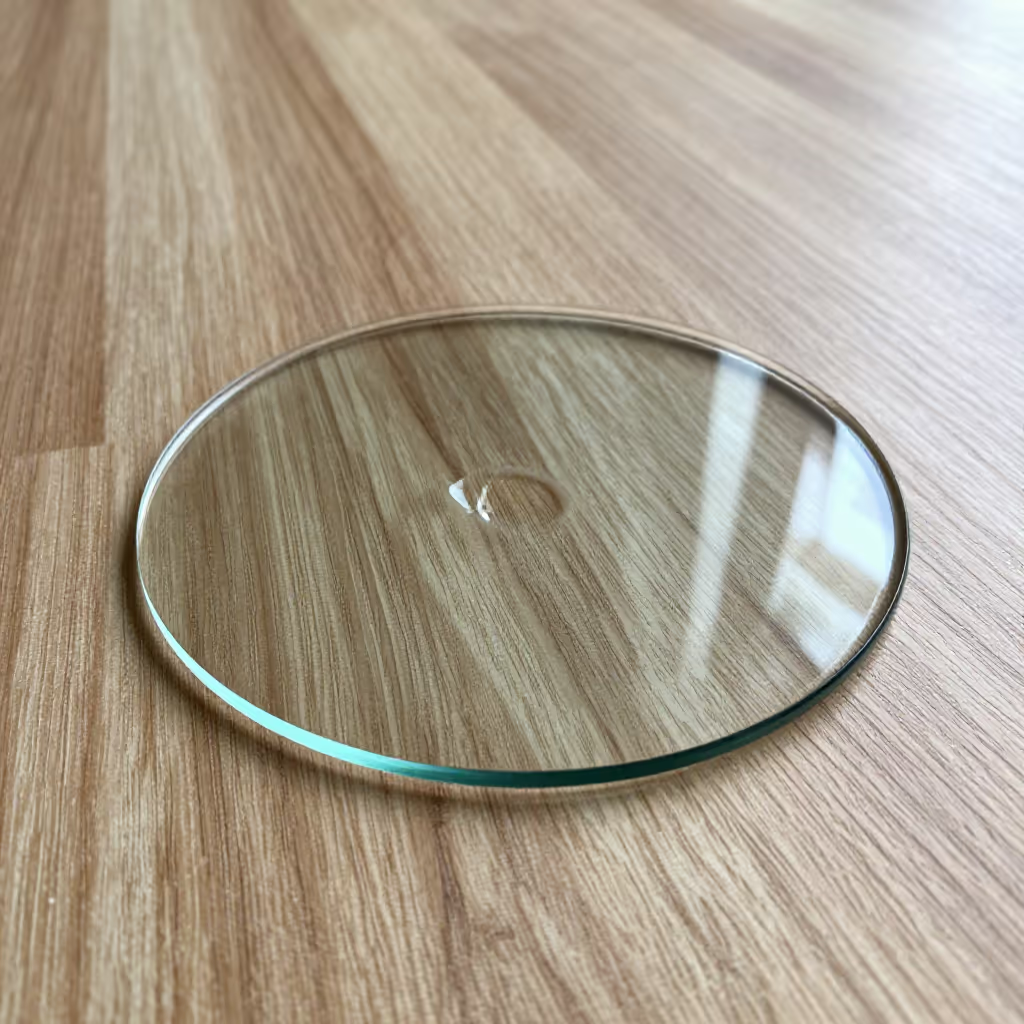
indentation / impression
A mark or depression made by pressure on a surface.
Im weichen Sand sah man deutlich den Eindruck seiner Fußspuren.
In the soft sand, the impressions of his footprints were clearly visible.
The word consists of 'ein' (in/into) and 'Druck' (pressure). Literally, it describes the 'pressure' that something leaves on a surface (a mark), or metaphorically the effect that a person has on someone else's mind.
Der schwere Schrank hat einen tiefen Eindruck im Teppich hinterlassen.
The heavy cabinet left a deep impression in the carpet.
To express how a person or thing comes across, the verbs 'machen' (to make) or 'hinterlassen' (to leave) are often used. When forming an opinion about something, you 'gewinnt' (gain) or 'bekommt' (get) an impression.
Die neue Kollegin hat einen kompetenten Eindruck gemacht.
The new colleague made a competent impression.
When you want to say on whom a person or thing makes an impression, use the preposition 'auf' (on) with the accusative.
Sein Vortrag hat auf die Zuhörer einen großen Eindruck gemacht.
His lecture made a big impression on the audience.
The phrase 'den Eindruck haben' (to have the impression) is a fixed expression. It is often combined with a 'dass' clause or an infinitive construction with 'zu' to express a suspicion or assumption.
Ich habe den Eindruck, dass er müde ist.
I have the impression that he is tired.
The literal meaning of a physical mark is usually clear from context. It often appears together with materials or surfaces such as sand, snow, wax, or dough.
Man konnte die Eindrücke der Reifen im nassen Schlamm sehen.
You could see the impressions of the tires in the wet mud.
picture / image
An Eindruck is the immediate effect that a person or thing has on someone. A Bild is more the mental picture formed from it and can develop through further experiences. Eindruck fits the initial effect; Bild fits the overall picture that has formed.

Beim ersten Gespräch hatte Lea einen guten Eindruck von ihrem neuen Chef.
During their first conversation, Lea got a good impression of her new boss.
Nach einem Jahr Zusammenarbeit hat Lea ein klares Bild von ihrem neuen Chef.
After a year of working together, Lea has a clear picture of her new boss.