
An impression, feeling, or perception that arises in the mind through external influences.
example
Die Reise nach Japan hinterließ bei mir viele unvergessliche Impressionen.
The trip to Japan left me with many unforgettable impressions.
Usage tips
International word
'Impression' is an international word that comes from Latin. You can find it in a similar form in many languages, for example in English or French. This makes it easier to recognize and understand.
EXAMPLE
Die Architektur der Stadt hinterließ eine bleibende Impression.
The architecture of the city left a lasting impression.
Register
The word 'Impression' is often used in an elevated, poetic, or educated context to describe a subjective impression.
EXAMPLE
In seinem Reisetagebuch hielt er seine persönlichen Impressionen fest.
In his travel diary, he recorded his personal impressions.
Typical collocations
Common verbs used with 'Impression' are 'Impressionen sammeln' (to gather impressions), 'eine Impression gewinnen' (to gain an impression), or 'eine Impression hinterlassen' (to leave an impression).
EXAMPLE
Auf der Messe konnten wir viele neue Impressionen sammeln.
At the trade fair, we were able to gather many new impressions.
Context clue
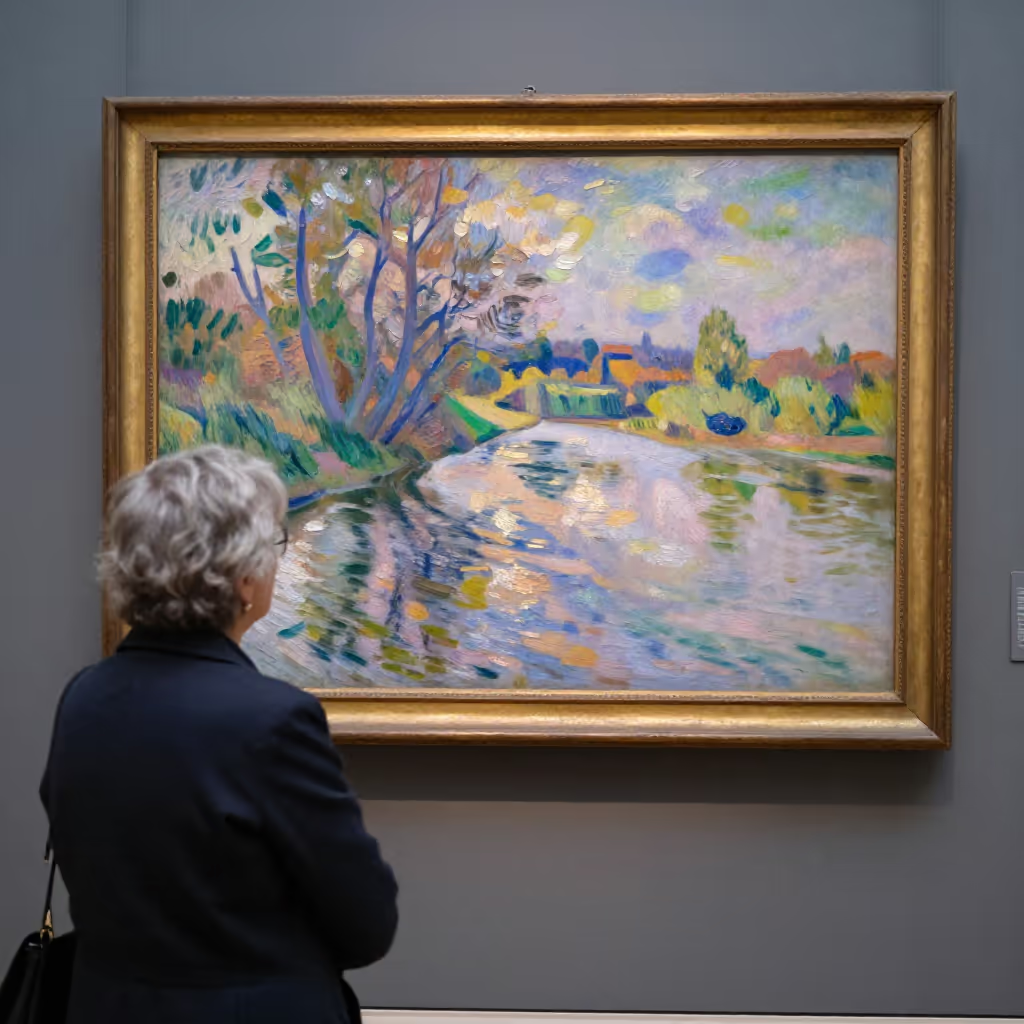
When art, painters, museums, or the art movement 'Impressionismus' (Impressionism) are being discussed, 'Impression' refers to a work of art in this style.
EXAMPLE
Das Museum besitzt mehrere frühe Impressionen des Künstlers.
The museum owns several early impressions by the artist.
Compare with
near_synonym · confusable
Impression vs Gefühl
feeling / sense
'das Gefühl' and 'die Impression' can both describe what arises in a person when they experience or perceive something. 'das Gefühl' is much more common in everyday language and works well for real emotions such as fear, joy, or uncertainty. It can also be a hunch. 'die Impression' more often means an impression created by something external, for example by a place, an image, or a mood. The word sounds a bit more elevated and often appears in art, travel, or reports. Learners may confuse the words because both describe something internal. As a practical rule: for personal emotions, you usually use 'Gefühl'; for a fleeting impression from outside, 'Impression' is more likely.
Impression
Die Fotos aus Paris geben eine schöne Impression vom Leben in der Stadt.
The photos from Paris give a lovely impression of life in the city.
Gefühl
Nach dem Gespräch hatte sie das Gefühl, dass etwas nicht stimmt.
After the conversation, she had the feeling that something was wrong.