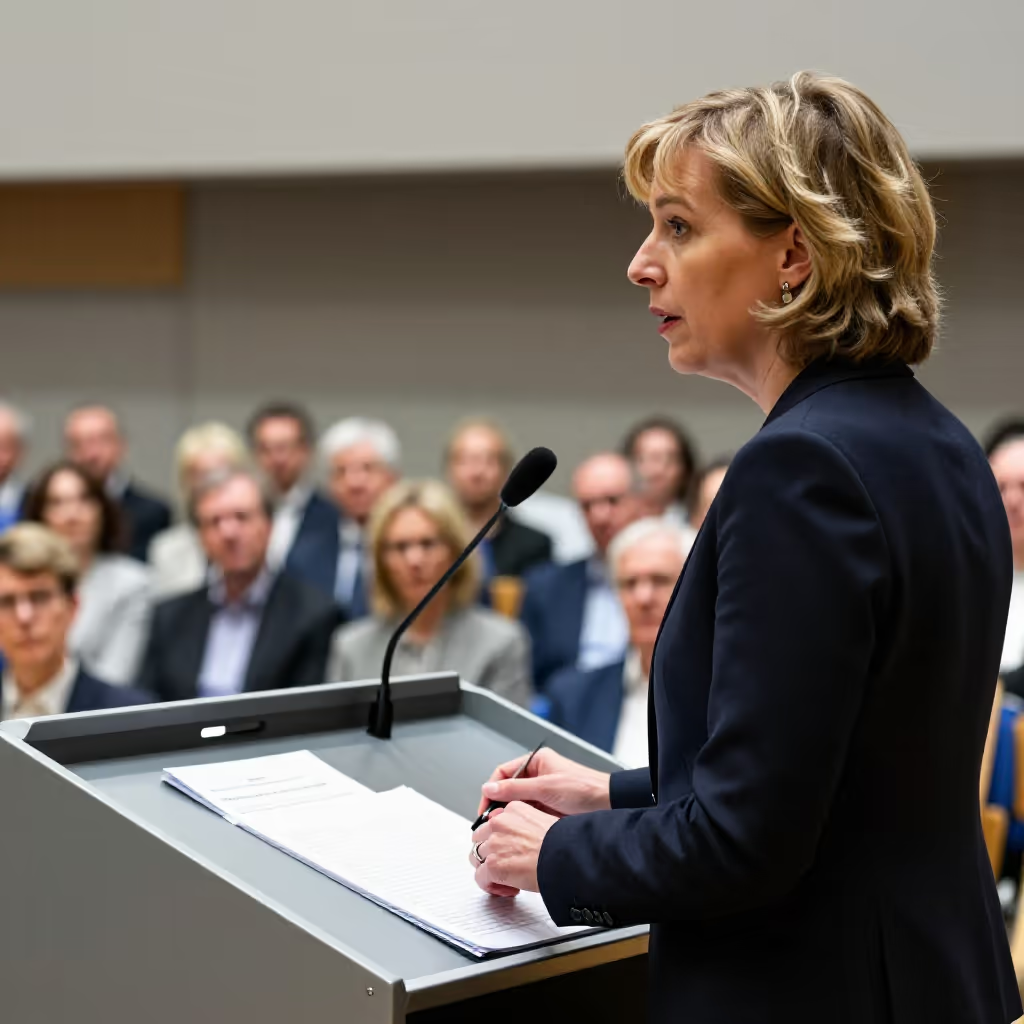
Indicates the beginning of something, either in time or in a text or speech. It is a more formal variant of 'am Anfang' (at the beginning).
example
Eingangs möchte ich allen für ihr Kommen danken.
At the beginning, I would like to thank everyone for coming.

Usage tips
Word structure
The word 'eingangs' (at the beginning/at the entrance) is derived from the noun 'der Eingang' (the entrance). The ending '-s' forms an adverb here, similar to 'abends' (in the evenings) or 'morgens' (in the mornings). The basic meaning 'at the entrance' is preserved in both uses, once spatially and once figuratively for the beginning of a text or speech.
EXAMPLE
Eingangs des Tals befindet sich ein kleiner See.
At the entrance to the valley there is a small lake.
Sentence position
When 'eingangs' (at the beginning) is at the beginning of a main clause (position 1), the verb follows directly after it in position 2. The subject of the sentence then moves behind the verb.
EXAMPLE
Eingangs wurde die Tagesordnung vorgestellt.
At the beginning, the agenda was presented.
Register
'Eingangs' (at the beginning) is a formal word that is mainly used in written language, in speeches, or in formal contexts. In normal conversation, people would more likely say 'am Anfang' (at the beginning).
EXAMPLE
Eingangs seiner Rede betonte der Präsident die Wichtigkeit des Themas.
At the beginning of his speech, the president emphasized the importance of the topic.
Context clue
You can almost always recognize the spatial meaning by the fact that 'eingangs' (at the entrance) is used with a genitive object. This object describes the place whose entrance is meant.
EXAMPLE
Eingangs des Gebäudes müssen alle Besucher ihre Taschen vorzeigen.
At the entrance to the building, all visitors must show their bags.
Compare with
near_synonym · confusable
eingangs vs zunächst
first / for now
'zunächst' and 'eingangs' can both mark the beginning. 'zunächst' is general and fits well when describing the first step in an action. 'eingangs' sounds more formal and is used especially in texts, speeches, meetings, or explanations. It means roughly 'at the beginning of it'. The words can be confused because both point to the beginning. In everyday language, 'zunächst' is usually more natural; 'eingangs' fits better when someone mentions something at the beginning of a text or conversation.
eingangs
Eingangs hat die Ärztin erklärt, warum die Untersuchung wichtig ist.
At the beginning, the doctor explained why the examination was important.
zunächst
Lea gießt zunächst die Pflanzen auf dem Balkon und räumt danach die Küche auf.
Lea first waters the plants on the balcony and then tidies up the kitchen.