

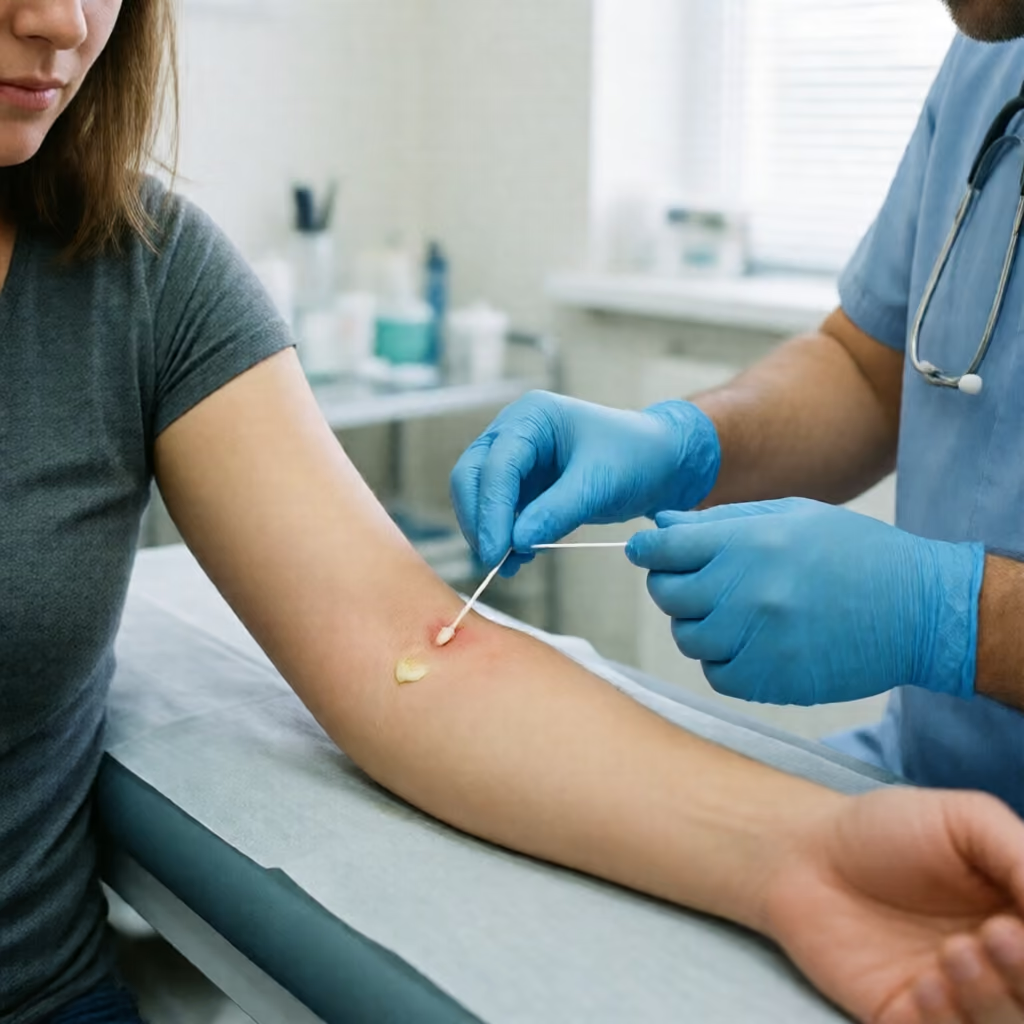
der Eiter
pus
A thick, yellowish-white fluid that can form in the body during inflammation or infection and consists of dead cells, bacteria, and tissue fluid.
EXAMPLE
Aus der entzündeten Wunde trat Eiter aus.
Pus came out of the infected wound.
pus
der Eiter
Loading your saved state.
pus
A thick, yellowish-white fluid that can form in the body during inflammation or infection and consists of dead cells, bacteria, and tissue fluid.
Aus der entzündeten Wunde trat Eiter aus.
Pus came out of the infected wound.
| gender | masculine der |
|---|---|
| genitive | des Eiters |
| singular | plural | |
|---|---|---|
| nominative | der Eiter | – |
| accusative | den Eiter | – |
| dative | dem Eiter | – |
| genitive | des Eiters | – |
The article changes with the case; it is shown in colour.
The verbs 'sich bilden' (to form), 'austreten' (to leak out), and 'abfließen' (to drain away) are often used with 'Eiter' (pus). The expression 'eine Wunde eitert' (a wound is oozing pus) is also common in medical contexts.
Unter dem Verband hatte sich Eiter gebildet.
Pus had formed under the bandage.
With 'Eiter' (pus), the location is often indicated using 'aus' (out of) or 'in' (in): 'Eiter aus einer Wunde' (pus from a wound) describes the source, while 'Eiter in einer Wunde' (pus in a wound) describes where it is located.
Der Arzt entdeckte Eiter in der kleinen Wunde.
The doctor discovered pus in the small wound.
Die Ärztin ließ den Eiter aus dem Abszess ab.
The doctor let the pus drain from the abscess.
'Eiter' (pus) is mainly part of the vocabulary related to wounds, inflammation, and infections. In factual descriptions, the word is often used together with information about color, quantity, or smell.
Die Krankenschwester bemerkte gelblichen Eiter an der Wunde.
The nurse noticed yellowish pus on the wound.