


endlich
finally
Expresses that something happens after a long wait, a delay, or a lot of effort. It is often associated with relief.
EXAMPLE
Endlich bist du da, wir haben schon auf dich gewartet!
You're finally here; we've been waiting for you!
finally / finite
Loading your saved state.
finally
Expresses that something happens after a long wait, a delay, or a lot of effort. It is often associated with relief.
Endlich bist du da, wir haben schon auf dich gewartet!
You're finally here; we've been waiting for you!

finite
Means that something is limited and has an end; the opposite of infinite.
Das menschliche Leben ist endlich und sollte daher wertgeschätzt werden.
Human life is finite and should therefore be valued.
The word is derived from 'das Ende' (the end). This origin explains both meanings: reaching the 'Ende' (end) of a waiting period ('endlich!' — finally!) and having an 'Ende' (end), as in something being finite.
Endlich ist das Projekt fertig!
The project is finally finished!
You can recognize the meaning from its function in the sentence. As an adverb, it expresses relief ('Endlich ist Wochenende!' — It's finally the weekend!). As an adjective, it describes that something is limited ('Unsere Zeit ist endlich.' — Our time is finite.).
Endlich scheint die Sonne wieder.
The sun is finally shining again.
In the meaning 'schließlich' (finally), 'endlich' almost always conveys a strong emotion such as relief, joy, or even impatience. It emphasizes that one has waited a long time for something.
Der Zug kommt endlich, ich friere schon seit einer halben Stunde.
The train is finally coming; I've been freezing for half an hour.
The meaning 'begrenzt' (limited/finite) is used mainly in formal, philosophical, or scientific contexts. In everyday language, this usage is less common.
Die Anzahl der möglichen Lösungen ist endlich.
The number of possible solutions is finite.
finally / after all
Both words can express that something happens at the end of a longer process. „Endlich“ usually emphasizes relief or impatience after waiting. „Schließlich“ is more neutral and indicates the endpoint of a process or a final conclusion. Use „endlich“ when there is a strong sense of anticipation and „schließlich“ for a matter-of-fact sequence of events.
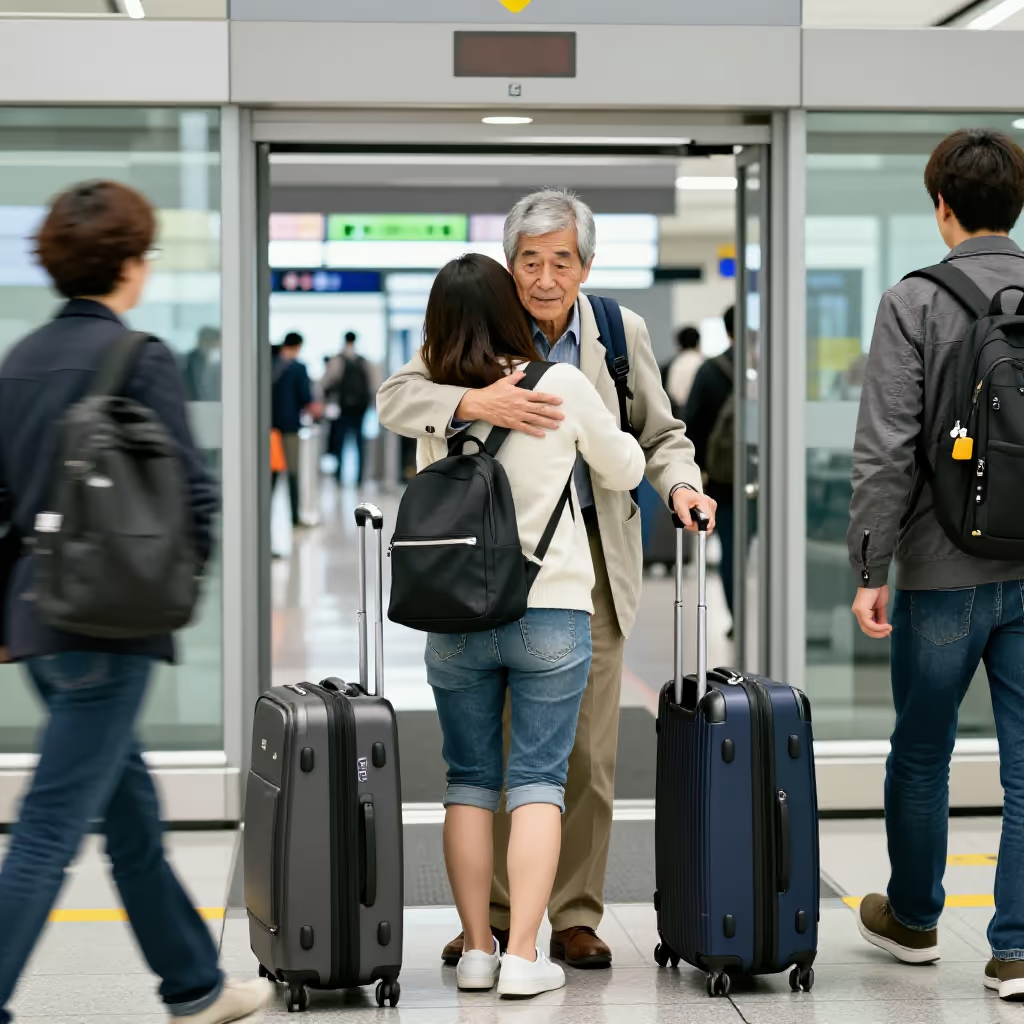
Nach drei Stunden Wartezeit kam der Bus endlich.
After waiting for three hours, the bus finally arrived.
Nach mehreren Versuchen gelang der Start schließlich.
After several attempts, the launch eventually succeeded.