

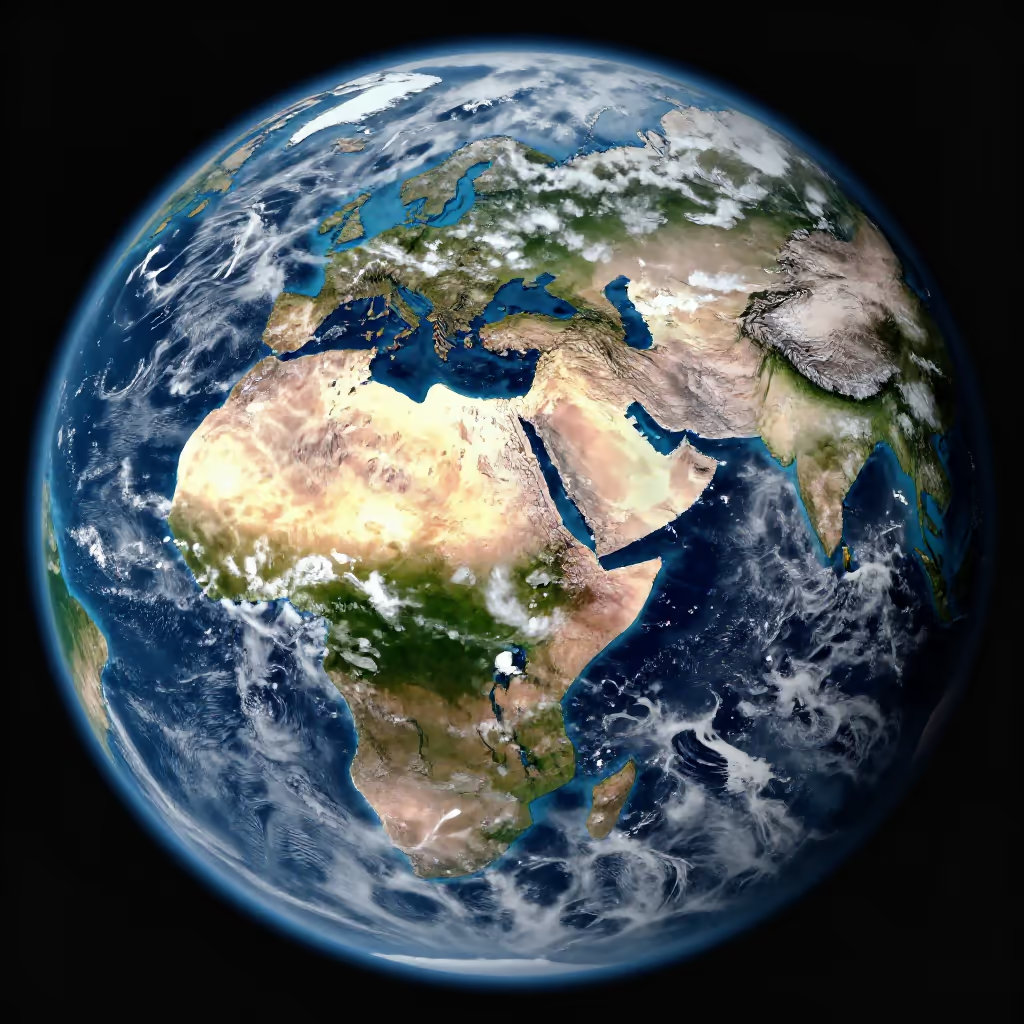
The outermost layer of planet Earth, including both the landmasses and the surface of the oceans, lakes, and rivers.
example
Rund 71 Prozent der Erdoberfläche sind von Wasser bedeckt.
Around 71 percent of Earth's surface is covered by water.

Usage tips
Compound word
This word is composed of 'die Erde' (the Earth) and 'die Oberfläche' (the surface). The gender of the word ('die') comes from the final component, 'die Oberfläche'.
EXAMPLE
Die Oberfläche des Tisches ist glatt.
The surface of the table is smooth.
Typical prepositions
To describe a position, use 'an der Erdoberfläche' (at/on Earth's surface) for things that are on it, and 'unter der Erdoberfläche' (below Earth's surface) for things that lie beneath it.
EXAMPLE
Die Temperatur an der Erdoberfläche ist heute sehr hoch.
The temperature at Earth's surface is very high today.
Usage context
'Erdoberfläche' (Earth's surface) is a factual and geographical term. It is often found in texts about science, geology, or outer space.
EXAMPLE
Vulkane transportieren Magma aus dem Erdinneren an die Erdoberfläche.
Volcanoes transport magma from Earth's interior to Earth's surface.
Compare with
near_synonym · confusable
Erdoberfläche vs Boden
floor / ground
'der Boden' and 'die Erdoberfläche' can both refer to a surface that belongs to the earth. But 'Boden' is much more everyday and is thought of on a smaller scale: you stand on the 'Boden', wipe the 'Boden', or plant something in the 'Boden'. 'Erdoberfläche' means the outer surface of the entire planet, including land and bodies of water. The word fits more in geography, natural science, or large-scale contexts. They can be confused because both describe something beneath or around us. In everyday life, people usually say 'Boden'; for global or scientific topics, 'Erdoberfläche' is more common.
Erdoberfläche
Satelliten beobachten Veränderungen auf der Erdoberfläche.
Satellites observe changes on Earth's surface.
Boden
Nach dem Regen ist der Boden im Garten sehr weich.
After the rain, the soil in the garden is very soft.