

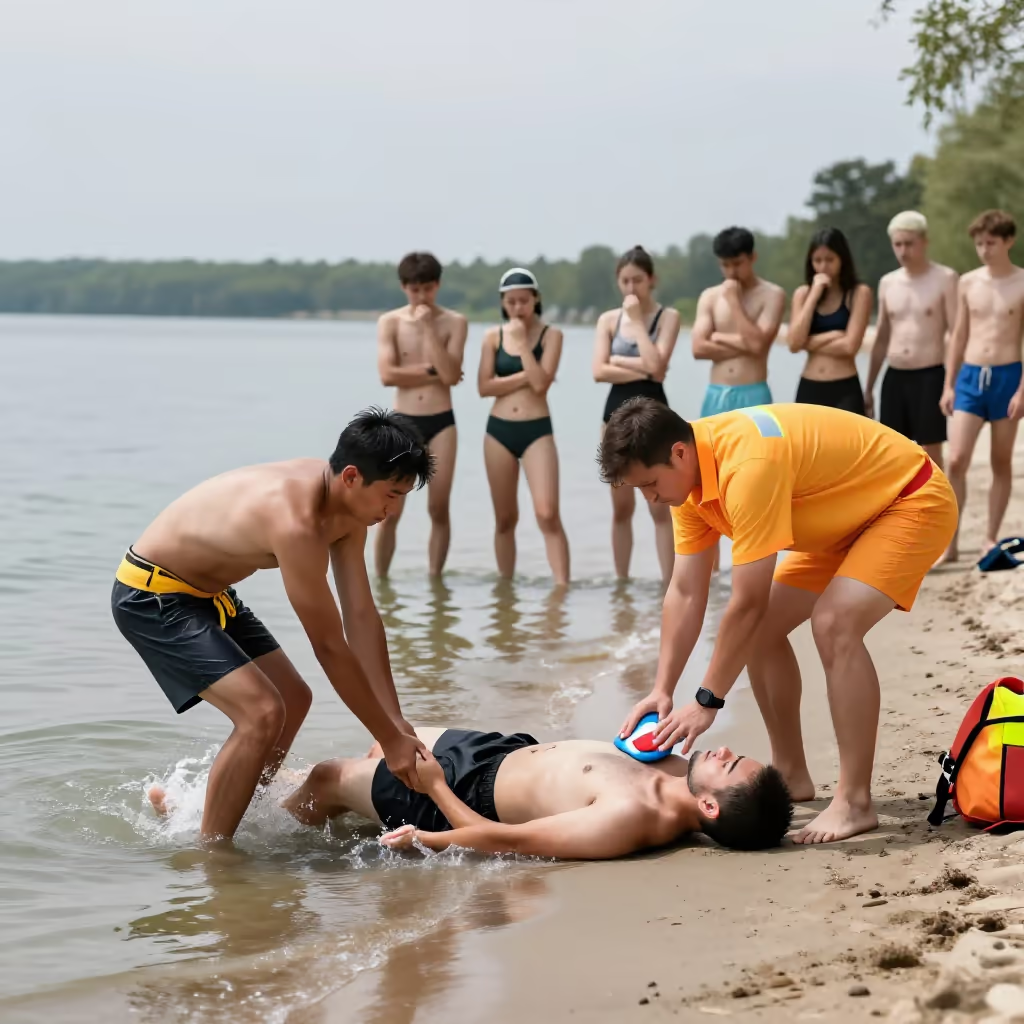
ertrinken
to drown
To die by suffocating in water or another liquid.
EXAMPLE
Ohne die schnelle Hilfe des Rettungsschwimmers wäre der Junge im See ertrunken.
Without the lifeguard's quick help, the boy would have drowned in the lake.
to drown
Loading your saved state.
to drown
To die by suffocating in water or another liquid.
Ohne die schnelle Hilfe des Rettungsschwimmers wäre der Junge im See ertrunken.
Without the lifeguard's quick help, the boy would have drowned in the lake.

to drown
Figuratively, to be completely overwhelmed or covered by something.
Seit der Beförderung hat er das Gefühl, in Arbeit zu ertrinken.
Since the promotion, he has felt like he is drowning in work.
The prefix 'er-' often indicates a final or fatal result of an action. 'Ertrinken' (to drown) follows this pattern, derived from 'trinken' (to drink), and describes death by liquid.
Viele Insekten ertrinken nach einem starken Regen in Pfützen.
Many insects drown in puddles after heavy rain.
Since 'ertrinken' (to drown) describes a change of state (from life to death), the perfect tense is always formed with the auxiliary verb 'sein' (to be).
Der Mann ist bei dem Bootsunfall beinahe ertrunken.
The man nearly drowned in the boating accident.
Whether the literal or figurative meaning is meant can be recognized from context. If the verb refers to a liquid such as water, it is literal. If it refers to an abstract concept such as work or worries, it is figurative.
Im kalten Wasser des Flusses ist ein Reh ertrunken.
A deer drowned in the cold water of the river.
In the figurative meaning, 'ertrinken' (to drown) is often combined with the preposition 'in' and abstract nouns. Common expressions are 'in Arbeit ertrinken' (to drown in work), 'in Schulden ertrinken' (to drown in debt), or 'in Selbstmitleid ertrinken' (to drown in self-pity).
Nach der Gründung ihrer Firma ertrank sie förmlich in Arbeit.
After founding her company, she was practically drowning in work.
to sink
Someone who is „ertrinken“ in work feels overwhelmed by its amount. Someone who is „versinken“ in work is concentrating on it so intensely that their surroundings become unimportant. „Ertrinken“ therefore emphasizes overload, while „versinken“ emphasizes becoming deeply absorbed in the activity.

Vor dem Abgabetermin ertrinkt Mia in Arbeit und schafft kaum alle Aufgaben.
With the deadline approaching, Mia is drowning in work and can barely finish all the tasks.
Vor dem Abgabetermin versinkt Mia in ihrer Arbeit und vergisst die Zeit.
With the deadline approaching, Mia is absorbed in her work and loses track of time.