

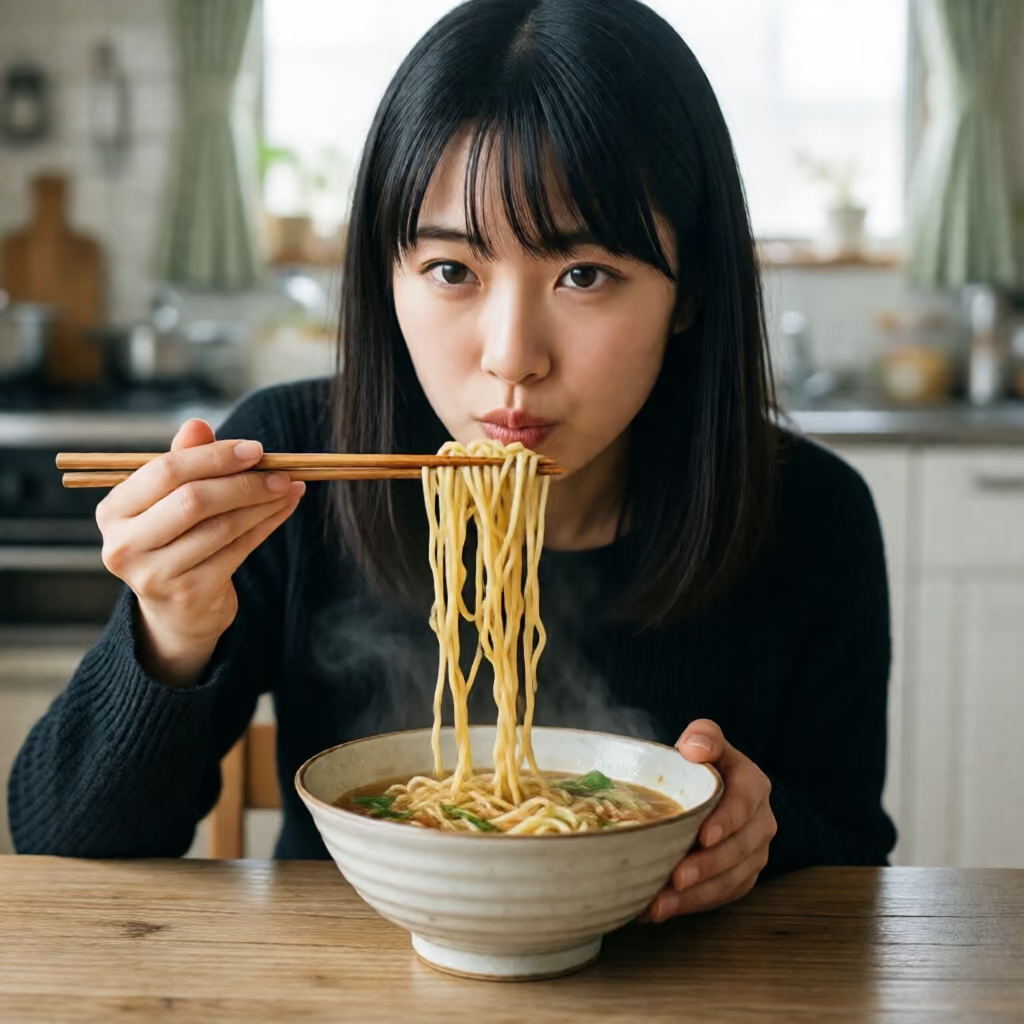
das Essstäbchen
chopstick
One of two slender sticks used to pick up food and bring it to the mouth, especially in East Asian countries.
EXAMPLE
Sie isst die Nudeln mit Essstäbchen.
She eats the noodles with chopsticks.
chopstick
das Essstäbchen, die Essstäbchen
Loading your saved state.
chopstick
One of two slender sticks used to pick up food and bring it to the mouth, especially in East Asian countries.
Sie isst die Nudeln mit Essstäbchen.
She eats the noodles with chopsticks.
| gender | neuter das |
|---|---|
| plural | die Essstäbchen |
| genitive | des Essstäbchens |
| singular | plural | |
|---|---|---|
| nominative | das Essstäbchen | die Essstäbchen |
| accusative | das Essstäbchen | die Essstäbchen |
| dative | dem Essstäbchen | den Essstäbchen |
| genitive | des Essstäbchens | der Essstäbchen |
The article changes with the case; it is shown in colour.
'Essstäbchen' (chopstick) consists of 'Ess-' (eating) and 'Stäbchen' (little stick). 'Ess-' refers to eating and explains what the sticks are used for.
Im Restaurant liegen die Essstäbchen neben der Schüssel.
The chopsticks are next to the bowl in the restaurant.
To name the utensil used for eating, use 'mit' (with) and the dative. The typical phrase is 'mit Essstäbchen essen' (to eat with chopsticks), usually without an article.
Kannst du mit Essstäbchen essen?
Can you eat with chopsticks?
Since two chopsticks are used together for eating, the phrase 'ein Paar Essstäbchen' (a pair of chopsticks) is common. You can use it, for example, to ask for a complete set for one person in a restaurant.
Könnten Sie mir bitte ein Paar Essstäbchen bringen?
Could you please bring me a pair of chopsticks?