

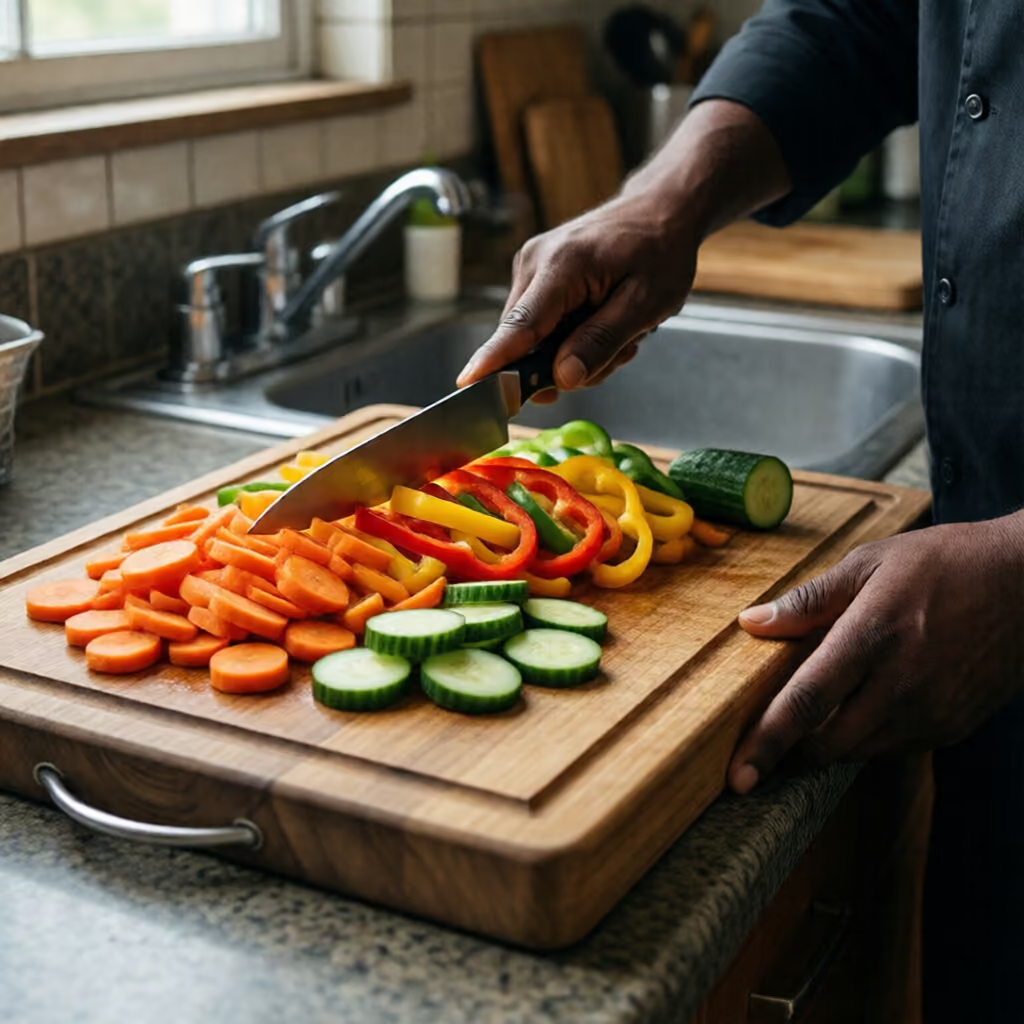
das Schneidebrett
cutting board
A sturdy, flat surface on which you cut food with a knife.
Ich lege das Gemüse auf das Schneidebrett und schneide es in kleine Stücke.
I put the vegetables on the cutting board and cut them into small pieces.
cutting board
das Schneidebrett, die Schneidebretter
Loading your saved state.

cutting board
A sturdy, flat surface on which you cut food with a knife.
Ich lege das Gemüse auf das Schneidebrett und schneide es in kleine Stücke.
I put the vegetables on the cutting board and cut them into small pieces.
| gender | neuter das |
|---|---|
| plural | die Schneidebretter |
| genitive | des Schneidebrettes |
| singular | plural | |
|---|---|---|
| nominative | das Schneidebrett | die Schneidebretter |
| accusative | das Schneidebrett | die Schneidebretter |
| dative | dem Schneidebrett | den Schneidebrettern |
| genitive | des Schneidebrettes des Schneidebretts | der Schneidebretter |
The article changes with the case; it is shown in colour.
In „Schneidebrett“ (cutting board), you can recognize the verb „schneiden“ (to cut) and the noun „Brett“ (board). The first part indicates the purpose, and the second part names the object: a board for cutting.
Zum Schneiden der Zwiebeln brauche ich ein Schneidebrett.
I need a cutting board to chop the onions.
When placing something on the surface, use „auf das Schneidebrett“ with the accusative. When stating where something is lying or being cut, use „auf dem Schneidebrett“ with the dative.
Sie legt den Käse auf das Schneidebrett.
She puts the cheese on the cutting board.
Sie schneidet den Käse auf dem Schneidebrett.
She cuts the cheese on the cutting board.
Common collocations include „ein Schneidebrett benutzen“ (to use a cutting board), „ein Schneidebrett gründlich reinigen“ (to clean a cutting board thoroughly), and „ein Schneidebrett aus Holz“ (a wooden cutting board). „Aus“ indicates the material.
Nach dem Kochen reinige ich das Schneidebrett aus Holz gründlich.
After cooking, I thoroughly clean the wooden cutting board.