

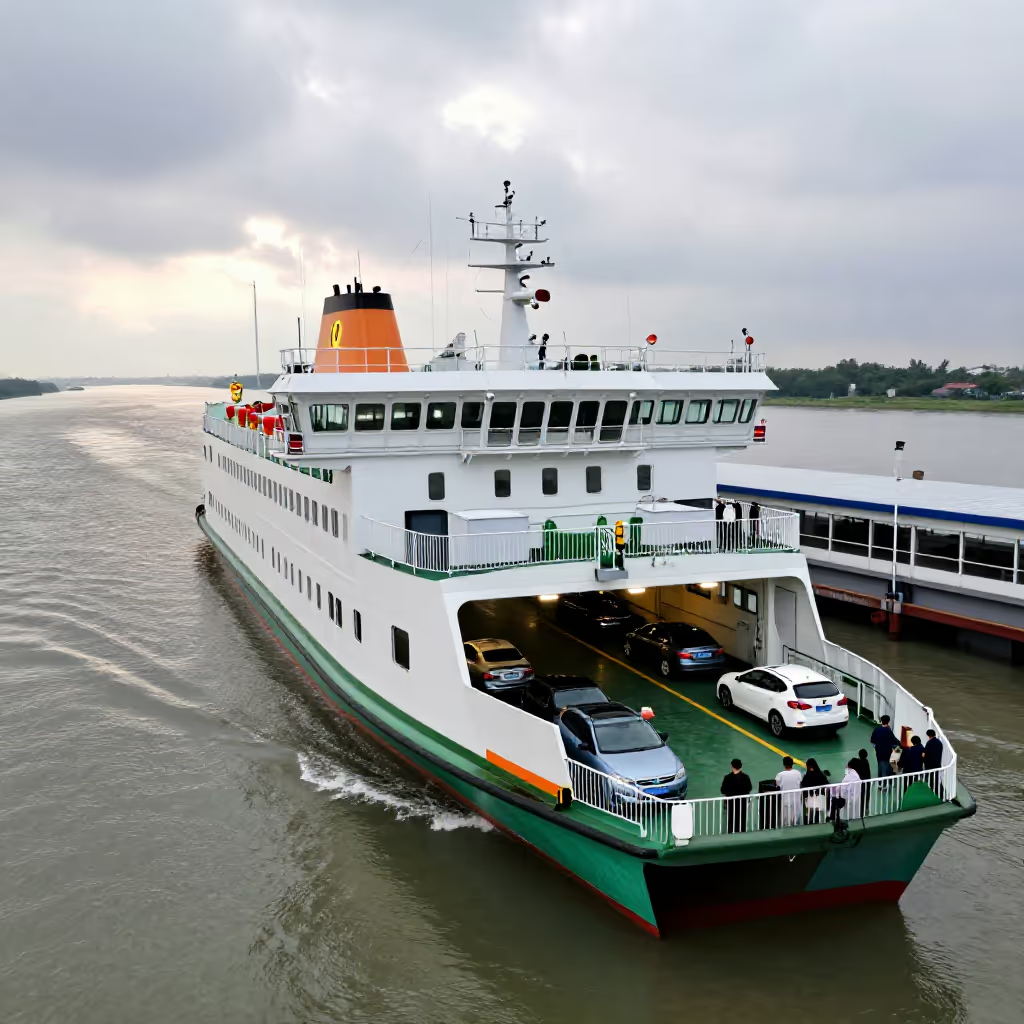
A ship or boat that transports people, vehicles, and goods across a body of water on a fixed schedule, for example across a river, a lake, or a strait.
example
Wir nehmen die Fähre, um auf die Insel zu gelangen.
We're taking the ferry to get to the island.
Usage tips
Word family
The word 'Fähre' (ferry) is closely related to the verb 'fahren' (to drive/go/travel). A ferry is a means of transport that 'fährt' (carries/transports) people and vehicles across the water.
EXAMPLE
Früher fuhren hier viel mehr Fähren über den Fluss.
In the past, many more ferries crossed the river here.
Correct preposition
To express that you use the ferry as a means of transport, you say 'mit der Fähre fahren' (to travel by ferry). When you are on the ship, you are 'auf der Fähre' (on the ferry).
EXAMPLE
Wir sind mit der Fähre nach England gefahren.
We traveled to England by ferry.
Typical verbs
Common verbs used with 'Fähre' (ferry) are 'die Fähre nehmen' (to take the ferry), 'auf die Fähre warten' (to wait for the ferry), or 'die Fähre verpassen' (to miss the ferry).
EXAMPLE
Wir müssen uns beeilen, sonst verpassen wir die letzte Fähre.
We have to hurry, or we'll miss the last ferry.
Compare with
near_synonym · confusable
Fähre vs Schiff
ship
'das Schiff' and 'die Fähre' both refer to a vehicle on the water. 'Schiff' is the more general term for a larger watercraft, for example for travel or transporting goods. 'Fähre' is more specific: it usually travels on a fixed route across a body of water according to a schedule and often carries people, cars, or bicycles. So you can see a ferry as a special kind of ship. The words can be confused if you only mean that something travels on water. If the regular connection across a river, lake, or strait is important, 'Fähre' fits better.
Fähre
Nach der Arbeit nimmt Jan die Fähre auf die andere Seite des Flusses.
After work, Jan takes the ferry to the other side of the river.
Schiff
Im Hafen liegt ein großes Schiff mit vielen Containern.
There is a large ship with many containers in the harbor.