

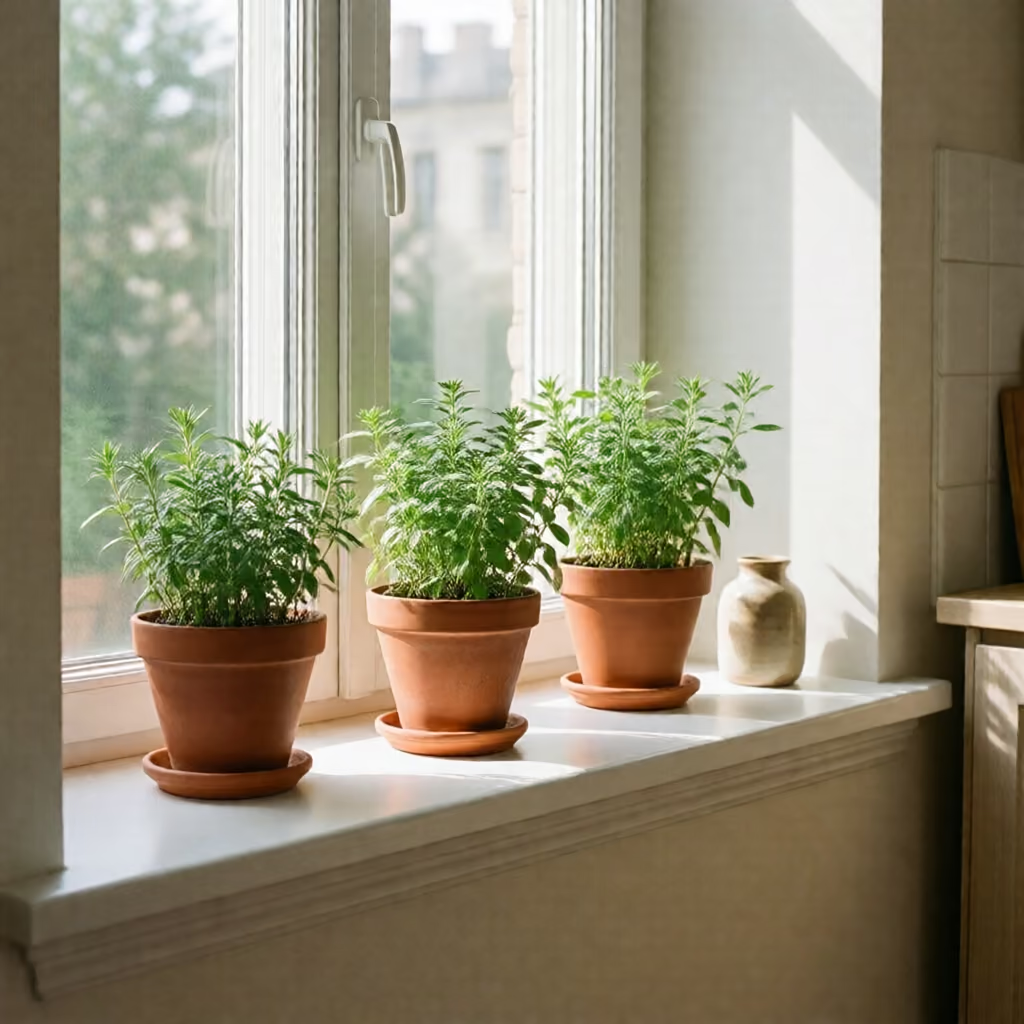
die Fensterbank
windowsill
A horizontal surface at the bottom of a window where you can place plants or other objects, for example.
EXAMPLE
Die Fensterbank ist breit genug für drei Blumentöpfe.
The windowsill is wide enough for three flowerpots.
windowsill
die Fensterbank, die Fensterbänke
Loading your saved state.
windowsill
A horizontal surface at the bottom of a window where you can place plants or other objects, for example.
Die Fensterbank ist breit genug für drei Blumentöpfe.
The windowsill is wide enough for three flowerpots.
| gender | feminine die |
|---|---|
| plural | die Fensterbänke |
| genitive | der Fensterbank |
| singular | plural | |
|---|---|---|
| nominative | die Fensterbank | die Fensterbänke |
| accusative | die Fensterbank | die Fensterbänke |
| dative | der Fensterbank | den Fensterbänken |
| genitive | der Fensterbank | der Fensterbänke |
The article changes with the case; it is shown in colour.
'Fensterbank' (windowsill) is made up of 'Fenster' (window) and 'Bank' (bench). The component 'Bank' helps you picture a long, narrow surface, but a windowsill is usually not intended for sitting on.
Auf der schmalen Fensterbank steht eine kleine Vase.
There is a small vase on the narrow windowsill.
Use 'auf' (on) for objects on this surface. A location takes the dative ('auf der Fensterbank' — on the windowsill), while a destination when placing something takes the accusative ('auf die Fensterbank' — onto the windowsill).
Die Kräutertöpfe stehen auf der Fensterbank.
The pots of herbs are on the windowsill.
Ich stelle die Kräutertöpfe auf die Fensterbank.
I put the pots of herbs on the windowsill.
When cleaning, 'die Fensterbank abwischen' (to wipe down the windowsill) and 'die Fensterbank putzen' (to clean the windowsill) are typical collocations. 'Feucht abwischen' (to wipe with a damp cloth) describes cleaning with a slightly wet cloth.
Nach dem Umtopfen wische ich die Fensterbank feucht ab.
After repotting the plants, I wipe down the windowsill with a damp cloth.