


der Fond
rear seat
The rear seating area in a passenger car.
EXAMPLE
Die Kinder saßen bequem im Fond und schauten einen Film.
The children sat comfortably in the rear seat and watched a film.
rear seat / stock / background
Loading your saved state.
rear seat
The rear seating area in a passenger car.
Die Kinder saßen bequem im Fond und schauten einen Film.
The children sat comfortably in the rear seat and watched a film.

stock
A concentrated broth made from meat, fish, or vegetables that is used in fine cuisine as a base for sauces and soups.
Für die Soße verwendete der Koch einen kräftigen Wildfond.
For the sauce, the chef used a rich game stock.
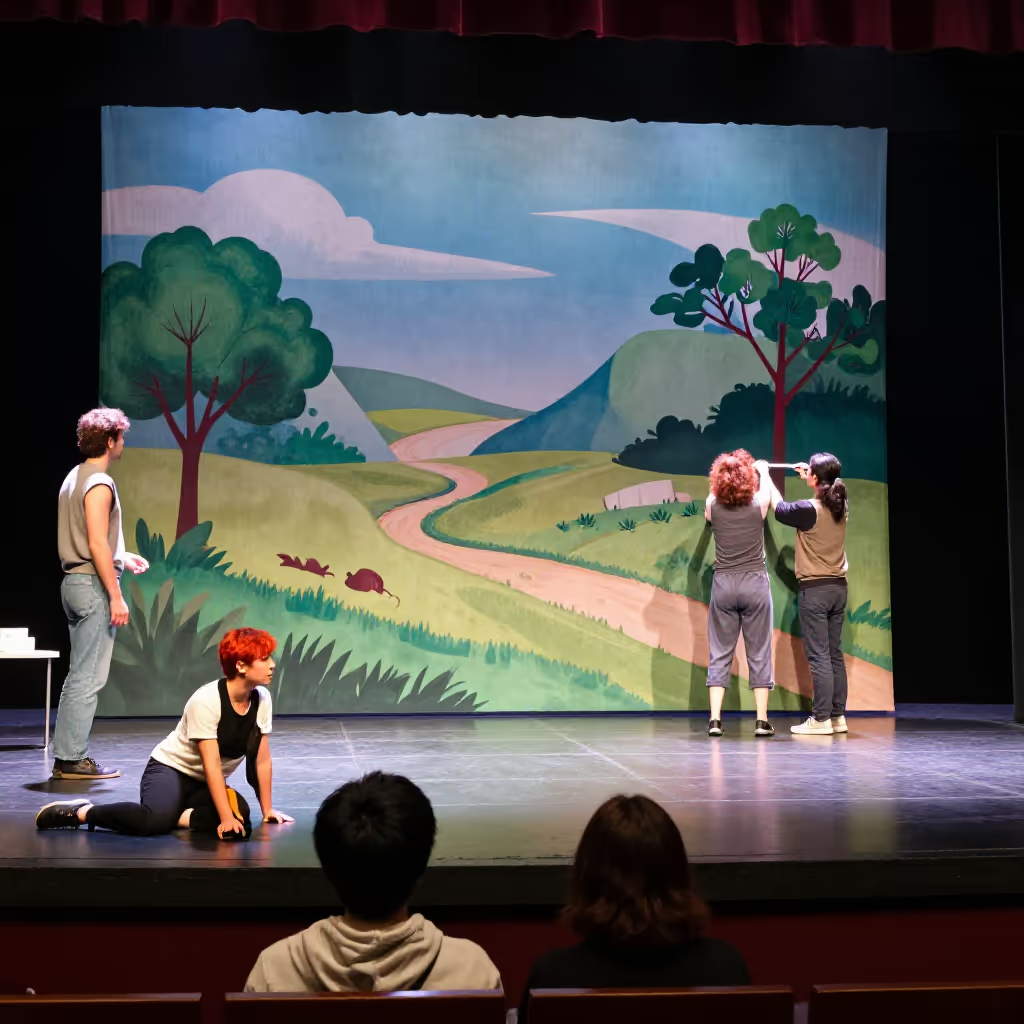
background
The background, especially in a painting, on a stage, or in an image. This meaning is rather rare today.
Auf dem alten Porträt hebt sich die Figur deutlich vom dunklen Fond ab.
In the old portrait, the figure stands out clearly against the dark background.
The word 'Fond' comes from French. Therefore, the final letter 'd' is not pronounced, and the vowel 'o' is pronounced nasally.
Bitte nehmen Sie im Fond Platz.
Please take a seat in the rear.
The three meanings are clearly separated by context. In connection with cars, it refers to the seating area; in cooking, to the broth; and in art, to the background.
Die Papiere liegen hinten im Fond des Wagens.
The papers are in the back, in the rear seat area of the car.
When referring to the seating area in a car, you use 'im Fond' (dative) for location and 'in den Fond' (accusative) for movement toward it.
Die Jacke liegt noch im Fond.
The jacket is still in the rear seat area.
In cooking, 'Fond' is often used in compounds such as 'Gemüsefond' (vegetable stock), 'Fischfond' (fish stock), or 'Kalbsfond' (veal stock). Typical verbs are 'einen Fond ansetzen' (to start/make a stock) or 'mit Fond ablöschen' (to deglaze with stock).
Der Braten wurde mit einem kräftigen Rinderfond abgelöscht.
The roast was deglazed with a rich beef stock.
The meaning 'Hintergrund' (background) is rare today. You find it almost only in art history or in descriptions of paintings and stage designs.
Das Porträt zeigt eine helle Figur vor einem dunklen Fond.
The portrait shows a bright figure against a dark background.
background
Hintergrund and Fond can both refer to the rear area of a painting or stage set. Hintergrund is the usual neutral choice. Fond is rare in this meaning and sounds like art terminology, so it is more appropriate in a specialist description.

Im Fond des Gemäldes erkennt die Kunsthistorikerin ein kleines Dorf.
The art historian recognizes a small village in the background of the painting.
Im Hintergrund des Gemäldes erkennt man ein kleines Dorf.
A small village can be seen in the background of the painting.