


der Hintergrund
background
The part of an image, stage, or scene that is farthest away from the viewer.
EXAMPLE
Im Hintergrund des Familienfotos kann man das Meer sehen.
In the background of the family photo, you can see the sea.
background
Loading your saved state.
background
The part of an image, stage, or scene that is farthest away from the viewer.
Im Hintergrund des Familienfotos kann man das Meer sehen.
In the background of the family photo, you can see the sea.

background
The hidden causes, connections, or circumstances of an event.
Die Journalisten recherchierten die politischen Hintergründe der Affäre.
The journalists investigated the political background of the affair.

background
A person's social origin, education, and previous experience.
Die Bewerberin hat einen beeindruckenden akademischen Hintergrund.
The applicant has an impressive academic background.
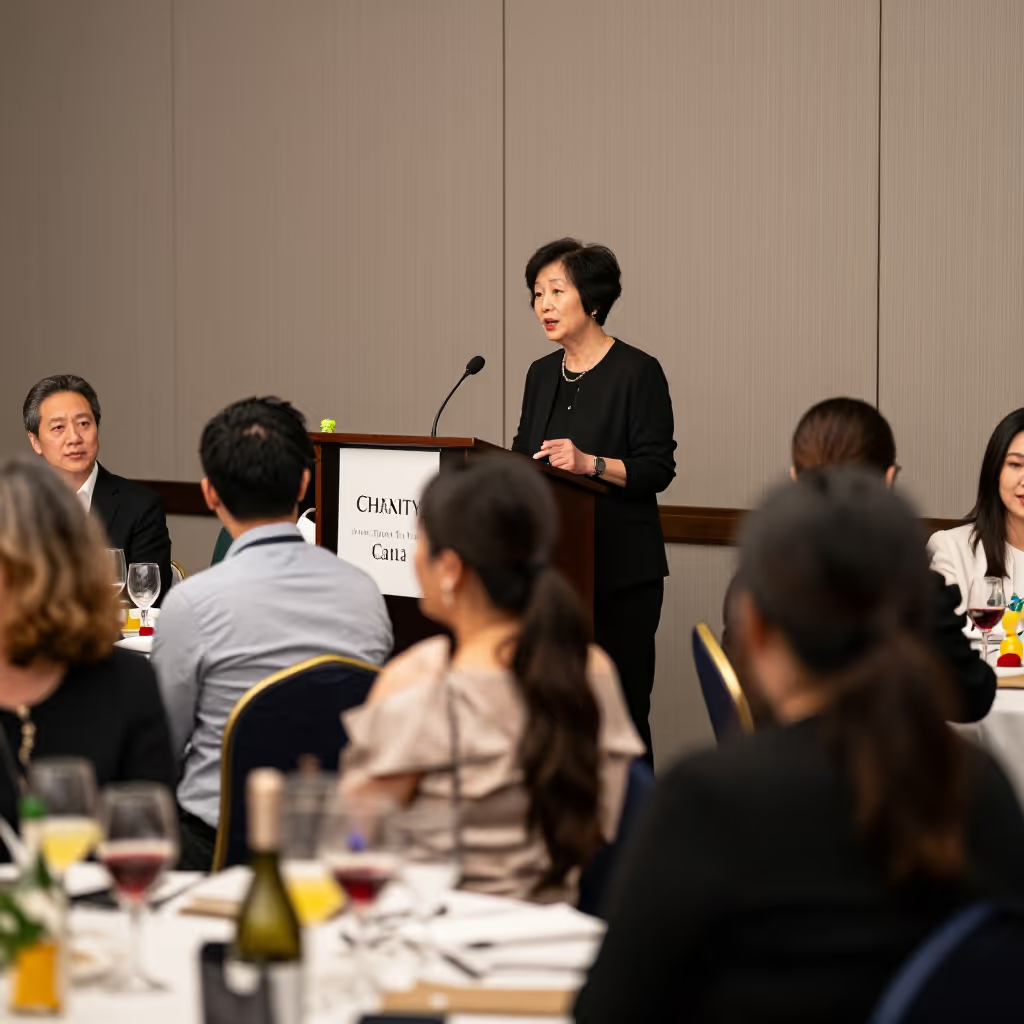
to stay in the background
To deliberately behave inconspicuously and not put oneself in the spotlight.
Während der Diskussion hielt er sich lieber im Hintergrund.
During the discussion, he preferred to stay in the background.

background
In computer technology, an area in which programs or processes run without being directly visible.
Das Antivirenprogramm läuft unbemerkt im Hintergrund.
The antivirus program runs unnoticed in the background.
The word is made up of 'hinter' (behind) and 'Grund' (ground, reason). This origin explains the different meanings: the visual background (what lies behind the main subject) and the causal background (the reasons behind an event).
Der wahre Hintergrund des Streits wurde erst später bekannt.
The true background of the dispute only became known later.
The preposition 'in' ('im Hintergrund' — in the background) usually describes a position or state. The preposition 'vor' ('vor dem Hintergrund' — against the background) is often used to give a context or reason for an event.
Im Hintergrund der Bühne stand ein Chor.
A choir stood in the background of the stage.
When it is about causes and connections, 'Hintergrund' (background) is often combined with adjectives such as 'politisch' (political), 'historisch' (historical), or 'wirtschaftlich' (economic). Typical verbs are 'aufklären' (to clarify), 'verstehen' (to understand), or 'recherchieren' (to research).
Ein Journalist deckte die wirtschaftlichen Hintergründe des Skandals auf.
A journalist uncovered the economic background of the scandal.
To describe a person's origin or experience, 'Hintergrund' (background) is often connected with 'akademisch' (academic), 'beruflich' (professional), or 'familiär' (family-related). A very common phrase is 'einen Migrationshintergrund haben' (to have a migration background).
Bewerber mit einem technischen Hintergrund werden bevorzugt.
Applicants with a technical background are preferred.
The expression 'sich im Hintergrund halten' (to stay in the background) is reflexive. This means the verb 'halten' (to hold/stay) is always used with a reflexive pronoun (mich, dich, sich, etc.) that matches the person.
Bei Familienfesten halte ich mich lieber im Hintergrund.
At family celebrations, I prefer to stay in the background.
In computer language, 'im Hintergrund' (in the background) describes processes that are not directly visible to the user. Typical verbs in this context are 'laufen' (to run) or 'ausführen' (to execute).
Während du arbeitest, laufen mehrere Updates im Hintergrund.
While you work, several updates are running in the background.
origin
„Herkunft“ refers to a person’s social, geographical, or family origin. „Hintergrund“ is broader and can include education and experiences in addition to social origin. Use „Herkunft“ for someone’s origin, and „Hintergrund“ for their entire life experience and knowledge.

Im Bewerbungsgespräch spricht Ana über ihren beruflichen Hintergrund und ihre bisherigen Erfahrungen.
During the job interview, Ana talks about her professional background and previous experience.
Im Bewerbungsgespräch spricht Ana über ihre Herkunft aus einer Arbeiterfamilie.
During the job interview, Ana talks about her origins in a working-class family.