

frisch
fresh
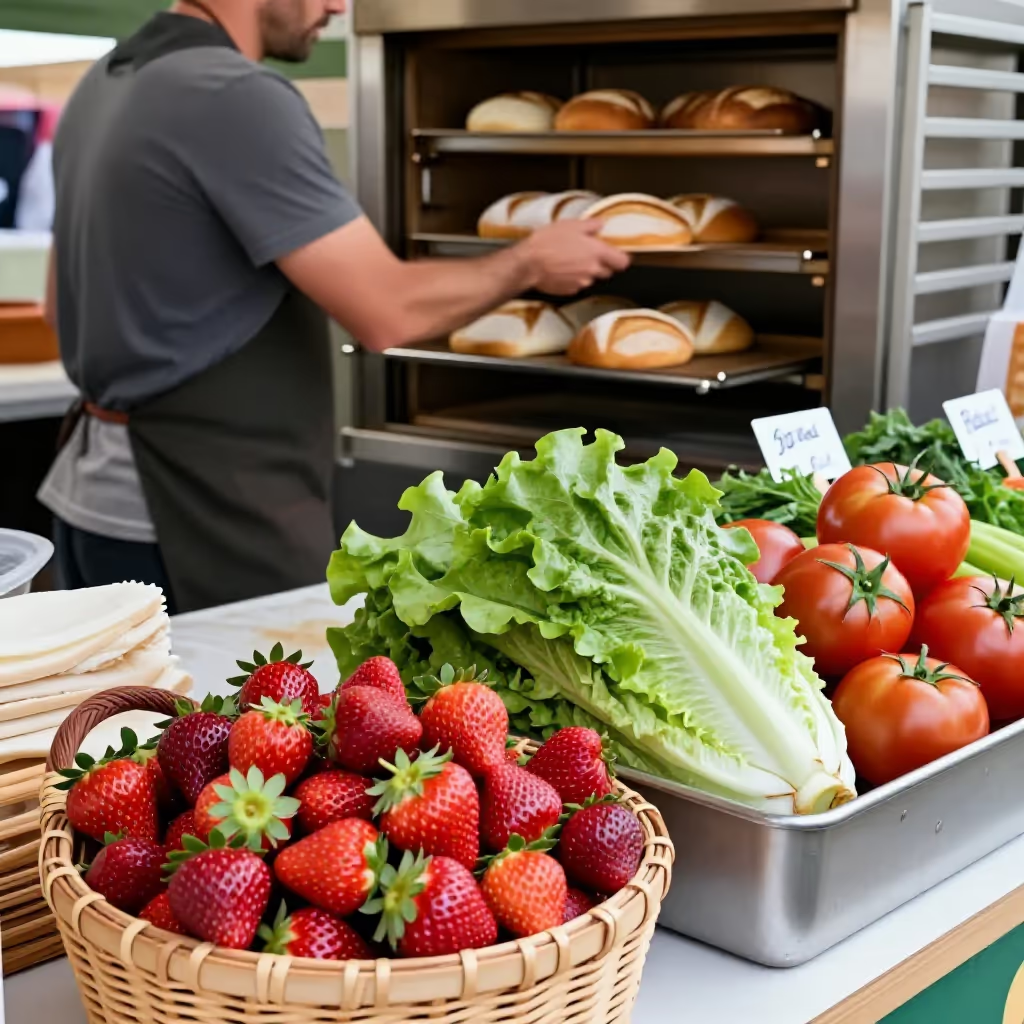
Refers to food that was recently harvested, produced, or prepared and is not old or spoiled.
EXAMPLE
Ich liebe den Geruch von frisch gebackenem Brot.
I love the smell of freshly baked bread.
fresh
Loading your saved state.
fresh
Refers to food that was recently harvested, produced, or prepared and is not old or spoiled.
Ich liebe den Geruch von frisch gebackenem Brot.
I love the smell of freshly baked bread.

fresh
New, clean, and unused.
Nach dem Duschen zog er ein frisches Hemd an.
After showering, he put on a fresh shirt.

fresh
Cool and pleasant, especially in relation to air or weather.
An einem heißen Tag tut ein Bad im frischen See gut.
On a hot day, a swim in the fresh lake feels good.

fresh
Rested, alert, and full of energy.
Nach einer Tasse Kaffee fühle ich mich wieder frisch und konzentriert.
After a cup of coffee, I feel fresh and focused again.

cheeky
Colloquial for cheeky, bold, or disrespectful.
Der Junge gab eine ziemlich frische Antwort, die seine Eltern überraschte.
The boy gave a pretty cheeky answer that surprised his parents.
'Frisch' is very often used as an adverb meaning 'just now' or 'newly', usually in combination with a past participle. Typical examples are 'frisch gestrichen' (freshly painted), 'frisch verliebt' (newly in love), or 'frisch gemäht' (freshly mowed).
Das frisch verliebte Paar ging Hand in Hand spazieren.
The newly in-love couple went for a walk hand in hand.
In connection with food, 'frisch' is often used with: 'frisches Obst' (fresh fruit), 'frisches Gemüse' (fresh vegetables), 'frischer Fisch' (fresh fish), or 'frisch gepresster Saft' (freshly squeezed juice).
Auf dem Markt kaufe ich immer frisches Gemüse.
At the market, I always buy fresh vegetables.
In the meaning 'clean' or 'unused', typical combinations are 'frische Wäsche' (clean laundry), 'frische Bettwäsche' (fresh bed linen), or 'ein frisches Handtuch' (a fresh towel).
Ich habe die Betten gerade frisch bezogen.
I just put fresh sheets on the beds.
When talking about air or weather, the most common combinations are 'frische Luft' (fresh air) and 'ein frischer Wind' (a fresh breeze).
Lass uns nach draußen gehen und etwas frische Luft schnappen.
Let's go outside and get some fresh air.
To express that you feel full of energy, 'frisch' is often used predicatively, for example in the phrase 'frisch und munter sein' (to be fresh and lively) or 'sich frisch fühlen' (to feel fresh).
Nach einer kurzen Pause fühlte er sich wieder frisch.
After a short break, he felt fresh again.
The meaning 'cheeky' or 'disrespectful' is colloquial. It is mostly used to describe a surprisingly direct or impolite reaction.
Sei nicht so frisch zu deiner Großmutter!
Don't be so cheeky to your grandmother!
new
For food, „frisch“ emphasizes that it was prepared recently and is not yet old or spoiled. „Neu“ refers more to a product that was recently introduced or acquired. A new food product is therefore not automatically fresh.
Heute kaufe ich das frisch gebackene Brot aus dem Ofen.
Today I’m buying the freshly baked bread straight from the oven.
Heute probiere ich das neue Brot aus dem Sortiment.
Today I’m going to try the new bread from the product range.