

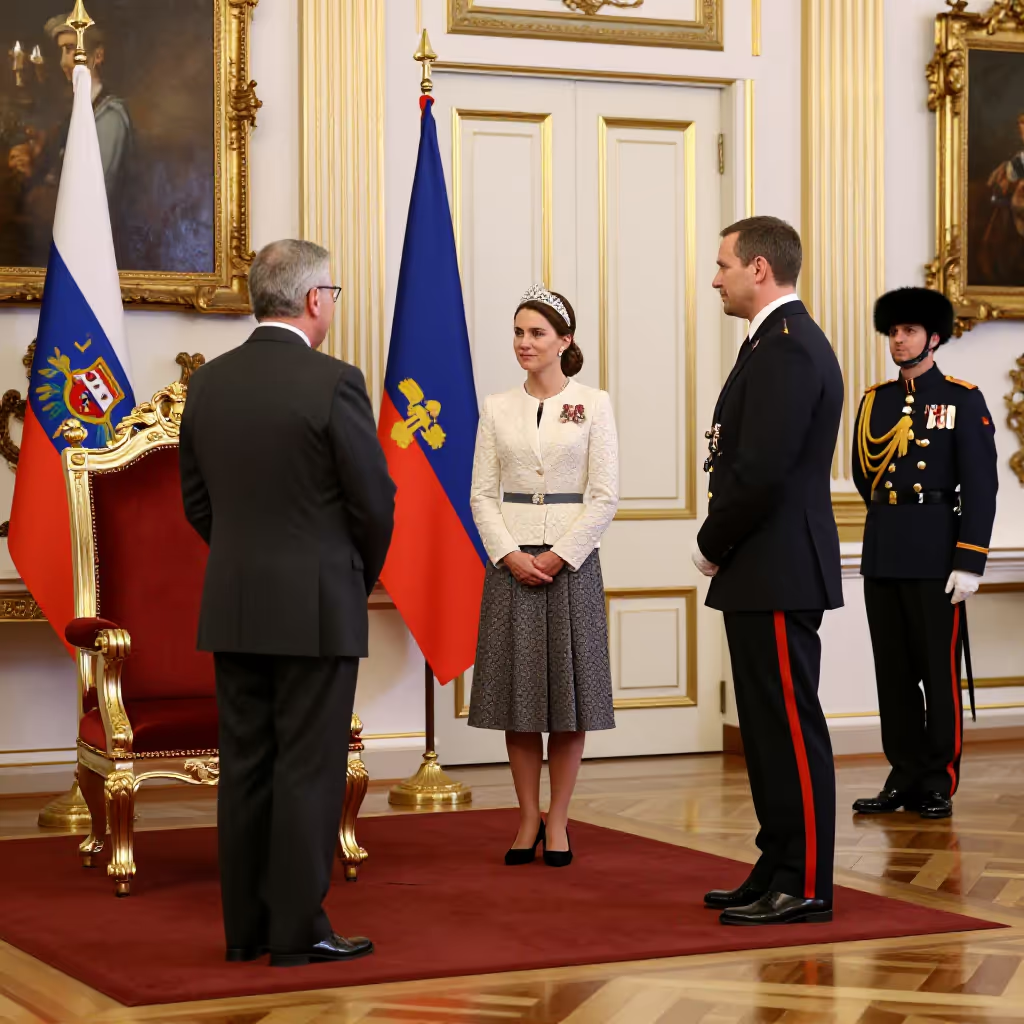
The territory ruled by a prince or princess. It is a form of monarchy in which the head of state bears the title prince or princess.
example
Monaco ist ein bekanntes Fürstentum in Europa.
Monaco is a well-known principality in Europe.
Usage tips
Word composition
The word is made up of 'Fürst' (prince) and the suffix '-tum'. The suffix '-tum' often refers to a territory, a state, or a collective whole, similar to 'Königtum' (kingship) or 'Christentum' (Christianity).
EXAMPLE
Liechtenstein ist ein kleines Fürstentum in den Alpen.
Liechtenstein is a small principality in the Alps.
Word family
The word is directly related to 'der Fürst' (the prince/ruler) and 'die Fürstin' (the princess/female ruler). A 'Fürstentum' (principality) is therefore the country over which a prince or princess rules.
EXAMPLE
Der Fürst regiert sein Fürstentum seit über 20 Jahren.
The prince has ruled his principality for over 20 years.
Typical use
'Fürstentum' (principality) is almost always used together with the geographical name of the corresponding state. The best-known examples are the sovereign states Monaco and Liechtenstein.
EXAMPLE
Das Fürstentum Monaco ist für sein Casino und seine luxuriösen Yachten bekannt.
The Principality of Monaco is known for its casino and its luxury yachts.
Compare with
antonym
Fürstentum vs Republik
republic
'die Republik' and 'das Fürstentum' describe different forms of government. In a republic, there is no king, queen, or prince as head of state; the head of state is elected for a certain period of time. A principality, on the other hand, is a form of monarchy headed by a prince or princess. So the most important difference is: elected in a republic, princely-monarchical in a principality.
Fürstentum
Am Wochenende liest Anton einen Text über das Fürstentum Liechtenstein.
At the weekend, Anton reads a text about the Principality of Liechtenstein.
Republik
Frankreich ist eine Republik mit einem gewählten Präsidenten.