

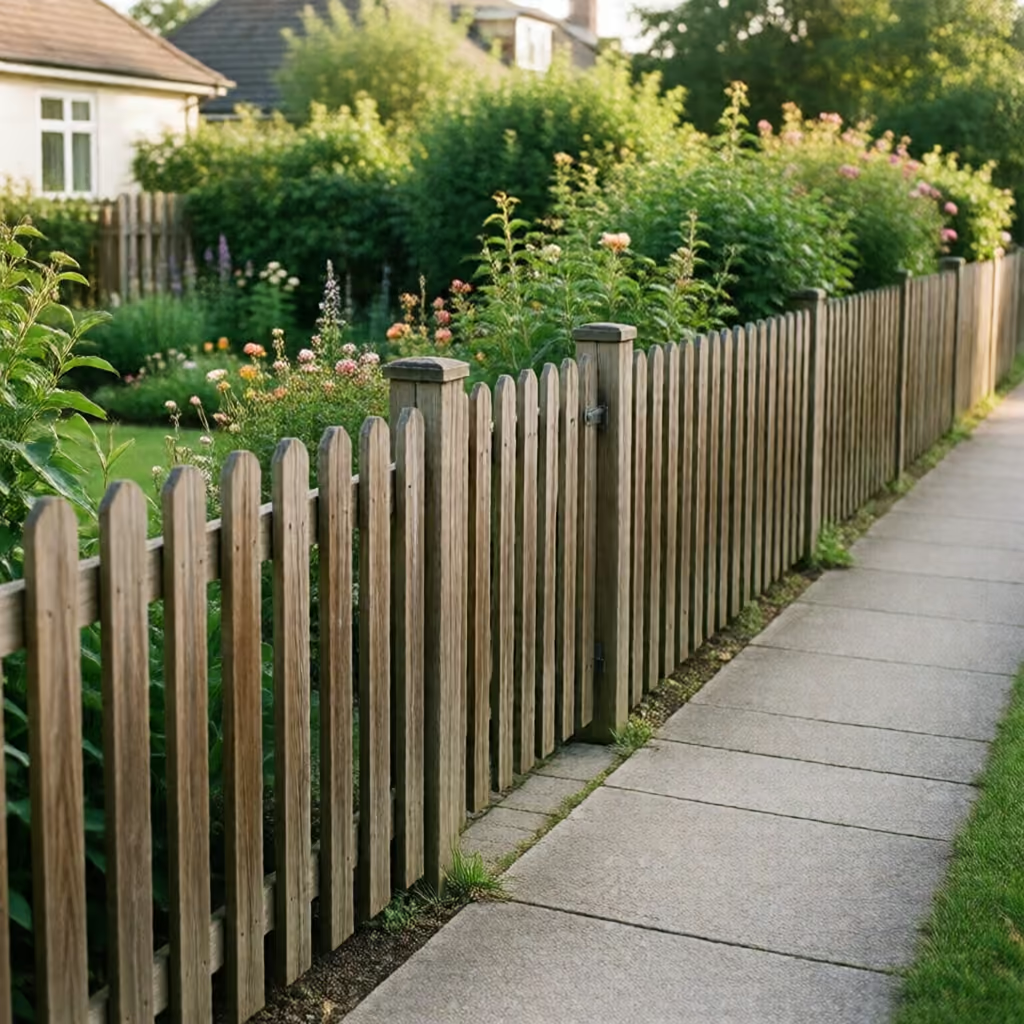
der Gartenzaun
garden fence
A fence that encloses a garden and usually separates it from a property, a path, or the street.
EXAMPLE
Der Gartenzaun muss dringend gestrichen werden.
The garden fence urgently needs to be painted.
garden fence
der Gartenzaun, die Gartenzäune
Loading your saved state.
garden fence
A fence that encloses a garden and usually separates it from a property, a path, or the street.
Der Gartenzaun muss dringend gestrichen werden.
The garden fence urgently needs to be painted.
| gender | masculine der |
|---|---|
| plural | die Gartenzäune |
| genitive | des Gartenzaunes |
| singular | plural | |
|---|---|---|
| nominative | der Gartenzaun | die Gartenzäune |
| accusative | den Gartenzaun | die Gartenzäune |
| dative | dem Gartenzaun | den Gartenzäunen |
| genitive | des Gartenzaunes des Gartenzauns | der Gartenzäune |
The article changes with the case; it is shown in colour.
'Gartenzaun' (garden fence) consists of 'Garten' (garden) and 'Zaun' (fence). The last component names the object, while the first explains which area it belongs to.
Unser Gartenzaun ist aus Holz und passt gut zu den Pflanzen.
Our garden fence is made of wood and goes well with the plants.
Typical collocations are 'einen Gartenzaun aufstellen' (to put up a garden fence), 'einen Gartenzaun streichen' (to paint a garden fence), and 'einen Gartenzaun reparieren' (to repair a garden fence). You can use these to talk about putting up and maintaining the fence.
Im Frühjahr wollen wir den Gartenzaun reparieren.
We want to repair the garden fence in spring.
To refer to a location directly by the garden fence, German often uses 'am Gartenzaun' (by the garden fence) with the dative. If something is placed there, 'an den Gartenzaun' (against the garden fence) is used with the accusative.
Mein Fahrrad steht am Gartenzaun.
My bicycle is by the garden fence.
Ich stelle mein Fahrrad an den Gartenzaun.
I put my bicycle against the garden fence.