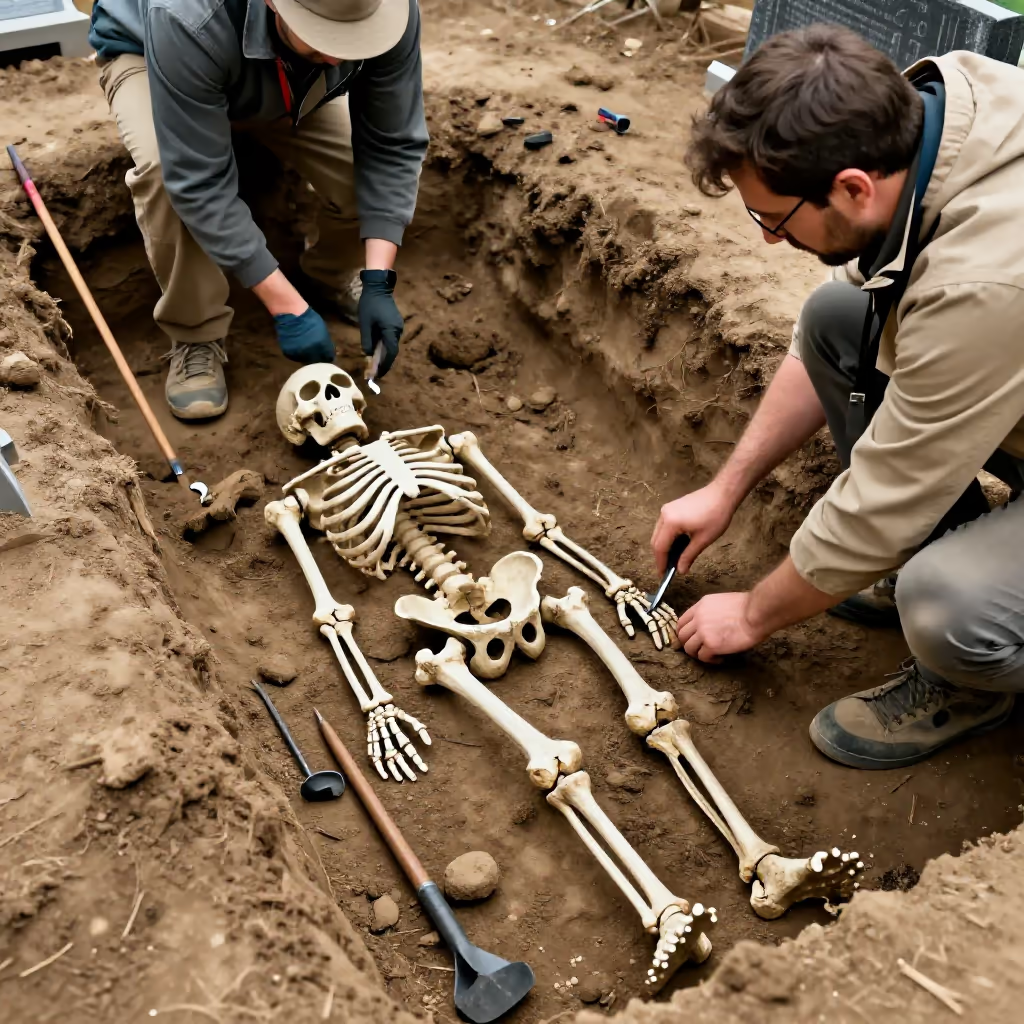
Elevated or literary term for the bones of a deceased person; the skeleton. The word is used almost exclusively in the plural ('die Gebeine' — the bones/remains).
example
Bei den Ausgrabungen wurden die Gebeine eines römischen Soldaten gefunden.
During the excavations, the remains of a Roman soldier were found.

Usage tips
Word structure
The word is made up of the collective syllable 'Ge-' and the noun 'Bein' (leg/bone). Similar to 'Gebirge' (mountain range, many mountains), 'Gebein' refers to the totality of the bones, that is, the skeleton.
EXAMPLE
Die Archäologen legten vorsichtig das Gebein eines Mammuts frei.
The archaeologists carefully uncovered the skeleton of a mammoth.
Use in the plural
Although the word has a singular form ('das Gebein'), it is used almost exclusively in the plural 'die Gebeine' when talking about the bones of a deceased person.
EXAMPLE
Die Gebeine des Heiligen werden in einem Schrein aufbewahrt.
The saint's remains are kept in a shrine.
Register and style
'Gebeine' is an elevated and rather literary word. It is often found in historical, archaeological, or ceremonial contexts, but rarely in everyday colloquial speech.
EXAMPLE
Der Dichter beschrieb in seinem Gedicht die verstreuten Gebeine auf dem Schlachtfeld.
In his poem, the poet described the scattered bones on the battlefield.
Typical collocations
Common verbs used with 'Gebeine' describe finding or burying. Typical phrases are 'Gebeine finden' (to find remains), 'Gebeine bergen' (to recover remains), or 'Gebeine beisetzen' (to bury remains).
EXAMPLE
Die sterblichen Überreste wurden geborgen und die Gebeine feierlich beigesetzt.
The mortal remains were recovered and the bones were ceremonially buried.
Compare with
near_synonym · confusable
Gebein vs Knochen
bone
'Knochen' and 'Gebein' can both refer to hard parts of the skeleton. 'Knochen' is the normal everyday word for humans and animals, including at the doctor’s or when talking about food. 'Gebein' sounds elevated, old-fashioned, or literary and today is almost only used in the plural as 'Gebeine', especially when referring to the bones of a deceased person. Learners may confuse the words because both relate to the skeleton. In everyday language, 'Knochen' is almost always correct; 'Gebeine' is more appropriate in historical, religious, or literary texts.
Gebein
Bei den Bauarbeiten wurden alte Gebeine gefunden.
Old bones were found during the construction work.
Knochen
Nach dem Sturz zeigte das Röntgenbild, dass kein Knochen gebrochen war.
After the fall, the X-ray showed that no bone was broken.