

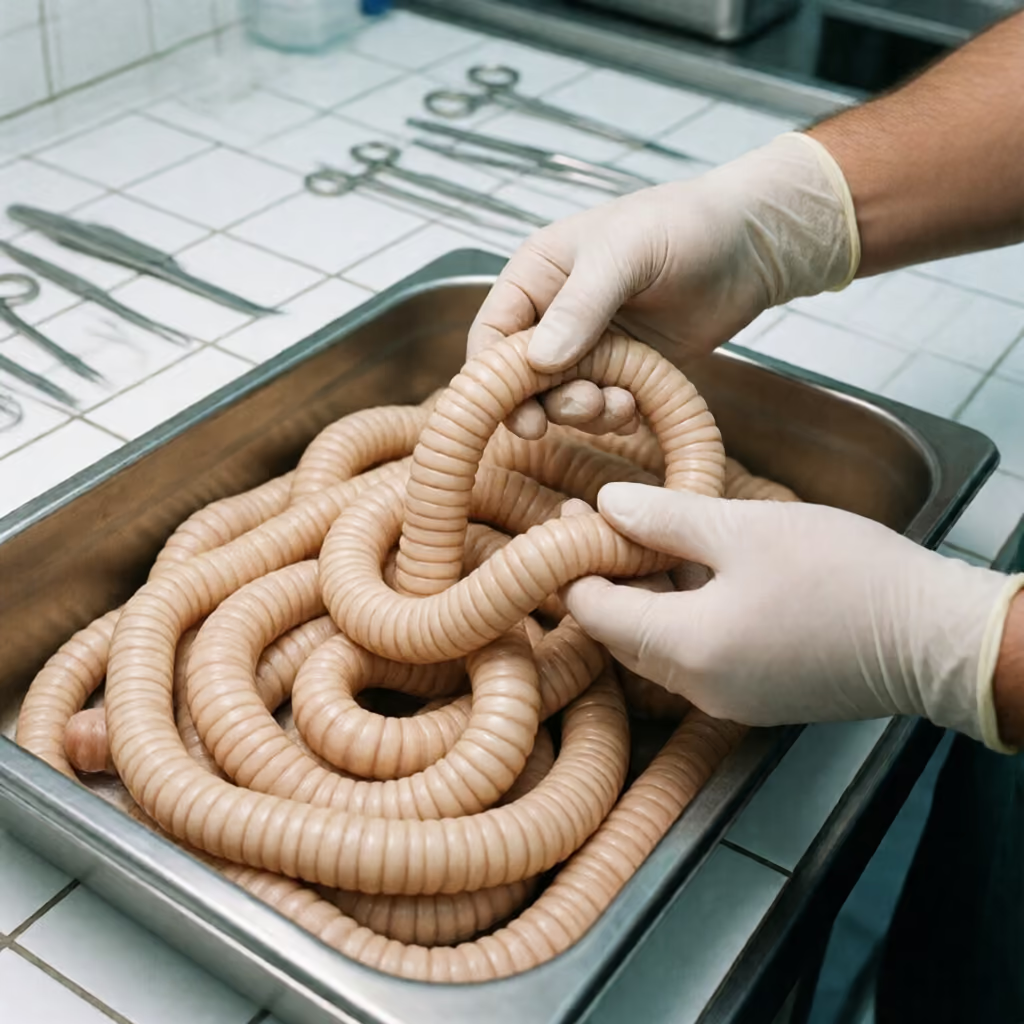
das Gedärm
guts
The intestines as a whole in a human or animal body; also an animal's internal organs.
EXAMPLE
Beim Schlachten wurde das Gedärm des Schweins sorgfältig entfernt.
During slaughter, the pig's guts were carefully removed.
intestines / guts
das Gedärm, die Gedärme
Loading your saved state.
guts
The intestines as a whole in a human or animal body; also an animal's internal organs.
Beim Schlachten wurde das Gedärm des Schweins sorgfältig entfernt.
During slaughter, the pig's guts were carefully removed.
| gender | neuter das |
|---|---|
| plural | die Gedärme |
| genitive | des Gedärms |
| singular | plural | |
|---|---|---|
| nominative | das Gedärm | die Gedärme |
| accusative | das Gedärm | die Gedärme |
| dative | dem Gedärm | den Gedärmen |
| genitive | des Gedärms des Gedärmes | der Gedärme |
The article changes with the case; it is shown in colour.
'Das Gedärm' (guts) is usually singular in German, even though it refers to multiple intestines or the entire intestinal region. The verb therefore takes a singular form.
Das Gedärm des Tieres ist stark beschädigt.
The animal's guts are badly damaged.
'Gedärm' (guts) is often used with verbs related to examination or processing: 'Das Gedärm' can be 'untersucht' (examined), 'entfernt' (removed), 'gereinigt' (cleaned), or 'herausgenommen' (taken out).
Vor der Zubereitung muss das Gedärm gründlich gereinigt werden.
Before cooking, the guts must be thoroughly cleaned.
'Gedärm' (guts) is a vivid word used mainly when discussing animals, slaughter, or graphic descriptions. In factual medical texts, 'Darm' (intestine) or 'Eingeweide' (internal organs) is more common.
Der Jäger nahm das Gedärm des Wildschweins vorsichtig heraus.
The hunter carefully took out the wild boar's guts.