


der Gedanke
thought
A single idea, mental image, or consideration that arises in the mind.
EXAMPLE
Mir kam plötzlich der Gedanke, dass ich den Herd angelassen hatte.
The thought suddenly occurred to me that I had left the stove on.
thought
Loading your saved state.
thought
A single idea, mental image, or consideration that arises in the mind.
Mir kam plötzlich der Gedanke, dass ich den Herd angelassen hatte.
The thought suddenly occurred to me that I had left the stove on.

idea / intention
The intention, plan, or purpose of doing something.
Er spielte schon länger mit dem Gedanken, sein eigenes Unternehmen zu gründen.
He had been toying with the idea of starting his own company for some time.

to be lost in thought
An expression meaning that someone is deeply absorbed in their own thinking and therefore inattentive to their surroundings.
Entschuldigung, ich war gerade in Gedanken und habe dich nicht gehört.
Sorry, I was lost in thought just now and didn't hear you.
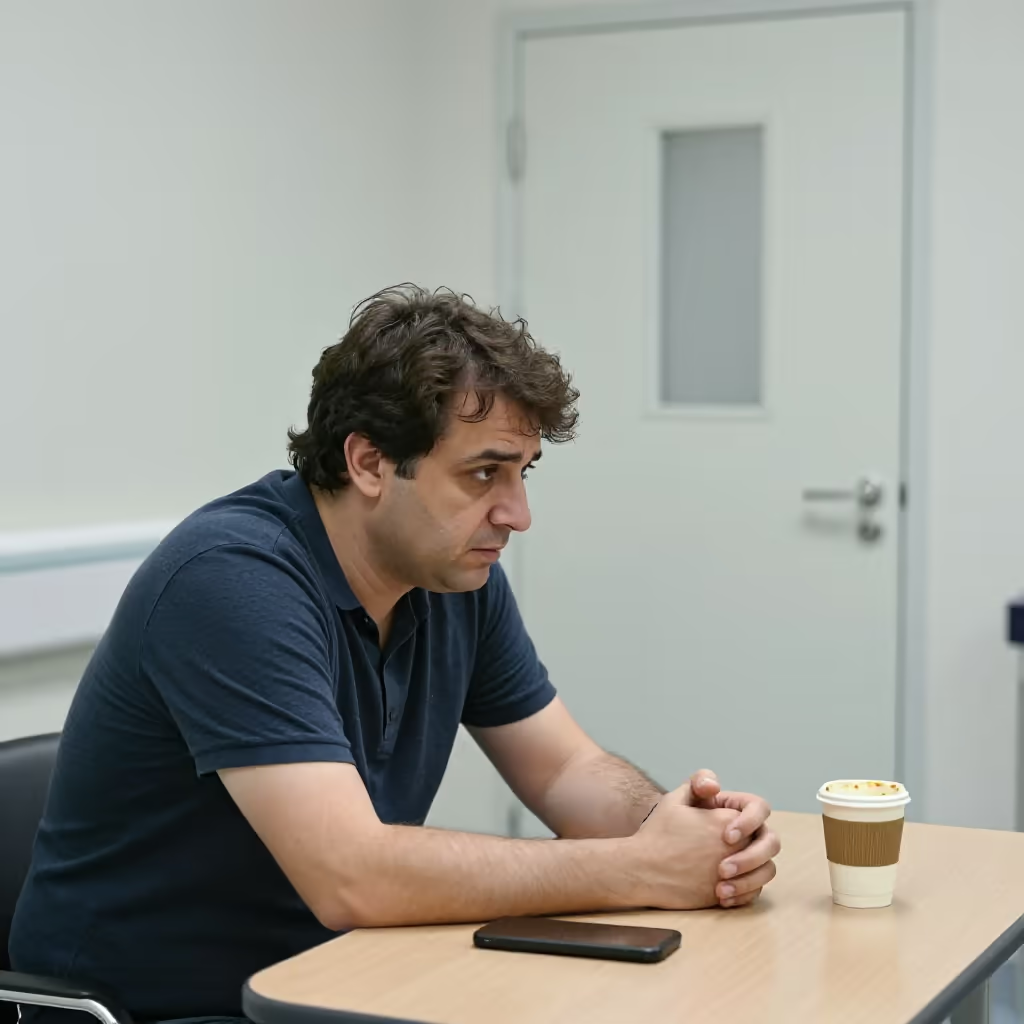
to worry / think
An expression meaning to think intensely about something or to worry about something or someone.
Du musst dir keine Gedanken machen, die Prüfung wird sicher gut laufen.
You don't need to worry; the exam will surely go well.
'Der Gedanke' is the noun corresponding to the verb 'denken' (to think). It describes the result of the thinking process: an idea or a consideration.
Ich denke oft an unsere gemeinsame Reise.
I often think about our trip together.
'Gedanke' is a weak noun (n-declension). This means that it takes the ending '-n' in all cases except the nominative singular, for example 'den Gedanken' (the thought), 'dem Gedanken' (to the thought), 'die Gedanken' (the thoughts).
Ich kann deinen Gedanken nicht folgen.
I can't follow your thoughts.
The expression 'sich Gedanken machen' means 'nachdenken' (to think) or 'sich sorgen' (to worry). It is used reflexively and always takes the preposition 'über' (about) + accusative.
Ich mache mir Gedanken über meine Zukunft.
I'm thinking about my future.
To express that you have an intention or are thinking about a plan, the expression 'mit dem Gedanken spielen' (to toy with the idea) is often used.
Sie spielt mit dem Gedanken, nach Berlin zu ziehen.
She is toying with the idea of moving to Berlin.
The content of a thought is often explained by a following subordinate clause with 'dass' (that) or an infinitive construction with 'zu' (to).
Der Gedanke, dass ich etwas Wichtiges vergessen habe, beunruhigt mich.
The thought that I have forgotten something important worries me.
The idiom 'in Gedanken sein' (to be lost in thought) or 'in Gedanken versunken sein' (to be absorbed in thought) describes the state when someone is thinking so deeply that they do not notice their surroundings.
Er starrte aus dem Fenster und war ganz in Gedanken.
He stared out the window and was completely lost in thought.
idea
Idee and Gedanke both refer to something that arises in the mind. An Idee is often an Einfall or proposal that can be developed or implemented. A Gedanke is more generally a single thought and does not have to aim at implementation.

Der Gedanke an eine Feier im Park kam ihr beim Spaziergang.
The thought of a celebration in the park occurred to her while she was out walking.
Ihre Idee, die Feier in den Park zu verlegen, lässt sich leicht umsetzen.
Her idea of moving the celebration to the park can easily be put into practice.