

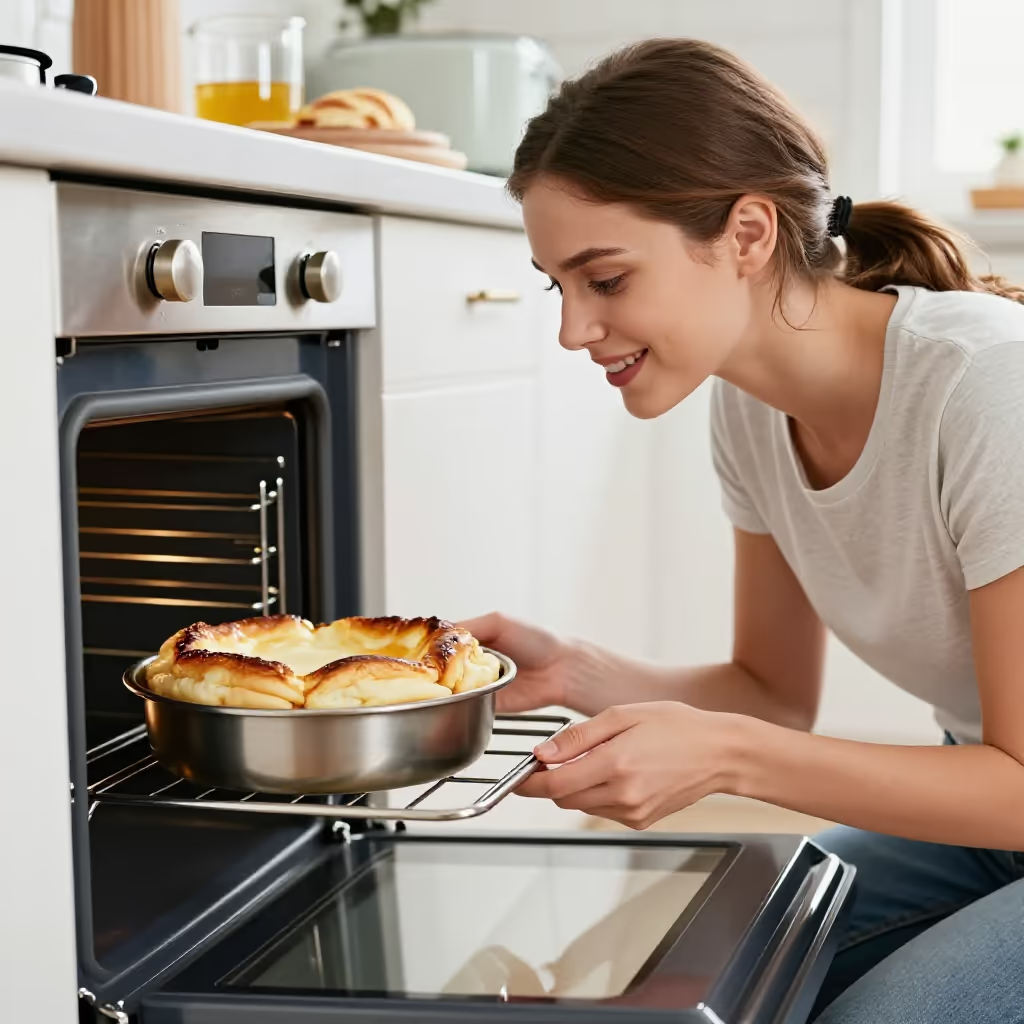
To proceed successfully or lead to a good result. The subject is usually 'es' (it), and the person who succeeds at something is in the dative.
example
Nach vielen Versuchen ist es mir endlich gelungen, den perfekten Kuchen zu backen.
After many attempts, I finally succeeded in baking the perfect cake.
Usage tips
Dative construction
This verb always needs a person in the dative. The subject of the sentence is the thing that is successful, often expressed by 'es' (it) or a noun.
EXAMPLE
Ihm ist ein beeindruckendes Kunstwerk gelungen.
He succeeded in creating an impressive work of art.
Auxiliary verb in the perfect tense
The perfect tense of 'gelingen' (to succeed) is always formed with 'sein' (to be), not with 'haben' (to have). It describes a change of state from 'not successful' to 'successful'.
EXAMPLE
Die Überraschung ist uns vollkommen gelungen.
The surprise was a complete success for us.
Typical subjects
'Gelingen' (to succeed) is often used for the successful completion of plans, attempts, projects, or creative works. Typical subjects are 'der Plan' (the plan), 'das Experiment' (the experiment), 'die Flucht' (the escape), or 'das Gericht' (the dish).
EXAMPLE
Der erste Versuch ist leider nicht gelungen.
Unfortunately, the first attempt did not succeed.
Compare with
near_synonym · confusable
gelingen vs schaffen
to manage / create
'schaffen' and 'gelingen' both have to do with success. You use 'schaffen' when a person actively manages a task: the person is usually the subject of the sentence. 'gelingen' describes that something goes successfully or has a good result. The person is often in the dative, for example 'mir gelingt etwas' (I succeed at something / something works out for me). Learners may confuse the words because both express success, but the grammar is different. 'Ich schaffe die Aufgabe' (I manage the task) and 'Die Aufgabe gelingt mir' (I succeed at the task / the task works out for me) mean similarly successful situations, but they sound different.
gelingen
Beim zweiten Versuch gelingt uns der Kuchen viel besser.
On the second attempt, the cake turns out much better for us.
schaffen
Sie schafft die Vorbereitung noch vor dem Termin.
She manages to finish the preparation before the appointment.