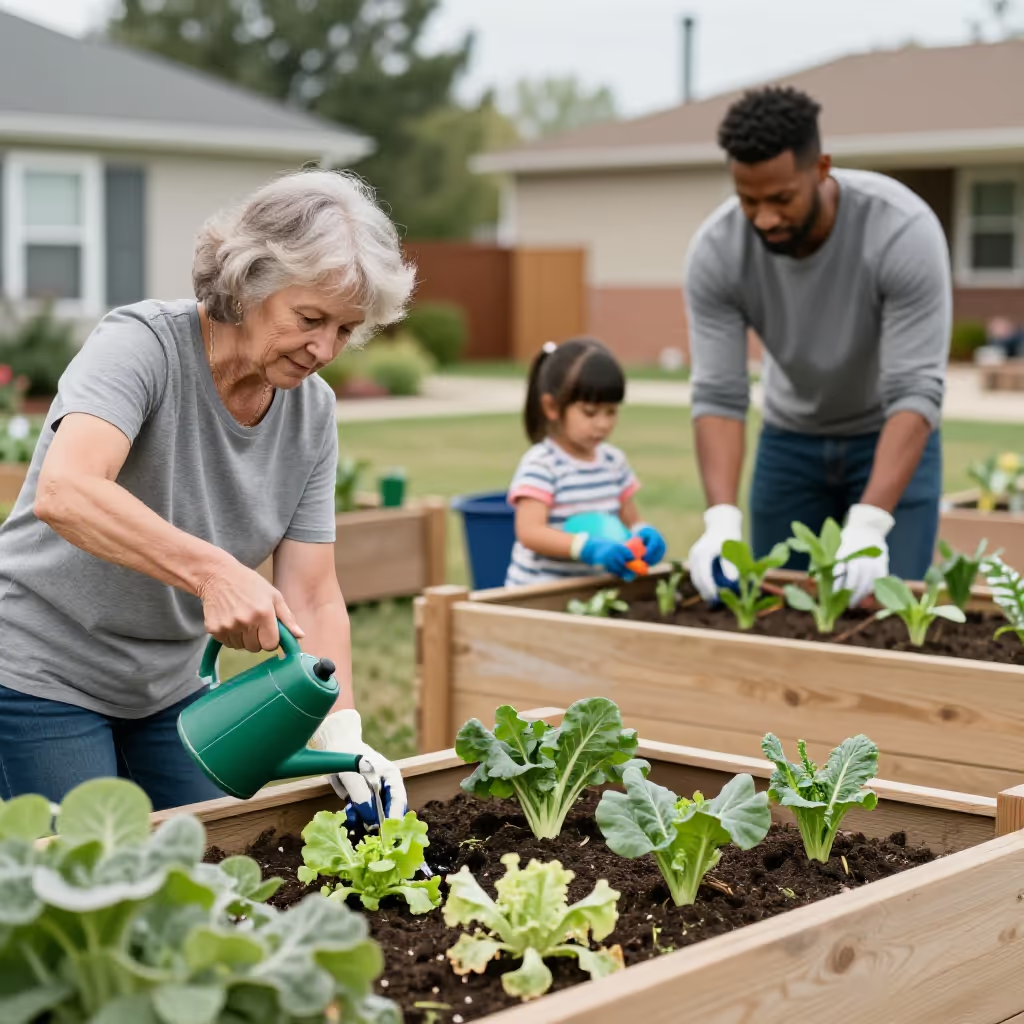
A group of people connected by shared interests, a place of residence, values, or goals.
example
In unserer Hausgemeinschaft kennen und helfen sich alle Nachbarn.
In our residential community, all the neighbors know and help each other.

Usage tips
Word structure
The word is made up of 'gemein' (in the sense of 'gemeinsam' — shared/common) and the suffix '-schaft' (-ship/-hood). The suffix '-schaft' is often used to form nouns that describe a group, a state, or a relationship.
EXAMPLE
Die Freundschaft zwischen den beiden Ländern ist sehr stark.
The friendship between the two countries is very strong.
Typical verbs
Common verbs used with 'Gemeinschaft' (community) are 'eine Gemeinschaft bilden' (to form a community), 'einer Gemeinschaft angehören' (to belong to a community), or 'die Gemeinschaft stärken' (to strengthen the community).
EXAMPLE
Die Anwohner haben eine Gemeinschaft gebildet, um den Park zu pflegen.
The residents formed a community to maintain the park.
Context clue: the feeling
When 'Gemeinschaft' (community) means the abstract feeling of belonging together, it is often combined with verbs like 'fühlen' (to feel), 'erleben' (to experience), 'spüren' (to sense), or adjectives like 'stark' (strong) and 'eng' (close).
EXAMPLE
Beim gemeinsamen Singen entstand ein tiefes Gefühl von Gemeinschaft.
A deep sense of community developed while singing together.
Formal compounds
In legal, political, or economic contexts, 'Gemeinschaft' (community/association) often forms compound nouns to specify the type of connection. Examples are 'Wirtschaftsgemeinschaft' (economic community), 'Erbengemeinschaft' (community of heirs), or 'Staatengemeinschaft' (community of states).
EXAMPLE
Nach dem Tod der Eltern bildeten die Kinder eine Erbengemeinschaft.
After the parents' death, the children formed a community of heirs.
Compare with
near_synonym · confusable
Gemeinschaft vs Familie
family
'die Familie' and 'die Gemeinschaft' both describe groups in which people belong together. But 'Familie' usually means relatives, for example parents, children, or also uncles and grandparents. 'Gemeinschaft' is more appropriate when people are connected by a place, a goal, an interest, or a feeling. Learners may confuse the words because both express closeness and cohesion. When it is about relatives, 'Familie' is more natural. When it is about a group with shared values or goals, 'Gemeinschaft' is more precise.
Gemeinschaft
In der kleinen Gemeinschaft helfen die Nachbarn einander beim Einkaufen.
In the small community, the neighbors help each other with shopping.