


die Gruppe
group
A number of people or things that are together, belong together, or form a unit.
EXAMPLE
Eine Gruppe von Touristen wartete vor dem Museum.
A group of tourists was waiting in front of the museum.
group
Loading your saved state.
group
A number of people or things that are together, belong together, or form a unit.
Eine Gruppe von Touristen wartete vor dem Museum.
A group of tourists was waiting in front of the museum.
group
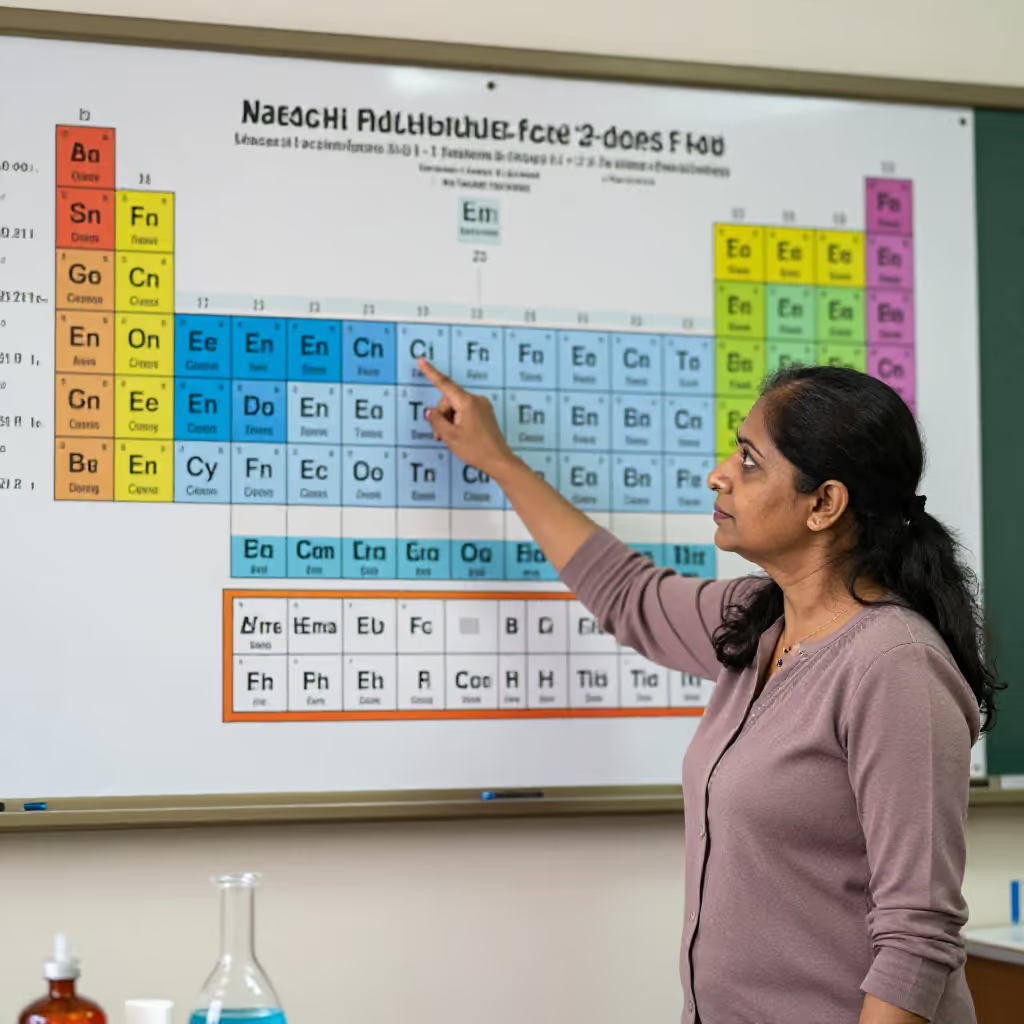
In chemistry, a column in the periodic table of elements whose elements have similar chemical properties.
Helium und Neon gehören zur Gruppe der Edelgase.
Helium and neon belong to the group of noble gases.

squad
A small military unit that typically consists of eight to twelve soldiers and is led by a non-commissioned officer.
Der Feldwebel gab seiner Gruppe den Befehl zum Vorrücken.
The sergeant gave his squad the order to advance.
group
In mathematics, an algebraic structure consisting of a set and an operation that satisfies certain axioms.
Die Menge der ganzen Zahlen bildet mit der Addition eine Gruppe.
The set of integers forms a group under addition.
The exact meaning of 'Gruppe' (group) is usually clear from the context. Words like 'Touristen' (tourists) or 'Freunde' (friends) point to the general meaning, while terms like 'Elemente' (elements) or 'Soldaten' (soldiers) indicate specialized language.
Eine Gruppe von Wissenschaftlern diskutierte die Ergebnisse.
A group of scientists discussed the results.
The noun 'Gruppe' (group) is the basis for other useful words. These include the verb 'gruppieren' (to arrange in groups) and the compound noun 'die Gruppenarbeit' (group work).
Der Lehrer gruppierte die Schüler für das Projekt neu.
The teacher regrouped the students for the project.
The meanings in chemistry, the military, or mathematics are specific technical terms. In normal everyday life, you will almost exclusively encounter the general meaning 'Ansammlung von Personen oder Dingen' (collection of people or things).
In der Chemie werden die Elemente im Periodensystem in Gruppen eingeteilt.
In chemistry, the elements in the periodic table are divided into groups.
In the general meaning, 'Gruppe' (group) is often combined with certain verbs. Common phrases are 'eine Gruppe bilden' (to form a group), 'in einer Gruppe arbeiten' (to work in a group), or 'zu einer Gruppe gehören' (to belong to a group).
Er möchte gern zu unserer Lerngruppe gehören.
He would like to belong to our study group.
Pay attention to the prepositions. 'In einer Gruppe' describes membership or activity. 'Eine Gruppe von ...' describes what the group consists of.
In dieser Gruppe fühlen sich alle sehr wohl.
Everyone feels very comfortable in this group.
society / company
Gesellschaft and Gruppe can both refer to several people who are together. Gesellschaft emphasizes being together or having social company, while Gruppe describes the people more as a collective unit. Use Gesellschaft for pleasant company and Gruppe for a neutral group of people.

Auf dem Foto steht eine Gruppe von Freunden vor dem Hotel.
A group of friends is standing in front of the hotel in the photo.
Auf der Reise genoss ich die Gesellschaft meiner Freunde.
I enjoyed the company of my friends during the trip.