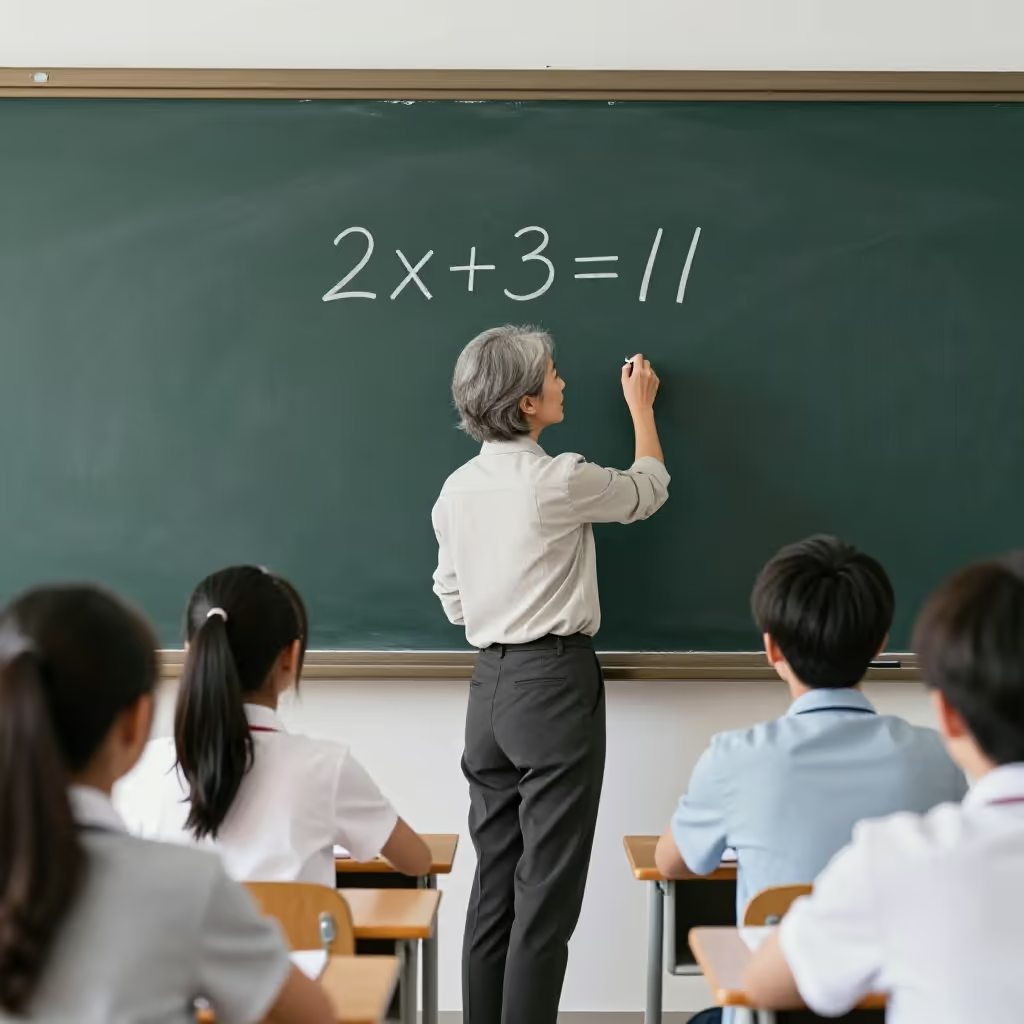
A mathematical expression stating that two terms are connected by an equals sign (=) and have the same value.
example
In der Prüfung mussten wir eine komplexe Gleichung mit zwei Unbekannten lösen.
In the exam, we had to solve a complex equation with two unknowns.

Usage tips
Word structure
The word 'Gleichung' (equation) is derived from the adjective 'gleich' (equal/same). The suffix '-ung' turns it into a feminine noun that describes the process or result of 'Gleichsetzen' (equating).
EXAMPLE
In einer Gleichung sind beide Seiten gleich viel wert.
In an equation, both sides are worth the same amount.
Typical verbs
In a mathematical context, 'Gleichung' (equation) is often combined with specific verbs. Typical examples are: 'eine Gleichung lösen' (to solve an equation), 'eine Gleichung aufstellen' (to set up an equation), or 'eine Gleichung vereinfachen' (to simplify an equation).
EXAMPLE
Kannst du mir helfen, diese Gleichung zu lösen?
Can you help me solve this equation?
Figurative meaning
In the figurative sense, the expression 'eine Gleichung mit vielen Unbekannten' (an equation with many unknowns) is very common. It describes a confusing situation whose outcome is hard to predict.
EXAMPLE
Die Zukunft des Unternehmens ist derzeit eine Gleichung mit vielen Unbekannten.
The future of the company is currently an equation with many unknowns.
Fixed expression
The idiom 'die Gleichung geht auf' means that a plan works or a calculation adds up. The opposite is 'die Gleichung geht nicht auf' (the equation doesn't work out).
EXAMPLE
Wir haben weniger ausgegeben als geplant, also geht unsere Gleichung auf.
We spent less than planned, so our equation works out.
Compare with
near_synonym
Gleichung vs Problem
problem
'das Problem' and 'die Gleichung' can both describe a difficult situation that you have to understand or solve. 'das Problem' is the normal, general word. 'die Gleichung' is used figuratively when many factors have to fit together, almost like in mathematics. It sounds somewhat more figurative and often more complex. The phrase 'die Gleichung geht auf' means that a plan works out in the end. For simple difficulties, 'Problem' is more natural; when there are many interdependent parts, 'Gleichung' can be appropriate.
Gleichung
Nach dem Gespräch war klar, dass die Gleichung aus Miete, Zeit und Arbeit nicht aufgeht.
After the conversation, it was clear that the equation of rent, time, and work would not work out.
Problem
Vor dem Termin mit der Vermieterin müssen wir das Problem mit der Heizung klären.
Before the appointment with the landlady, we have to sort out the problem with the heating.