

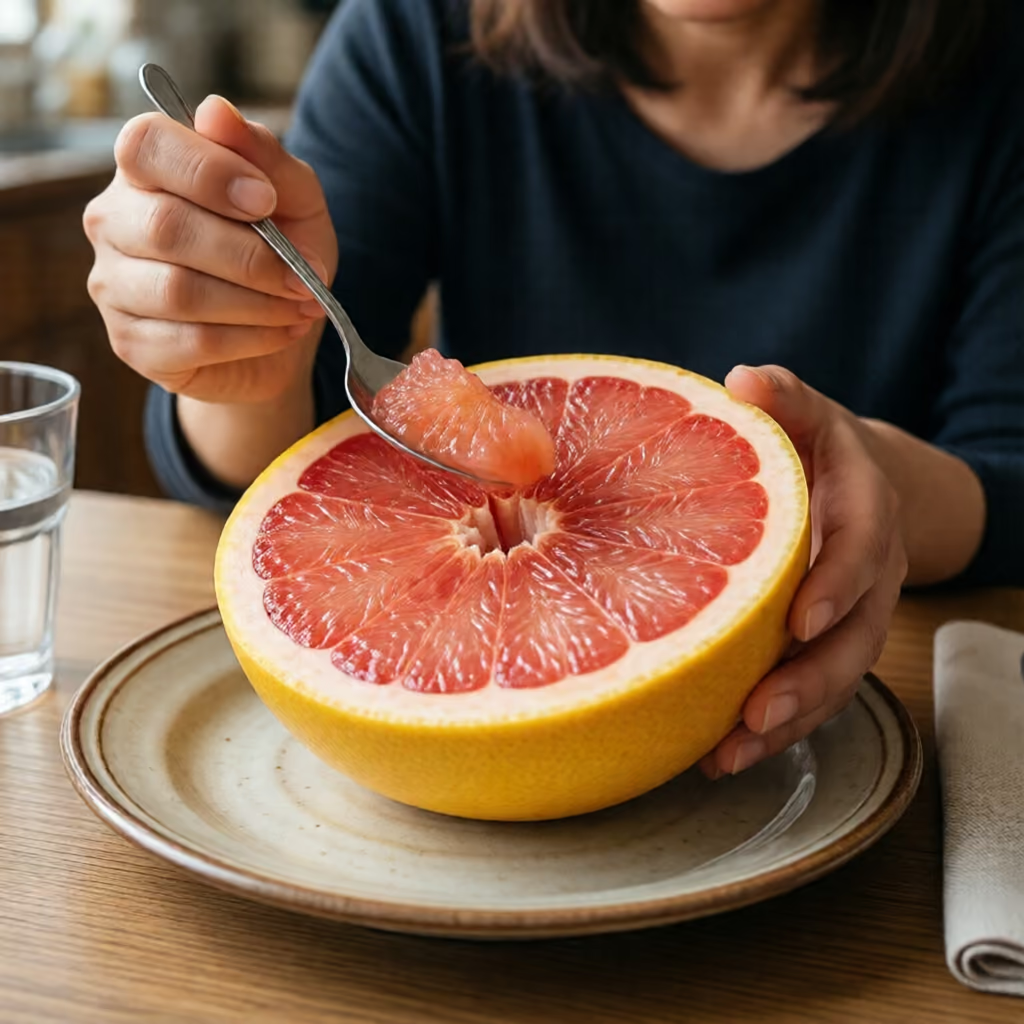
die Grapefruit
grapefruit
A large, round citrus fruit with yellow to reddish skin and juicy, yellowish to red flesh that tastes tart and slightly bitter.
EXAMPLE
Zum Frühstück aß sie eine halbe Grapefruit.
She ate half a grapefruit for breakfast.
grapefruit
die Grapefruit, die Grapefruits
Loading your saved state.
grapefruit
A large, round citrus fruit with yellow to reddish skin and juicy, yellowish to red flesh that tastes tart and slightly bitter.
Zum Frühstück aß sie eine halbe Grapefruit.
She ate half a grapefruit for breakfast.
| gender | feminine die |
|---|---|
| plural | die Grapefruits |
| genitive | der Grapefruit |
| singular | plural | |
|---|---|---|
| nominative | die Grapefruit | die Grapefruits |
| accusative | die Grapefruit | die Grapefruits |
| dative | der Grapefruit | den Grapefruits |
| genitive | der Grapefruit | der Grapefruits |
The article changes with the case; it is shown in colour.
'Grapefruit' is often the first part of compound words such as 'Grapefruitsaft' (grapefruit juice) and 'Grapefruitschale' (grapefruit peel). The second part indicates which product or part of the fruit is meant.
Für den Grapefruitsaft presse ich zwei Grapefruits aus.
I squeeze two grapefruits to make the grapefruit juice.
When preparing it, the expressions 'eine Grapefruit halbieren' (to cut a grapefruit in half), 'eine Grapefruit auspressen' (to juice a grapefruit), and 'eine Grapefruit auslöffeln' (to eat a grapefruit with a spoon) are common. 'Auslöffeln' here describes eating the flesh directly from the peel with a spoon.
Ich halbiere die Grapefruit und löffle sie dann aus.
I cut the grapefruit in half and then scoop it out with a spoon.
For smaller quantities, expressions such as 'ein Stück Grapefruit' (a piece of grapefruit) or 'eine Scheibe Grapefruit' (a slice of grapefruit) are used. After 'Stück' and 'Scheibe', 'Grapefruit' can appear directly without an article.
Sie legt eine Scheibe Grapefruit an den Rand des Glases.
She places a slice of grapefruit on the rim of the glass.